Clutch Upgrade for Road Car
Overview
This article is all about finding the optimal clutch plate, pressure plate, and flywheel combination for road-going cars and some drag-race street cars.
I will explain a few considerations and try to give you some options to make it easier to find the proper setup for you. Your choice depends on how you use your car and your priorities. Comfortable driving…, harsh driving…, sporty driving…, drag racing…! And at the end, my recommendation.
First of all, read my article about Clutch here to know in more detail how a clutch works.
Introduction
The clutch is one of the most frequently replaced components on a high-performance car (with brake pads and tires, that is). So it helps if you can understand the basic concepts yourself without relying on other people’s advice. Read this and you’ll be able to talk about clutch configurations, their applications, and how you might possibly be able to improve your own car’s wavering clutch!
The clutch disc is probably the most frequently abused bit of hardware on a high-performance car. It’s the poor little thing that gets squeezed in between the engine’s flywheel and the pressure plate (clutch cover). In this position, it can often be subjected to massive loads as well as intense heat. Sometimes on even just a slightly modified car, the clutch can prove to be the weak link of your car.
Here are the possible solutions to the problem, and the essentials of current clutch technology.
Considerations
To find an effective solution to a clutch problem, the application of the replacement clutch package must first be considered. Factors to weigh include available tire traction, gearing, driving style, engine torque at certain rpm, and the amount of load frequently placed on the engine – in other words, how hard the car gets driven. All of these contributing values have a bearing on the right combination. It is important not to focus only on the clutch plate, as the flywheel and pressure plate also play a major role. A good overall package is the goal.
Types of Clutch Plates
Clutches come in a variety of sizes. The limiting factor in their diameter is the space available within the bellhousing. As a guide, most Japanese cars (even the high-performance ones) come with a 20 to 22 centimetre clutch, while a Commodore V8 comes with a larger plate diameter of around 25 to 28 centimetres.
Paddle/Puck/Button Clutches
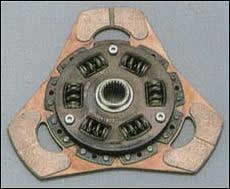
These clutches are sometimes quite unusually shaped and have relatively small areas of friction lining on each paddle. This serves to reduce the overall contact area acting upon the flywheel when compared to a full-face clutch. With no other accompanying changes, fitting one of these gives a higher maximum clamping pressure (pressure = force / area) and therefore delivers more resistance to slip. There are, however, some problems with simply installing a paddle clutch with no other changes. Because the total contact area of the clutch is reduced, the rate of lining wear is increased, clutch engagement is more sudden, and shudder can also be encountered on take-off.
Full-Face
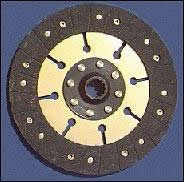
Full-face clutches are full-circle clutch plates fitted with a full circular area of friction material. These come with a varying amount of lining area (narrow or wide). The appropriate pressure plate rating and engagement smoothness depend on the area and fabrication material of the lining. The clutch plate itself is often more substantial in construction when compared to the more sculpted paddle types, with the trade-off being increased mass.
Hybrid
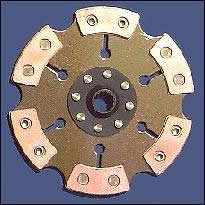
Combination full-face/paddle clutches are now appearing in the form of full (or near-full) circle clutch plates fitted with small areas of friction material. These come with a varying amount of lining area and are a great compromise for those seeking some of the advantages of both full-face and paddle clutches. The appropriate pressure plate rating and engagement smoothness depend on the area of the lining material of the individual clutch plate. The clutch plate itself is often more substantial in construction when compared to the more sculpted paddle types, with the trade-off being increased mass.
Multi-Plate
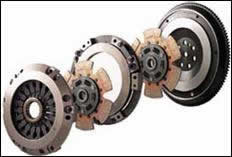
Multi-plate clutches are becoming increasingly popular in the aftermarket, especially among high-performance Japanese vehicles. Theoretically, however, they should only be used where there is not enough room for a larger-diameter clutch. In a multi-plate design, the total friction area is greatly increased, as there are multiple clutch plates. The advantages include the ability to use a lower-rated pressure plate, which gives lighter pedal weight. The trade-offs are the possibility of shudder and noise during operation and increased mass. Only the more expensive high-performance factory vehicles, such as the twin-turbo V8 Lotus Esprit, run a twin-plate clutch as standard.
Clutch Centres and Cushioning
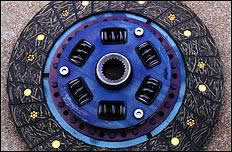
Most factory cars come fitted with a sprung centre to aid engagement smoothness. These units have a series of small springs located radially around the hub that allow the clutch assembly to rotate slightly upon engagement to the flywheel. This helps smooth out any torsional fluctuations and vibration that would otherwise be passed on through the driveline and cabin. Damping the movement of these springs are small friction washers fitted between the hub, retainer, and adaptor plate.
Not surprisingly, a solid-centre clutch plate does not have any springs fitted as the cushioning medium (see the hybrid and full-face clutch pictures above). Because there is no “give” upon engagement, its operation is much more ragged, making it less suitable for road use. The primary goal of a solid centre is to achieve the highest possible strength and durability under extreme conditions.
However, solid centres can sometimes be used in conjunction with a “marcel backing” around the outer edge of full-face clutches. The marcel backing is a wavy material-lined backing on the clutch plate, which gets progressively compressed and released against the flywheel and pressure plate in relation to pedal movement. This design is sometimes used when some form of softening is required on the take-up of the pedal, and when space limitations within the hub prevent larger hub springs from being fitted. The larger hub springs are used when backing a high-torque engine.
The aforementioned Lotus Esprit uses this design to soften the operation of its factory multi-plate clutch arrangement. For a road car, this has a positive effect on clutch pedal feel between the engaged and disengaged positions.
Clutch Linings
There are four main types of clutch lining material available, with combinations of any two able to be bonded and/or riveted on either side of the clutch plate. Note that for each type of lining, aluminium or steel backings can be specified. This reduces the likelihood of high-rpm clutch explosions, while the aluminium-type backings have the advantage of reduced mass when compared to steel. The thickness of the clutch lining is also important. Thick linings offer longer service life and smoother operation but are not as suitable for race or competition applications. This is because their thickness does not offer quite as fast engagement, which equates to slower gear-change capabilities.
Organic
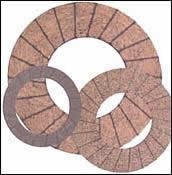
Organic lining (the same material found in stock cars) is by far one of the best materials for clutches in terms of engagement, coefficient of friction (how well it grabs), and longevity. However, organic lining’s worst enemy is heat caused by friction, which can tear it apart in a matter of seconds (a problem found in stock clutches). Car manufacturers pair the clutch with a stiffer pressure plate having a higher clamp load that reduces slip and allows better grabbing, as well as a specialised brass-lined organic compound on the disc itself. The brass weavings inside the compound help keep the lining together and hold and transfer much more heat than conventional organic materials. This provides the stock drivability characteristics while allowing the clutch to take much more of a beating. Organic linings are most frequently used on factory stock cars as they are durable, smooth, easy on mating surfaces, and cheap to manufacture. With a low coefficient of friction of around 0.32, they also require a fairly high clamping pressure.
Ceramic
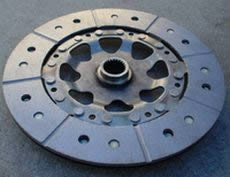
Of all types of linings, ceramics offer the highest coefficient of friction, at around 0.48 to 0.55. This means they can be used with a lower clamping-force pressure plate, as the lining provides the grip. But because of this attribute, they cause a lot of wear on mating surfaces and shudder can be commonly encountered. Ceramics can take
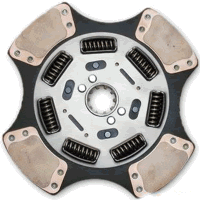
more heat than an organic material, but deliberately slipping the clutch tends to burn up the flywheel and pressure plate more than the lining. Made from sintered bronze with ceramic material mixed in, there are a few different brands available that vary in their carbon content, but they are all mainly suitable for competition use.
Kevlar
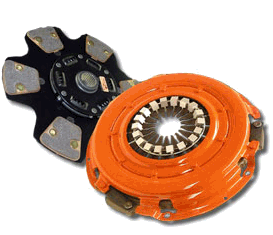
Kevlar, like organic linings, needs a fairly high clamping pressure to maintain grip. This is because Kevlar’s coefficient of friction is similar, at around 0.30 to 0.35. Its biggest advantage over organics is its ability to withstand large amounts of heat – up to 40-50% more can be endured, so long as it is used in conjunction with a highly rated pressure plate. It also places virtually no wear on its mating surfaces. However, the downsides include poor drivability (rough engagement), noticeable chatter, and ultimately worse longevity than even an OEM clutch.
Carbon
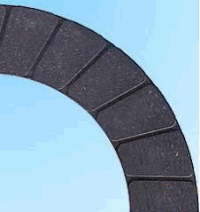
Pure carbon-lined clutch plates for road-going cars are very hard to find and not a practical solution. Carbon as a clutch lining is used only in very extreme environments because of its strong grip and the harsh manner in which it must be operated. Carbon’s ideal working temperature range is around 200 to 500 degrees Celsius. The coefficient of friction is around 0.50 to 0.65. It must be used in conjunction with a very highly rated pressure plate. It places virtually no wear on its mating surfaces, but carbon itself has a high wear rate. Carbon composite lining is used for improved and maximum torque capacity, while a carbon composite puck-style (segmented) facing is used for positive engagement and maximum holding capacity. The picture shows non-abrasive Feramic (ceramic + graphite alloy) lining, which provides an extremely high coefficient of friction while remaining non-abrasive to the flywheel surface. It is a very friendly yet very high performance lining, and is extremely expensive.
Pressure Plates/Clutch Covers
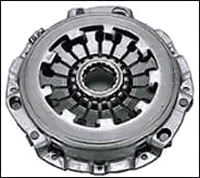
Pressure plates squeeze the clutch plate against the flywheel, so they are obviously largely responsible for the total amount of holding force generated. Car manufacturers usually aim to achieve a light clutch pedal weight to make driving easier, and they do this by using a fairly marginal pressure plate load rating. The good news is that the clamping force of an OEM pressure plate can usually be increased by 50-100% by altering the fulcrum point and swapping or re-shaping the diaphragm. However, the extent of this increase depends on the location of the factory fulcrum point, and the quality of the OE part can also be a concern. Some cars, such as the Toyota GT-4 turbo, only have scope for another 10% pressure, in which case an aftermarket pressure plate is usually required.
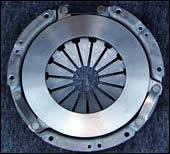
The maximum tolerable pedal weight is merely an individual opinion, but note that clutch cables (where fitted) can be stretched or overloaded if the increase goes too far. On the other hand, cars fitted with hydraulic clutch actuation can accommodate a pressure plate of substantially more load rating without excessive pedal pressure. Note that with a too highly rated pressure plate, it is also possible to bend or break clutch forks and strain engine crankshaft bearings.
Flywheels
|
High performance Cast iron Flywheel |
|
Aluminium Flywheel |
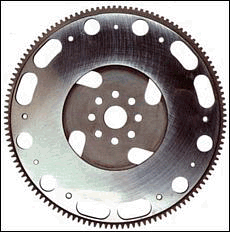
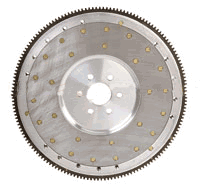
The flywheel can be of significant importance in the overall clutch equation. The lighter a flywheel is, the less moment of inertia it has. Lightened OE, light steel, or aluminium flywheels offer faster engine acceleration at the expense of idle quality, ease of take-off, steady-state cruising, and light-throttle smoothness. The good news for the clutch is that whenever the pedal is engaged, the rotational difference in speed between the clutch and the lightweight flywheel can be quickly equalised. The faster this speed stabilisation occurs, the less accompanying clutch slip there is.
But problems can arise. For example, when aluminium flywheels are combined with ceramic clutches, it is possible for some microscopic aluminium particles to be lost to the harsh clutch lining. To combat this, some companies now heat-treat their flywheels prior to installation, and some have a replaceable steel heat shield inset in the mating faces.
On the other hand, really hard-launching cars might need to opt for an extra-strong flywheel such as a hardened billet steel or chromoly item, as OE and some lightweight flywheels have been known to disintegrate off the starting line. Factory cast flywheels that have been lightened are notorious for failing, so caution is advised.
Some Typical Clutch Problem Solutions
Choosing the Right Clutch
For those who want to keep stock drivability and characteristics while requiring the clutch to hold more power than a stock unit, the organic lining is the way to go. The standard organic clutch will be paired with a pressure plate that holds approximately 220 m/kg (325 ft/lbs) of torque, while stiffer pressure plates are also optional. This combination works with both OEM and aftermarket flywheels.
When discussing clutches, the word “practical” is more appropriate than “best”. There are clutches that will hold 350, 400, or even 700 m/kg (500, 600, or even 1,000 ft/lbs) of torque using 6 or even 3-4 puck discs. All-wheel-drive launches can be performed all day long until the car breaks and the clutch will not fail, but it will also drive poorly for everyday use. For drag racing, these are ideal; for practical daily driving, they are not. A common misconception is that because these “high power” clutches hold so much power and can take so much abuse, they will also last longer. In reality, this is false. Having less surface contact area allows the clutch to grab better, making it an on/off clutch that will not slip, but less contact and surface area also means less material being used, resulting in poor longevity for race/puck discs.
There are also “street” clutches that drive like stock, using organic linings as opposed to heavy-duty Kevlar and ceramic. However, organic linings will easily burn up during a 6,000 rpm drop. Organic linings last the longest, but their biggest weak spot is heat – and when a clutch is slipping, heat is being generated.
Taking these factors into account, the ideal solution is something that provides real-world daily driver attributes (smooth engagement, longevity) yet also handles routine beating on track days. These are the attributes that suit the “practicality” needs of a clutch for both highway driving and track day use.
|
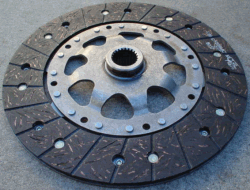
“OFE” (Organic/Feramic Element) Clutch |
Recommended Setup: OFE
As a result, I recommend an OFE unsprung stock organic clutch disc, lined with a brass-weaved organic lining, as well as a Feramic compound (graphite + ceramic) – hence the name “OFE” (Organic/Feramic Element).
The brass weaving on the disc allows the organic material to maintain its favourable characteristics while taking much more heat, so that it will not tear apart after some launches. The Feramic element provides a higher coefficient of friction (more grabbing force), yet the graphite element inside the Feramic makes the element less abrasive (graphite wears down on the flywheel like pencil lead), so the flywheel will not wear down as quickly.
To top it off, what prevents slippage during hard driving is the pressure plate. A stock OEM pressure plate has approximately 680 kg of clamping pressure, and the more clamping pressure applied, the stronger it will clamp the clutch disc and keep it from slipping. The OFE uses an approximately 800 kg pressure plate, which holds around 220 m/kg of torque. The clutch drives and engages like stock, and will take a hard beating without smelling like burnt ashes (unlike the OEM unit).
Upgrade Scenarios
With the above information in mind, here are some examples of typical clutch upgrade scenarios and the recommended solutions:
Scenario 1 - A mildly modified 4WD turbo owner wants to spend as little money as possible and is seeking long clutch life with near-factory smoothness that can withstand occasional hard launches.
Solution - Retain the standard cast flywheel, re-line the standard full-face clutch with Kevlar lining or organic OFE-lined plate, and fit a more serious aftermarket pressure plate.
Scenario 2 - A Suzuki Swift GTi owner wants to achieve more positive clutch pedal engagement and less chance of slip.
Solution - Fit a Kevlar or organic-lined OFE hybrid-type sprung-centre clutch plate, along with a high clamping pressure plate and standard flywheel.
Scenario 3 - The owner of a regularly drag-raced 400-500 hp Holden Commodore wants to eliminate any chance of slip, maintain maximum service life, and is not too concerned about engagement smoothness or cost.
Solution - Option one would be a single-plate clutch in a large-as-can-fit (26 centimetre) diameter with a heavy-duty pressure plate. A choice of linings would be available to suit. The second option would be a twin-plate clutch, also with a choice of linings, but a medium-duty pressure plate will suffice.
I am conveying this through my good and bad experiences in finding the “best” clutch for my Audi A4… I’ve used heavy duty “race” clutches, and I’ve also used OE-style “driver friendly” clutches as well, and after going through 4 clutches on my A4 and changing them out myself every time to see my “damage”, I can personally recommend the OFE… for it being the most “practical” for your needs.
To improve your knowledge about Formula 1 car clutches, check my article here.
Summary
With this information, it should be possible to speak knowledgeably on the topic of clutches and know what to do if a car’s clutch needs replacing.