Zylon (PBO)
Interior of the Babolat Syntronic 900 Zylon 900 Zylon microfibers form the core of the string
What Is Zylon?
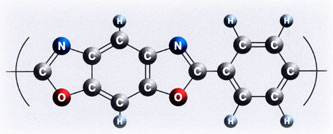
PBO (Poly(p-phenylene-2,6-benzobisoxazole)) is a liquid crystal polymer developed by Japan-based Toyobo Co., Ltd under the trade name Zylon.
Zylon was invented and developed in the 1980s. Like Kevlar, Zylon is used in applications that require very high strength with excellent thermal stability. Tennis racquets, table tennis blades, various medical applications, and some of the Mars rovers are among the more well-known products.
Zylon is a gold-coloured fibre with an initial modulus significantly higher than other high-modulus yarns, including aramids. It is the strongest man-made fibre in the world, with four extraordinary characteristics:
- Extraordinary tensile strength – stronger than steel and twice as strong as Kevlar
- Remarkably high modulus (resistance of fibre to stretch) – also twice as high as Kevlar
- Flame resistance – it will burn only when exposed to atmospheric conditions consisting of at least 68% oxygen, a state not naturally encountered in Earth’s atmosphere
- Incredible thermal stability – it decomposes only at temperatures in excess of 780 degrees Celsius (1470 degrees Fahrenheit)
Ballistic Protection
Zylon’s unique physical properties allow Zylon-based body armour to provide remarkable ballistic protection at a light – and therefore comfortable and wearable – weight. Since the introduction of Zylon-based bullet-resistant vests, the percentage of police officers wearing them regularly has increased significantly.
Technical Properties
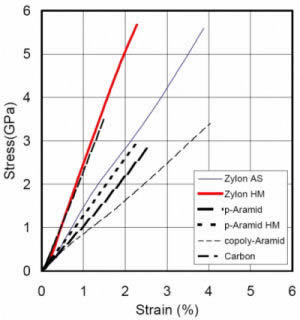
Polybenzobisoxazole (PBO) is a rigid-rod isotropic crystal polymer. Zylon has superior tensile strength and modulus compared to p-Aramid fibres. It also has outstanding flame resistance and thermal stability. Zylon shows excellent performance in properties such as creep resistance, chemical resistance, cut and abrasion resistance, and high-temperature abrasion resistance, far exceeding p-Aramid fibres. Its moisture regain is low (0.6%) and it is dimensionally stable against humidity. Despite its extremely high mechanical properties, Zylon is quite flexible and has a very soft hand. It can be processed into various product forms, including continuous filament, staple fibre, spun yarn, woven and knitted fabrics, chopped fibre, and pulp.
Zylon fibre has an interesting additional property: a negative thermal expansion coefficient in the fibre direction. Zylon fibre reinforced plastic (ZFRP) therefore expands in the fibre direction during cooling from room temperature to liquid helium temperature.
Zylon fibre degrades when exposed to UV and visible light, seawater, and chafing. It is therefore protected by a synthetic melted-on jacket.
Use in Formula 1
Starting in the 2007 season, the F1 driver’s cockpit must be clad in special anti-penetration panels made of Zylon. The Indy Racing League also adopted Zylon starting in 2008.
To meet revised technical requirements from the FIA, engineers were required to make significant changes to the car’s body and chassis, including the addition of a thick pad of Zylon to improve side impact protection.
Wheel Tethers
Since 1998, F1 cars have been required to fit wheel tethers connecting each wheel to the chassis. This rule was introduced to prevent wheels from coming free and bouncing around dangerously during accidents. The tethers used are made of Zylon and are designed to withstand a force of greater than 5500 kg of load.
The tether must be attached to the chassis at one end and to the wheel hub (wheel assembly) at the other. They are hidden within and pass through the suspension arms.
Unfortunately, wheels still come off Formula 1 cars more often than desirable. The tethers work, but they have not always been reliable enough. A marshal was tragically killed at the Italian GP in 2000, and a fatal Formula 2 accident at Brands Hatch claimed the life of Henry Surtees after he was struck on the head by a loose wheel. However, every time a tether has prevented a wheel from becoming detached, it has potentially prevented death or serious injury.
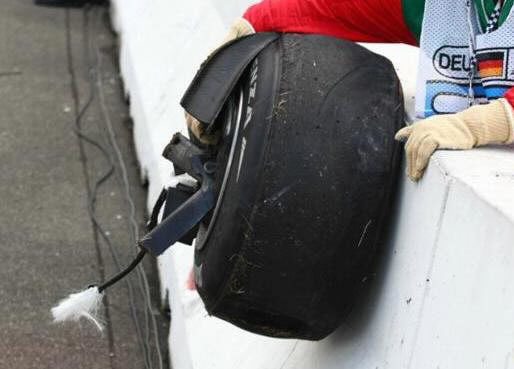
Double Tethers from 2011
After discussion at the Technical Working Group, the FIA introduced an extra tether to each wheel for the 2011 season. Rather than assuming each tether is 100% reliable, the new approach places two independently routed, fully redundant tethers on each corner – one in the upper wishbone and one in the lower wishbone – drastically improving the probability that one or both will survive an accident.
Le Mans Prototype LMP cars adopted tethers from 2014 onward.
The drawback of Zylon is that it must be protected from light and UV radiation, so it must be covered in a shrink-wrapped protective cover. The tethers are designed to withstand enormous loads, but they can break during accidents, especially if the cable becomes twisted by broken suspension members. Teams normally replace the tethers every two or three races. Most tethers are hidden inside suspension wishbones for aerodynamic purposes; the only requirement is that each tether be attached to the wheel on one end and to the chassis on the other, with the exact routing left somewhat to the teams’ discretion.
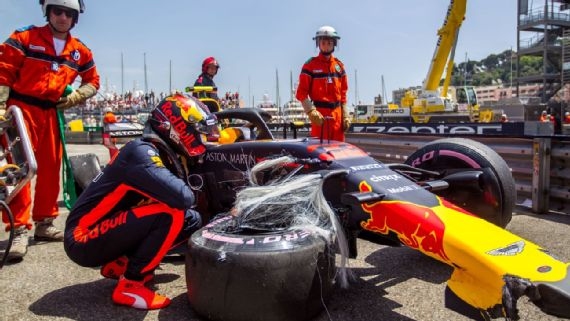
The FIA-approved wheel tethers are manufactured by two companies (TECHNICAL LIST No. 37, List of cables in compliance with the “FIA standard for Formula One wheel restraint cables”): Future Fibres in London, and Cortex Humbelin AG in Rupperswil, Switzerland. They take the form of a rope and are a derivative of high-performance marine ropes, made specifically for each car.
FIA Test Specification 03/07 for Formula One Wheel Restraint Cables
1. SCOPE
Wheel restraint systems are important to improve protection to the drivers and the personnel (spectators and officials) within the proximity of the race event. It has been shown that during an accident a wheel may be ejected at velocities in excess of 150km/h (42m/s) relative to the car, which corresponds to a linear kinetic energy of 17kJ for a 20kg wheel assembly.
This specification provides test methods, criteria and limits to assess the performance of wheel restraint systems to ensure that the potential for wheel ejection is reduced. During early development work, an advanced wheel restraint system was considered in two parts; an energy absorbing unit and a connecting tether. However, the latest research has demonstrated that an integrated tether
can absorb the required energy without the need for a separate energy absorbing unit. And, therefore, an integrated tether is the preferred solution. Other designs may be acceptable, but the geometry and function must be approved by the FIA before submitting for certification. A definition of the key components is provided below.
2. DEFINITIONS
2.1 Wheel Assembly
Those parts, likely to include the wheel, tire, upright, brake calliper and brake disk, that are considered to be a single projectile during a wheel ejection event.
2.2 Wheel Restraint Cable (Tether)
Flexible load carrying element that connects the wheel assembly to the main structure of the car and that provides the required strength and energy absorbing capability.
2.3 Energy Absorber
The energy absorbing capability of the tether. A separate energy absorbing element may be permitted but must be approved by the FIA before submitting for certification.
2.4 Tether End Fitting
Feature at each end of the tether to facilitate attachment to the car and the wheel assembly. The tether end fitting may include a bobbin if this represents the in-car conditions.
The in-board-tether-end-fitting connects to the car chassis
The out-board-tether-end-fitting connects to the wheel assembly
2.5 Tether Attachment
Attachment between the tether end fitting and the main structure of the car that achieves the strength and geometrical requirements defined by the Technical Regulations.
2.6 Tether Sliding Surface
Rigid structure that represents the local structure of the car over which the tether must slide if the wheel is ejected in any direction normal to the axis of rotation of the rear wheels.