Yaw Control
Basic Definition
Similar to a Limited Slip Differential, yaw control governs the distribution of torque to the left and right side wheels. It helps cars reduce understeer and provides a faster turning ability.
If yaw control is set too high, there is a risk of creating excessive oversteer, and tire wear increases significantly. However, when properly adjusted, the car’s turn-in ability is tremendous. Adjusting yaw control is always a compromise depending on track layout. Yaw is not controllable from the F1 cockpit.
Yaw Explained in Depth
To make the concept more understandable, the following explanation examines yaw and how it is controlled in a NASCAR environment, based on the specific construction of stock cars. This analysis is drawn from the Stockcarscience website.
Why Jeff Gordon Was Jealous of Carl Edwards’ Yaw
David Newton reported on ESPN.com that Jeff Gordon asked NASCAR to examine the No. 99 car of Carl Edwards because he believed that yaw was the reason Edwards had been so competitive that season.
Locating an object in space requires three numbers – for example, a position defined by two streets and a floor level. However, this description only identifies a point. A car, which has spatial extent, could be oriented in various ways that those three coordinates alone do not describe. Three additional angles must be specified with respect to three axes: the x-axis (along the car’s length), the y-axis (crosswise, pointing toward the driver’s right), and the z-axis (pointing downward, as is convention in vehicle dynamics).
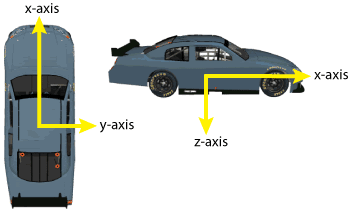
What Yaw Means
Yaw describes the rotation of the car about the z-axis. The yaw angle is the angle between the direction the car is moving and the car’s x-axis (the direction the car is pointing). In the simplest case, the car is travelling straight and pointing in the same direction it is moving, so it has no yaw. A yawed car is heading in a different direction than it is pointing.
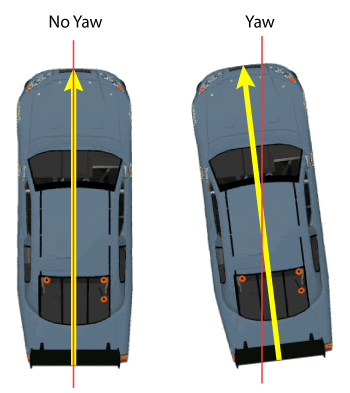
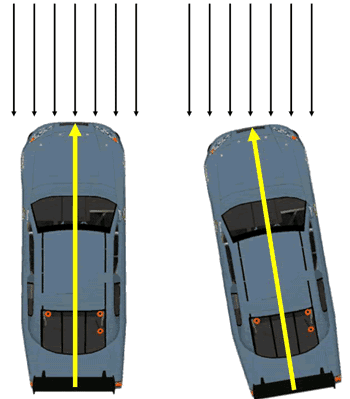
A car is by definition yawed when it corners, because it is pointing in a different direction from its direction of travel at every point along the turn. Yaw is important because air hits the car differently when it is at an angle to the oncoming airflow compared with when it meets the air head-on. In effect, a yawed car has a head start on the turn because it is already angled before entering the corner. Yaw positions the car so that the air helps it turn.
Built-In Yaw in NASCAR
A number of observers have noticed that some cars appear to be yawed even when heading down the straightaway, as if they have an inherent yaw built into them. Darlington Raceway has particularly long straightaways, which is why yaw became a talking point.
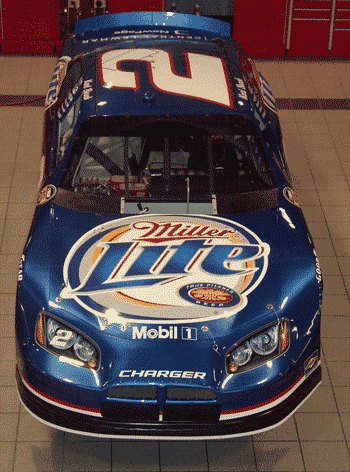
The older NASCAR cars were asymmetric – literally kidney-bean shaped. Gary Nelson, the founding director of the NASCAR Research and Development Center, once said that the cars were so misshapen that they looked as though they had been in an accident before they even got on the track.
All of this body manipulation was for aerodynamic advantage. However, the research costs and the expense of cutting off and replacing body panels were getting out of hand. This was one of NASCAR’s major motivations for introducing the new car.
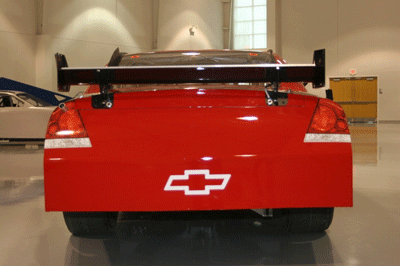
The new car still retained some asymmetry – for instance, the wing was not exactly centred between the two taillight decals, and the left rear quarter panel was much more tapered than the right. However, the degree of asymmetry was largely fixed by NASCAR’s body templates.
Of all the drivers, Jeff Gordon knew that one should not tamper with the new car’s body. He complained that the rear end gear on the No. 99 was creating abnormal yaw, giving it the same type of asymmetry that the new car’s fixed body shape was intended to eliminate.
How Yaw Is Induced
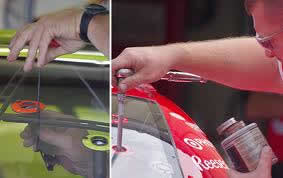
NASCAR cars have a solid rear axle. The rear end gear links the driveshaft to the rear wheels. There are three holes in the rear windshield: two for adjusting the springs on either side of the car, and the third (the bottom one on the right) for adjusting the trackbar. The trackbar shifts the rear end gear to the left or right.
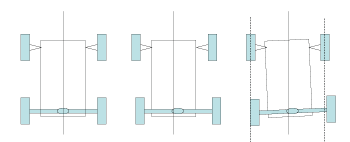
Kyle Busch described Edwards’ car as looking “stupid going down the straightaway because it’s dog-tracking.” A running dog is typically slightly sideways, with the rear paws never following in the front paw prints. This phenomenon, sometimes called “crabbing,” means the rear wheels do not track directly behind the front ones.
Gordon remarked that some cars could not even get on the inspection scales because they were running so sideways, and urged NASCAR to address it. The scales consist of four plates aligned with each other; Gordon suggested the offset between front and rear wheels was so great that some cars had difficulty fitting onto them.
Multiple Methods of Inducing Yaw
There are rules limiting how far the trackbar can be moved, so other techniques were clearly being used to induce yaw. One possibility involved the wheelbase: the allowable range was 110 inches plus or minus half an inch. By making the wheelbase 109.5 inches on the left side and 110.5 inches on the right side, a full inch of asymmetry could be gained. Numerous other small adjustments across the car could add up to a significant effect.
The result was that cars were drifting, much like they do on dirt tracks. It was no surprise, then, that Edwards – who still did considerable dirt track racing – was comfortable driving a car set up this way. This was one rationale for why Edwards, who had struggled with the new car the previous year, was performing so well. As with other innovations such as coil binding, some teams figured out how to exploit yaw sooner than others. The question remained whether there were alternative ways to improve cornering that would be more comfortable for drivers who were not accustomed to travelling sideways down the straights.