Wing In Ground Effect (WIG)
Not to be confused with ground effect in auto racing, which is explained in this article.
Overview
Aircraft may be affected by a number of ground effects, or aerodynamic effects due to a flying body’s proximity to the ground.
The most significant of these effects is known as the wing in ground (WIG) effect, which refers to the reduction in induced drag experienced by an aircraft as it approaches a height approximately equal to half the aircraft’s wingspan above ground or another level surface, such as the sea. The effect increases as the wing descends closer to the ground, with the most significant effects occurring at an altitude of one half the wingspan. It can present a hazard for inexperienced pilots who are not accustomed to correcting for it on their approach to landing, but it has also been used to effectively enhance the performance of certain kinds of aircraft.
Aerodynamic Principles
Article from FAA site faatest.com
It is possible to fly an aeroplane just clear of the ground (or water) at a slightly slower airspeed than that required to sustain level flight at higher altitudes. This is the result of a phenomenon that is better known than understood, even by some experienced pilots.
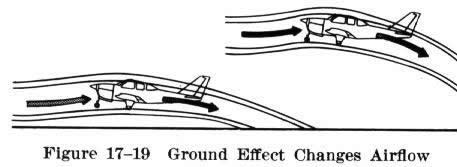
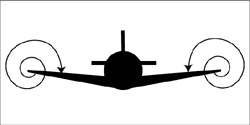
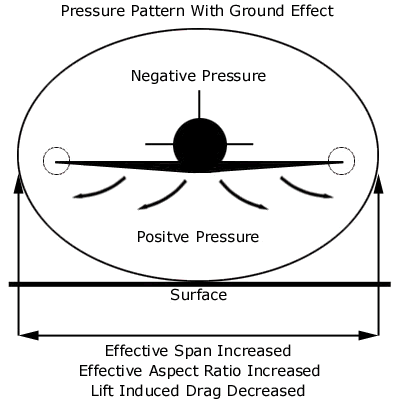
When an aeroplane in flight gets within several feet of the ground surface, a change occurs in the three-dimensional flow pattern around the aeroplane because the vertical component of the airflow around the wing is restricted by the ground surface. This alters the wing’s upwash, downwash, and wingtip vortices. These general effects due to the presence of the ground are referred to as “ground effect.” Ground effect is therefore due to the interference of the ground (or water) surface with the airflow patterns about the aeroplane in flight.
While the aerodynamic characteristics of the tail surfaces and the fuselage are altered by ground effects, the principal effects due to proximity of the ground are the changes in the aerodynamic characteristics of the wing. As the wing encounters ground effect and is maintained at a constant lift coefficient, there is a consequent reduction in the upwash, downwash, and the wingtip vortices.
Induced Drag Reduction
Induced drag is a result of the wing’s work of sustaining the aeroplane, and the wing lifts the aeroplane simply by accelerating a mass of air downward. Reduced pressure on top of an airfoil is essential to lift, but that is only one of the factors that contributes to the overall effect of pushing an air mass downward. The more downwash there is, the harder the wing is pushing the mass of air down. At high angles of attack, the amount of induced drag is high, and since this corresponds to lower airspeeds in actual flight, it can be said that induced drag predominates at low speed.
However, the reduction of the wingtip vortices due to ground effect alters the spanwise lift distribution and reduces the induced angle of attack and induced drag. Therefore, the wing will require a lower angle of attack in ground effect to produce the same lift coefficient or, if a constant angle of attack is maintained, an increase in lift coefficient will result.
Ground effect also alters the thrust required versus velocity. Since induced drag predominates at low speeds, the reduction of induced drag due to ground effect causes the most significant reduction of thrust required (parasite plus induced drag) at low speeds.
The reduction in induced flow due to ground effect causes a significant reduction in induced drag but has no direct effect on parasite drag. As a result, the thrust required at low speeds will be reduced.
Due to the change in upwash, downwash, and wingtip vortices, there may be a change in position (installation) error of the airspeed systems associated with ground effect. In the majority of cases, ground effect causes an increase in the local pressure at the static source and produces a lower indication of airspeed and altitude. Thus, the aeroplane may be airborne at an indicated airspeed less than that normally required.
Quantifying Ground Effect
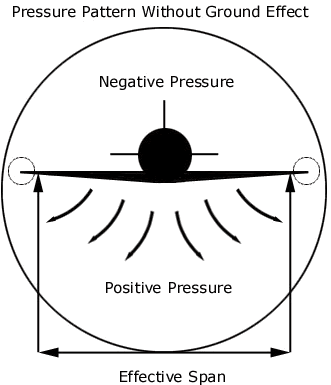
In order for ground effect to be of significant magnitude, the wing must be quite close to the ground. One of the direct results of ground effect is the variation of induced drag with wing height above the ground at a constant lift coefficient. When the wing is at a height equal to its span, the reduction in induced drag is only 1.4 percent. However, when the wing is at a height equal to one-quarter its span, the reduction in induced drag is 23.5 percent, and when the wing is at a height equal to one-tenth its span, the reduction in induced drag is 47.6 percent. Thus, a large reduction in induced drag takes place only when the wing is very close to the ground. Because of this variation, ground effect is most usually recognised during liftoff for takeoff or just prior to touchdown when landing.
Effects During Takeoff
During the takeoff phase of flight, ground effect produces some important relationships. The aeroplane leaving ground effect after takeoff encounters the reverse of the aeroplane entering ground effect during landing. The aeroplane leaving ground effect will:
(1) require an increase in angle of attack to maintain the same lift coefficient
(2) experience an increase in induced drag and thrust required
(3) experience a decrease in stability and a nose-up change in moment
(4) produce a reduction in static source pressure and increase in indicated airspeed. These general effects highlight the possible danger in attempting takeoff prior to achieving the recommended takeoff speed. Due to the reduced drag in ground effect, the aeroplane may seem capable of takeoff well below the recommended speed. However, as the aeroplane rises out of ground effect with a deficiency of speed, the greater induced drag may result in very marginal initial climb performance. In extreme conditions such as high gross weight, high density altitude, and high temperature, a deficiency of airspeed during takeoff may permit the aeroplane to become airborne but be incapable of flying out of ground effect. In this case, the aeroplane may become airborne initially with a deficiency of speed and then settle back to the runway. It is important that no attempt be made to force the aeroplane to become airborne with a deficiency of speed; the recommended takeoff speed is necessary to provide adequate initial climb performance. For this reason, it is imperative that a definite climb be established before retracting the landing gear or flaps.
Effects During Landing
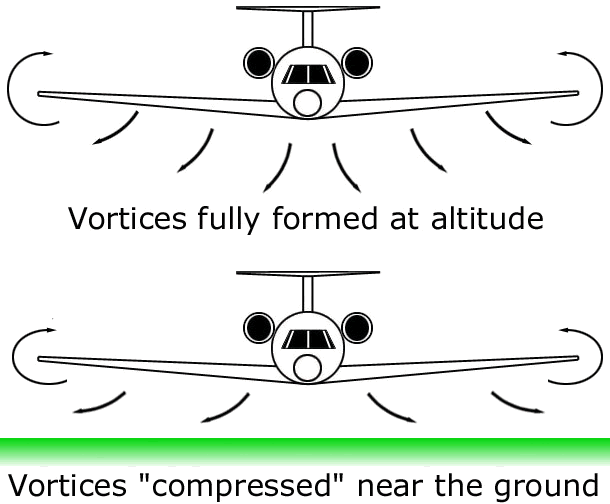
During the landing phase of flight, the effect of proximity to the ground must also be understood and appreciated. If the aeroplane is brought into ground effect with a constant angle of attack, the aeroplane will experience an increase in lift coefficient and a reduction in the thrust required. Hence, a “floating” effect may occur. Because of the reduced drag and power-off deceleration in ground effect, any excess speed at the point of flare may incur a considerable “float” distance. As the aeroplane nears the point of touchdown, ground effect will be most realised at altitudes less than the wingspan. During the final phases of the approach as the aeroplane nears the ground, a reduced power setting is necessary or the reduced thrust required would allow the aeroplane to climb above the desired glide path.
Ground Effect Vehicles
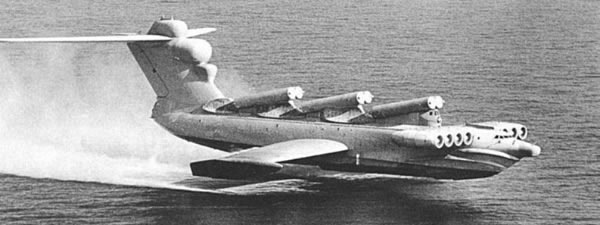
During the 1980s, the Soviets continued testing various ground effect vehicles for use in coastal defence and amphibious operations. The ORLAN-Class takes advantage of the increased aerodynamic lift that occurs when a wing operates near the surface. This greatly increases the craft’s ability to carry heavy loads over long distances, especially over water, making it well suited for amphibious warfare.
In 1966, the Central Hydrofoil Design Bureau under Rostislav Alekseev produced a gargantuan “ekranoplan” (“surface plane”) combining the smooth hull form of a ship with stub wings, a large vertical fin, and a horizontal tail. The craft featured ten engines: eight mounted in two clusters of four directly behind the cockpit to provide augmented lift, and two on the vertical fin to provide cruise power. This machine, which American intelligence organisations dubbed the Caspian Sea Monster, could lift 540 tons and cruise at over 300 mph at an altitude of over 10 feet.