Wheel Tethers
Purpose and History
| 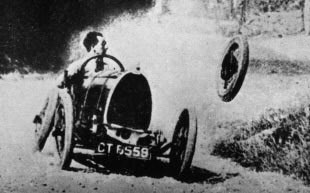 |
Raymond Mays loses a wheel on Brescia at Caerphilly hillclimb in the 1920s |
Since 1998, F1 cars have been required to fit wheel tethers connecting the wheels to the chassis. This rule was introduced to prevent wheels from coming free and bouncing around dangerously during accidents. The tether must be attached to the chassis at one end and to the wheel hub (wheel assembly) at the other, running hidden through the suspension arms.
Unfortunately, wheels still come off Formula 1 cars more often than desirable. The tethers work, but they have not always been reliable enough. A marshal was tragically killed at the Italian GP in 2000, and a fatal Formula 2 accident at Brands Hatch claimed the life of Henry Surtees after he was struck on the head by a loose wheel that had broken away from a car ahead. However, every time a tether has prevented a wheel from becoming detached, it has potentially prevented death or injury to drivers, marshals, or spectators.
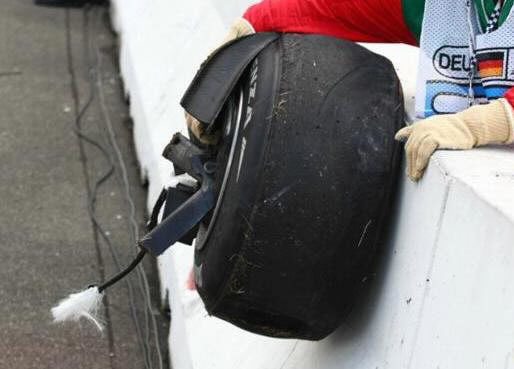
Double Tethers from 2011
After discussion at the Technical Working Group, the FIA introduced an additional tether to each wheel for the 2011 season. Rather than assuming each tether is 100% reliable, the new approach places two independently routed, fully redundant tethers on each corner – one in the upper wishbone and one in the lower wishbone – drastically improving the probability that one or both tethers will survive an accident.
Le Mans Prototype LMP cars adopted wheel tethers from 2014 onward.
Materials and Construction
The FIA-approved wheel tethers are manufactured by two companies (TECHNICAL LIST No. 37, List of cables in compliance with the “FIA standard for Formula One wheel restraint cables”): Future Fibres in London, and Cortex Humbelin AG in Rupperswil, Switzerland. The tethers take the form of a rope and are a derivative of high-performance marine ropes, made specifically for each car.
They are made from a special polymer called polybenzobisoxazole (PBO), commonly known as Zylon. Zylon has very high strength and stiffness characteristics (around 2700 MPa), exceeding carbon fibre. The advantage of Zylon is that it can be used as a pure fibre, unlike carbon which must be in composite form to achieve its strength.
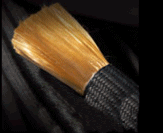
The drawback of Zylon is that it must be protected from light, so it is encased in a shrink-wrapped protective cover. The tethers are designed to withstand approximately 5500 kg of load, but they can break during accidents, especially if the cable becomes twisted by broken suspension members. Teams normally replace the tethers every two or three races to ensure they can withstand the forces encountered in an accident.
Double Tether Specifications for 2011
For safety reasons, the doubling of wheel tethers was mandated for the 2011 season. Each tether must pass through a different suspension member and have its own mounting points on both the upright and the chassis. No significant performance impact was expected, although the tethers are somewhat heavier, contributing (along with the side intrusion panel) to the increased minimum weight limit.
The challenge of flying wheels remains difficult because wheel tethers can only absorb a limited amount of impact force without their mountings being torn out.
FIA 2013 Technical Regulations
10.3.6 In order to help prevent a wheel becoming separated in the event of all suspension members connecting it to the car failing provision must be made to accommodate flexible tethers, each with a cross sectional area greater than 110mm². The sole purpose of the tethers is to prevent a wheel becoming separated from the car, they should perform no other function.
The tethers and their attachments must also be designed in order to help prevent a wheel making contact with the driver’s head during an accident.
Each wheel must be fitted with two tethers each of which exceed the requirements of 3.1.1 of Test Procedure 03/07.
Each tether must have its own separate attachments at both ends which :
- Are able to withstand a tensile force of 70kN in any direction within a cone of 45°
(included angle) measured from the load line of the relevant suspension member.**
**- On the survival cell or gearbox are separated by at least 100mm measured between the centres of the two attachment points.
On each wheel/upright assembly are separated by at least 90° radially with respect to the axis of the wheel and 100mm measured between the centres of the two attachment points.
Are able to accommodate tether end fittings with a minimum inside diameter of 15mm. Furthermore, no suspension member may contain more than one tether.
Each tether must exceed 450mm in length and must utilise end fittings which result in a tether bend radius greater than 7.5mm.