Camber
Definition
Camber is the angle of the wheels in relation to the ground when viewed from the front of the car. The tyre’s relationship with the road changes as the suspension moves through its travel.
Ideally, the camber curve should keep the tyre straight up and down when driving straight, and lean the tyre in slightly (1 to 2 degrees of negative camber) during cornering.
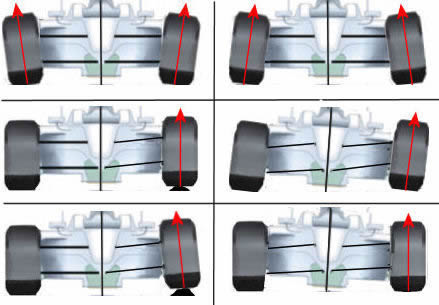
A neutral camber appears as |-| (when viewed from the front),
a negative camber as /-\ ,
and a positive camber as \-/ .
(TOP LEFT) Positive camber: The bottoms of the wheels are closer together than the tops.
(TOP RIGHT) Negative camber: The tops of the wheels are closer together than the bottoms.
(CENTER) When a suspension does not gain camber during deflection, this causes a severe positive camber condition when the car leans during cornering, which can cause erratic handling.
(BOTTOM) A suspension that gains camber during deflection will compensate for body roll. Tuning dynamic camber angles is one of the black arts of suspension tuning.
How Camber Affects Grip
Negative camber allows the weight of the car to lean on the outer, more loaded tyres, providing additional contact in a corner. However, on level ground and straights, the more camber there is, the less contact surface area the tyre has with the road.
While it is true that a car’s suspension will most likely pass through various degrees of camber during normal operation (depending on set-up and design), having a good baseline will be vital for a competitive package.
A negative camber setting for the front tyres is always recommended, and in most situations the front camber value should be higher than the rear. By keeping rear camber low, grip remains consistent for right and left corners despite the inside front tyre picking up slightly off the ground in extreme cases. Rear camber should be as close to zero or neutral as possible, providing as much contact patch and grip to the rear as possible. Unless the goal is to reduce oversteer, in which case a small amount of negative camber is acceptable.
On oval tracks (common in US racing series), the inner wheels need positive camber and the outer wheels need negative camber to counter the angle of the banked track (this was the subject of considerable discussion before the first US Grand Prix at Indianapolis, due to the banked final corner).
Using camber to reduce oversteer and understeer should be treated as a secondary option to adjusting springs and dampers or wings first – unless intentionally tuning a drift car. Using more camber than necessary is not advisable and will result in reduced grip on flat straights, as well as increased tyre overheating and wear. The tyre overheats in the contact area and remains too cold across the rest of its surface. This situation can cause blistering.
Aerodynamic Considerations
There are some key disadvantages of camber angle. Teams optimise the aerodynamics of the car around a specific camber angle in the wind tunnel and in CFD design software. Adjusting the camber too far either side of this tested reference can be detrimental to aerodynamic performance, as the position of the tyre’s wake can disrupt how airflow is manipulated over the car and interfere with the properties of front wing aero structures (such as the Y250 vortex).
Clear difference in camber values between Ferrari and RedBull Racing chalengers during 2013 Melbourne GP |
Camber Gain
Camber gain is the measure of how much the camber angle changes as the suspension is compressed. It is determined by the length and angle between the top and bottom suspension arms (or turnbuckles). If the top and bottom suspension arms are parallel, camber will not change as the suspension is compressed. If the angle between the arms is considerable, camber will increase as the suspension compresses. This is typical of modern Formula 1 cars with zero keel designs.
A certain amount of camber gain is desirable to maintain the face of the wheel parallel to the ground as the car rolls into a corner.
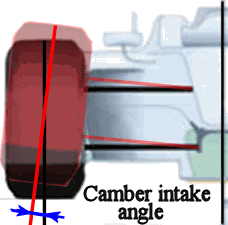
Note: the suspension arms should be either parallel or closer to each other on the inside (car side) than on the wheel side. Having suspension arms that are closer to each other at the wheel side than at the car side will result in camber angles that vary radically, producing erratic car behaviour.
Camber gain defines how the roll centre of the race car behaves. The roll centre in turn determines how weight is transferred when cornering, which has an important effect on handling.
Summary of Camber Types
Negative Camber: Improves cornering grip of the tyre during cornering, helping to maximise grip and provide better traction. The benefit is that the outer wheel generates greater lateral force on corner entry (known as camber thrust, similar to the way a motorcycle rider generates lateral force by leaning the bike over). The disadvantage is that the inner shoulders of both front tyres suffer greater stress when the car runs in a straight line. Too much negative camber will increase inner tyre wear and could result in handling imbalances, tyre overheating, and blistering.
Neutral Camber: Best suited for maximum acceleration and braking, this setting ensures a flat contact patch is retained on flat road surfaces. The inside wheels may lift at the inner contact edge of the tyre during extreme cornering.
Positive Camber: Used more for off-road applications, as this setting helps the wheels turn with lighter steering effort. The outside wheel under extreme cornering loads will benefit, but camber levels are normally linked (this might be a consideration for oval tracks).
Camber gain: The camber gain is the amount of camber “lost” due to car roll that is recovered through suspension motion. Higher camber gain improves the mechanical grip of the axle, but it also makes the camber more negative under braking.
Street Car Considerations
Lowering a car can cause negative camber to increase. When a car is lowered, the tyres lean inward, which causes irregular tyre wear if the problem is not corrected. Camber kits are necessary to correct the misalignment caused by the installation of new springs and are also highly recommended when upgrading stock wheels and tyres to aftermarket ones, to prevent future problems with tyre wear and alignment.
When a car leaves the manufacturer’s factory, camber is set according to OEM part specifications and extensive testing. Lowering the car or adding new rims risks throwing off the camber settings.
By adjusting negative camber, the car’s handling on the road can be improved. Conversely, an outward tilt (positive camber) provides less tyre wear and easier handling.