Wet Race Set-up
Weather Forecasting
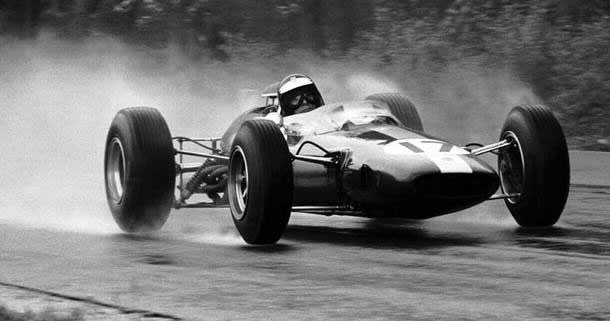
In the founding years of Formula 1, it was enough to glance up at the sky. Today, teams invest a significant amount of money and time in the most accurate weather forecasts possible, on which they base their race strategies. The setup used in qualifying is supposed to remain unchanged for the race, so engineers and tacticians spend countless agonising hours trying to forecast the weather. Despite state-of-the-art satellite technology, they are never safe from unpleasant surprises. The approach of a rain front in particular sets off alarm bells for the strategists on the pit wall.
Adapting to Changing Conditions
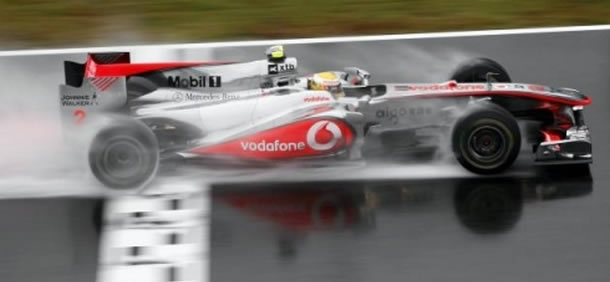
The recommendations of the meteorologists are passed on to the teams’ strategists. If it starts to rain during the race, drivers must adjust to impaired visibility and other changed conditions within seconds. How late can the driver brake? Should the car be steered around puddles? And most importantly: how much grip remains? The rubber build-up on track that improves grip along the racing line is often washed away by rain, leaving the track “green,” as drivers say. Consequently, the cars are more likely to slip and the drivers more likely to make mistakes.
Strategists must determine the difference in lap times amid the changing conditions and then pinpoint the precise moment at which it will make sense to switch from dry-weather tires to intermediates or full wets – and vice versa once the track begins to dry.
The regulations of Formula 1 offer various options for reacting to rain. If rain begins just before the start, the race director can abort the starting procedure, thereby providing teams with the opportunity to change tires.
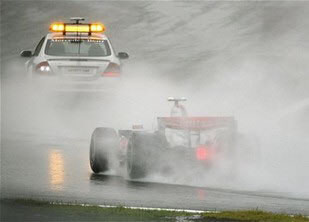
In heavy rain, the race director can order a flying start behind the safety car, or postpone the start of the race. Should track conditions become too dangerous, the race director has the option of deploying the safety car. The teams can then switch to intermediates or full wets. If that is not sufficient to ensure driver safety, the race can be suspended or restarted later.
Engine Setup
Engine setup
Formula 1 cars have so much power and torque that it is very difficult to put that power down on the track when it is wet and slippery, especially after the 2014 regulation changes and the introduction of V6 turbo engines. Because water on the track greatly reduces traction, improving the tire’s ability to stay connected to the road surface becomes the most important factor.
The engine is retuned to deliver a smoother, less harsh torque to the drivetrain using a wet-weather engine mapping. With modern engine electronic control units, this is easily accomplished. The engine may produce less peak power, but the power delivery is less sudden, reducing the risk of the rear wheels breaking loose.
As the top speed of the car will be lower than in dry conditions, the gear ratios may need adjustment. Usually, the ratios are lengthened in an attempt to reduce wheel spin – less power at each ratio means less chance of wheel spin. Drivers can also employ a simple technique known as “short shifting,” which involves the driver shifting up before peak horsepower is reached, keeping the car just out of the maximum power range.
In addition, teams ensure that water cannot enter the electronic systems. This is particularly important since the introduction of KERS in 2009 and the more complex power unit with ERS systems introduced in 2014, where water could act as a conductor between the high-voltage systems and the driver.
With these optimised settings for wet conditions, teams will be well prepared for the race – unless, of course, the track dries out during the race.
Mechanical and Aerodynamic Setup
Mechanical and Aero
The grip afforded by the tires is controlled by two parameters: mechanical grip and aerodynamic grip (downforce). Although there is a certain overlap between these two, mechanical grip is generally controlled by the suspension settings. These settings are established by the engineer based on prior knowledge of the track, car, and driver combination, and the anticipated weather conditions.
The rain suspension setup is, as always, a compromise. Since the car will be travelling slower than in dry conditions, the downforce generated will be proportionately lower. Therefore, the engineer will elect to increase the downforce generated by the wings. In the wet, grip is everything. For a full wet setup, downforce should be dramatically increased, sometimes by as much as 50%. Additionally, when the ride height is increased, the overall downforce created by the underbody and diffuser is reduced, and the engineer must compensate for this when deciding on the wing angles.
To prevent the car’s chassis from aquaplaning, the ride height is increased. Generous increases to ride height are advisable, as bottoming in the rain can be catastrophic. In dry conditions, cars are set up to run as close to the track as possible, as this makes the underbody aerodynamics work better and lowers the centre of gravity. Problems occur when the Formula 1 car’s flat undertray meets water. A large amount of water spray from the tires can be pulled by the airstream under the body, and combined with the water already present, the effect can be what is known as “body aquaplaning” – the entire car body begins to slide over a layer of water, like surfing.
Ideally, the engineer would prefer fitting softer suspension springs to increase mechanical grip, but since it will be necessary to increase overall downforce, the springs may well be left at the dry-setup specification with only wing downforce being increased. However, the shock absorbers (dampers) will need to be softened in both compression and rebound.
As the car will not generate high grip levels in corners, the anti-roll bar will also be softened. Some teams disconnect the anti-roll bars altogether.
It is important to keep both settings – wing downforce and suspension setup – in proportion to the dry-race setup to maintain overall balance. In other words, equal amounts of wing should be added front and rear, and the front and rear springs should be softened by equal amounts. As a result of these modifications, the ride height will need to be re-examined after a few laps.
Tire Selection
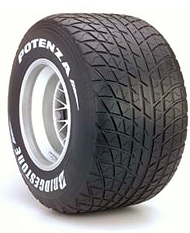
At very high speeds on wide tires, aquaplaning becomes a real concern; hitting a puddle of water can instantly reduce the driver to a passenger. The tread patterns of modern racing tires are mathematically designed to scrub the maximum amount of water possible from the track surface, ensuring the best possible contact between the rubber and the track.
Intermediate tires are generally used in partially wet conditions, where the driving surface is neither completely dry nor absolutely drenched. They provide moderate assistance in both conditions and are therefore favoured when part of the circuit is experiencing rain while the rest remains dry.
|
Pirelli heavy rain and intermediate tires |
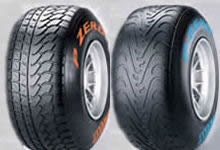
Heavily grooved, full rain tires come into play in heavier conditions. When the treads contact the track, they expand slightly due to the downforce and weight of the car, absorbing enough water to bring the tire back into contact with the surface. When the water-soaked area of the tire lifts off the track, it contracts again and releases the water. This is why pure rain tires have an incredibly soft compound – they must provide as much traction as possible. The rubber is so soft that if not cooled by water, their life expectancy can be as short as three laps. Because of the rain grooves and soft compound, the tread blocks squirm much more than on dry tires, generating much more heat. Thus, tires play an important safety role by keeping the car from sliding off uncontrollably.
Setup for a Drying Track
Another consideration is how to set up the car for a damp but drying track at the start of the race. In its simplest form, this might mean only fitting intermediate tires to the car. At other times, it involves the always-risky choice of adding a bit more downforce on the grid. However, the pitfall is that if the track dries later in the race, the car will have insufficient top speed to be competitive.