Weight Transfer
The Basics
Understanding the physics of weight transfer is the key to tuning cars. When stationary, the weight of the car is distributed more or less evenly on all four wheels. During acceleration, weight transfers to the rear wheels. During braking, weight transfers to the front wheels. During cornering, weight transfers to the outside wheels – in a left turn, the weight shifts to the two wheels on the right (when viewed from behind).
Setup Principles
Setting up a purpose-built race car or developing a racing setup for a street car follows the same principles. This discussion applies to any type of car, not only open-wheelers. In stock car racing, aerodynamics are not as important as in open-wheel design.
Aerodynamic influences such as aero balance, efficiency, and aero grip are set aside here to focus solely on achieving good mechanical grip through weight transfer.
Key Setup Changes
The key setup changes available on a race car are springs, anti-roll bars, and roll centre height. These adjustments affect ride stiffness (spring changes) and roll stiffness (springs, anti-roll bars, and roll centre height all contribute). Ride and roll stiffness are key inputs in determining the understeer/oversteer balance of the car.
The weight transfer setup recognises the importance of ride height and roll stiffness in determining a good balanced setup. It applies to all cars, especially racing, sports, and high-performance road cars.
The Role of Shock Absorbers
Shock absorbers are considered after ride and roll stiffness have been selected. They control tire contact with the road on bumpy surfaces, but they are not as effective as a tuning tool because the slow shock shaft speed forces are too weak to have a significant effect on weight transfer tuning. The desired tuning effect is the ability to influence the timing of weight transfer, and shock absorbers are simply too slow for this purpose.
Visualising Weight Transfer
The following illustrations show the natural centre of gravity adjusted during the design and setup process by means of adding ballast weight (1), and the centre of gravity altered by weight transfer during acceleration, braking, and cornering (2).
Weight transfer during the squat (acceleration)
Weight transfer during the pitch (deceleration)
Weight transfer during the roll (left corner)
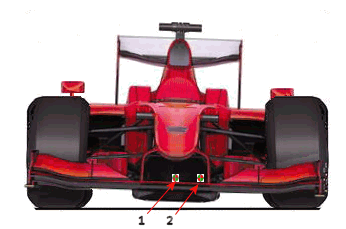
Weight transfer during the roll (right corner)
The Theory Behind Weight Transfer
The total lateral weight transfer at a given lateral g-force in cornering is a function of the vehicle’s mass, the centre of gravity height, and the track width. At mid-corner, the total weight transfer cannot be influenced by any other means – more or less body roll does not change it.
However, it is possible to influence the front-to-rear distribution of lateral weight transfer – increasing one while decreasing the other – thereby adjusting the balance of the car. Tire tests show that lateral grip increases with vertical tire load, but in decreasing increments. This is referred to as the “load sensitivity of the tires.” A pair of tires more unequally loaded has less grip than two tires more equally loaded. This mechanism provides an extremely sensitive adjustment for the relative grip between the front and rear wheels.
The Roll Couple Analogy
The concept of “roll resistance” is used to apportion weight transfer between front and rear. Consider the chassis of the car as a solid object with a compliant suspension at each end. The analogy is this: two people carrying a sailboard along a beach with the sail up, one at each end. A constant wind force in the sail tries to overturn the board. Both people apply counterforce (resistance) to balance the wind. If one decreases their counterforce, the other must increase theirs by a matching amount, and vice versa. This process is sometimes referred to as the “roll couple.”
The stiffer end in roll (higher roll resistance) will transfer more weight, purely because of the extra twist being applied to the chassis versus the other end. The softer end will transfer proportionally less weight.
Chassis Stiffness Requirements
A stiff chassis is needed to redistribute tire load in this way. However, some weight transfer goes directly through the suspension links and chassis, not through the springs (see geometric vs. elastic weight transfer below). This still occurs on a car with a flexible chassis. When a strut brace is fitted and better response is observed, this is partly because it assists more positive geometric weight transfer.
Through tire load sensitivity, the stiffer end loses grip and the softer end gains grip.
It is the difference in stiffness that matters. An increase in resistance at both ends that keeps the split the same results only in less roll, with no change in the car’s balance.
It is meaningless to consider what would happen if the front could roll independently of the rear. The two are interdependent: both ends contribute to one roll angle of the chassis.
It is the roll stiffness of the “wheel pair” that counts – the combined stiffness of the right-hand and left-hand springs. In roll only, different spring rates between right and left sides have no effect on balance, although this does affect balance in pitch and combined roll and pitch.
Three Components of Total Weight Transfer
Total weight transfer is the sum of three components:
Non-Suspended Weight Transfer:
Due to the lateral force component applied by the weight of the wheels, uprights, brakes, and similar parts. For a live axle, this includes the total axle assembly weight. The axle height serves as a close approximation to the centre of gravity for the non-suspended mass.
And two components of Suspended Weight Transfer:
Geometric Weight Transfer:
Due to the lateral force component applied directly at the Roll Centre (RC). Geometric weight transfer is reacted directly through the suspension linkages and does not induce body roll.
Elastic Weight Transfer:
Due to the lateral force component applied at the suspended mass centre of gravity, which does induce body roll. This force is reacted in the springs, anti-roll bars, and shocks, and is the only component of total weight transfer that induces body roll.
Roll Centre Height Implications
Low roll centres produce little geometric weight transfer, meaning most weight transfer passes through the springs (elastic weight transfer) and is therefore delayed by the time it takes for the vehicle to settle. Conversely, with high roll centres most weight transfer precedes body roll, leaving a smaller amount to go through the springs.
The location of roll centre heights and their effect on geometric versus elastic weight transfer is important in setup. Geometric weight transfer is a major factor for cars with high front weight percentage, front-wheel-drive vehicles, rear-wheel-drive vehicles with live rear axles, and current open-wheelers with high downforce and minimal suspension travel.
In current open-wheel racing, geometric weight transfer can be exploited because of the reduced jacking effect: small suspension travel, wide track, and long suspension arms prevent the roll centre height from moving excessively relative to the chassis. Geometric weight transfer helps reduce roll angle and suspension travel while using less rear anti-roll bar – sometimes none at all.
Conclusion
When modifying the setup of any vehicle, whether for racing or road use, it is essential to consider weight transfer numbers.