
Weight Balance
The Role of Ballast
Weight balance is a Formula 1-specific tuning option that works hand in hand with ballast. The best current F1 designs, using special materials such as titanium, carbon, and magnesium, may result in a bare car weighing around 450 kg. This total might comprise a 90 kg engine, a 50 kg monocoque, a 40 kg gearbox, the same weight for four wheels, an 11 kg rear wing, and so on, with the average driver contributing about 70 kg. A modern F1 clutch weighs around 900 grams. This is a considerable reduction from classics of the past, such as the Mercedes-Benz W196 that Fangio drove to the championship 50 years ago, which weighed roughly half as much again.
The purpose of ballast is to add weight – using very expensive tungsten plates – in precise, usually hidden locations (typically but not exclusively on the underside of the monocoque) to bring the car back up to the minimum allowed weight of 642 kg (for 2013). Over a complete season, a team may use ten sets of these plates, at a cost of approximately half a million dollars.
Adjusting Weight Distribution
After adding ballast, the weight balance of the car can be adjusted by placing more weight toward the front or rear depending on the car’s behaviour. The minimum permissible weight from 2013 was 642 kg, including the driver, fluids, and onboard cameras. The advantage of ballast is that it can be positioned anywhere in the car to achieve ideal weight distribution.
If the car is oversteering, the weight balance can be shifted toward the rear, providing more weight and grip at the rear axle. Conversely, if the car is understeering, moving weight toward the front will help.
Mandated Weight Distribution: 2011 to 2013
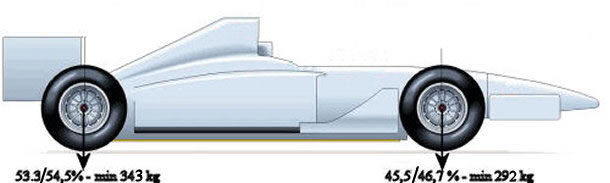
Along with the supply of Pirelli tires, a mandatory weight distribution was specified. Due to changes in their structure, Pirelli’s 2013 tires were approximately 2 kg heavier per set (4 pieces) than in 2012. The 2013 minimum car weight was accordingly increased from 640 to 642 kg. The weight distribution requirement was also revised to minimum figures of 292 kg (front) and 343 kg (rear). These specified minimum axle weights equated to a weight distribution ranging between 45.5-46.7% on the front axle and 53.3-54.5% on the rear – a few percentage points more than typical 2012 loadings.
Mandated Weight Distribution: 2014
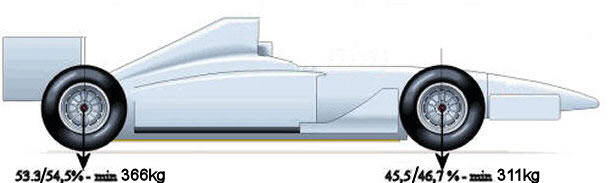
Following the extensive rule changes for 2014 – including new engines and heavy, complex ERS systems – the minimum car weight was raised from 642 kg to 690 kg to account for the heavier power units resulting from the switch to 1.6-litre turbos with extensive energy recovery. The weight distribution was adjusted to 311 kg on the front axle and 366 kg on the rear, corresponding to 45.5-46.7% front and 53.3-54.5% rear.
From the FIA 2014 technical regulations:
“4.1 Minimum weight: The weight of the car, without fuel, must not be less than 685kg at all times during the Event. If, when required for checking, a car is not already fitted with dry-weather tyres, it will be weighed on a set of dry-weather tyres selected by the FIA technical delegate.”
“4.2 Weight distribution:
**For 2014 only, the weight applied on the front and rear wheels must not be less than 311kg and 366kg respectively at all times during the qualifying practice session. If, when required for checking, a car is not already fitted with dry-weather tires, it will be weighed on a set of dry-weather tires selected by the FIA technical delegate.”
Originally agreed for the 2011 cars to cover the introduction of Pirelli tires for a single year, this regulation proved successful and was subsequently extended.
The Lighter Driver Advantage
This type of weight distribution regulation puts an emphasis on lighter drivers. A heavier driver means less freedom in weight distribution and less scope for strategic ballast placement. The teams kept voting for these rules, so they could not easily complain about the consequences.
This issue became particularly pronounced in 2014 because the new 1.6-litre turbo engines proved heavier than anticipated, and teams struggled to meet the minimum weight limit. Having a taller and therefore heavier driver could put a team at a disadvantage because it meant they were likely to exceed the weight limit. The issue was significant because 1 kg of weight equated to approximately 0.035 seconds per lap on an average circuit. This meant a smaller driver such as Ferrari’s Fernando Alonso, weighing 68 kg, held an advantage over taller drivers such as Sauber’s Hulkenberg, Jenson Button, or Mark Webber, all weighing around 74 kg – a difference of up to 0.2 seconds per lap if the team could not reduce the car weight by the corresponding amount. Even when they could, the taller driver was still at a disadvantage because their weight was positioned high in the car, adversely affecting the centre of gravity and performance. This was an advantage that should not exist simply by virtue of being born smaller, as it severely limited the tools available for adjusting the car. While the weight distribution was nominally fixed, there was still an allowable 1% variation – significant in F1 terms – and the ability to position ballast precisely.
The sport has evolved considerably since Carel Godin de Beaufort raced in the late 1950s and 1960s. He was of such size – at one time exceeding 100 kg – that he was nicknamed “Fatty Porsche.”
The solution was to raise the weight limit, but in Formula 1 self-interest has always prevailed. Teams with smaller drivers blocked any change to maintain their advantage. The focus should have been on finding ways to help larger drivers in the future.