Wankel Engine
The Inventor
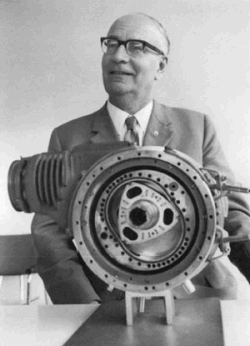
The Wankel rotary engine is a fascinating piece of engineering that features a clever rearrangement of the four elements of the Otto cycle.
Felix Wankel was born in 1903 in Lahr in the Schwarzwald (Black Forest) in Germany. He was employed in the sales department of a scientific publishing house in Heidelberg from 1921 to 1926. In 1924, he set up a workshop in Heidelberg where he built his first models of a rotary piston engine. Recognising that the principal problem with such designs was gas tightness, he spent considerable time attempting to resolve it, and by 1927 the problems were largely solved. During World War II, he worked for the German Luftfahrtministerium (Air Ministry). In 1951, Wankel and NSU signed a contract establishing a partnership to develop the rotary piston engine.
Early Development
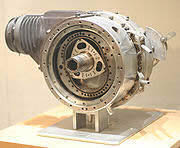
On 13 April 1954, the first Wankel rotary engine was built by NSU (DKM 54, Drehkolbenmotor), pictured left. In 1956, an NSU prototype motorcycle won all the trials in its category and broke several world records on the Great Salt Lake in the USA – its engine was fed by a Wankel supercharger.
The so-called KKM 57 (the Wankel rotary engine, Kreiskolbenmotor), pictured below, was constructed by NSU engineer Hanns Dieter Paschke in 1957 without the knowledge of Felix Wankel, who remarked: “you’ve turned my race horse into a plow mare”.
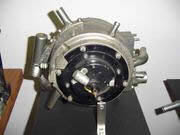
In 1958, NSU started tests on the Wankel engine. In 1960, the engine was first discussed publicly at the congress of the German Engineers’ Association. In 1963, NSU launched the Wankel-powered Spider at the Frankfurt Motor Show.
The Problem with Reciprocating Engines
In a conventional piston engine, many parts do not run smoothly. They are strongly accelerated and braked in short succession – pistons, connecting rods, valves, and valve rods, among others. For a long time, engineers tried to develop an alternative that would avoid the enormous acceleration forces of the reciprocating piston engine, which set a limit on crankshaft speed.
As early as 1636, a German named Pappenheim sketched a rotary pump, which was used about 150 years later in Watt’s steam engines. Unfortunately, the basic difficulties of sealing could not be solved at that time, and the efficiency of these rotary engines and pumps was far inferior to that of reciprocating piston engines. Many engineers tried in vain to solve these problems.
Commercial Development
The Wankel engine was developed in the 1970s by numerous companies, including General Motors, Daimler-Benz, Peugeot, and Mazda. Together, they built over one million Wankel-engine-powered cars.
However, due to rising environmental regulations and the oil crisis, further investment was largely abandoned.
Mazda and the Rotary Legacy

Only Mazda continued development with the rotary engine. The RX-7, which went on sale in 1978, was probably the most successful rotary-engine-powered car. It was preceded by a series of rotary-engine cars, motorcycles, trucks, and even buses, starting with the 1967 Cosmo Sport. The last year the RX-7 was sold in the United States was 1995.
The Mazda RX-8 featured a new, award-winning rotary engine called the RENESIS. Named International Engine of the Year 2003, this naturally aspirated two-rotor engine produced approximately 250 horsepower. The Renesis engine – also designated 13B-MSP (Multi Side Port) – which first appeared in production in the 2004 RX-8, was an evolution of the previous 13B. It was designed to reduce exhaust emissions and improve fuel economy, two of the most persistent drawbacks of rotary engines. Unlike its predecessors, it was naturally aspirated, resulting in lower peak power.
Two major changes were introduced. First, the exhaust ports were relocated from the peripheral position to the side of the housing, allowing engineers to eliminate overlap and redesign the intake port area. This produced noticeably more power thanks to a better compression ratio. Second, the rotors were reshaped with different side seals and low-height apex seals, offering optimised lubrication.
These innovations allowed the Renesis to achieve 49% higher output along with dramatically reduced fuel consumption and emissions (the RX-8 met LEV-II standards).
How the Rotary Engine Works
In a piston engine, combustion pressure is contained in cylinders and forces pistons to move back and forth. The connecting rods and crankshaft convert this reciprocating motion into rotational motion.
Rotary engines use the same four-stroke combustion cycle as piston engines, but accomplish it in a completely different way.
The heart of the rotary engine is the rotor. Roughly equivalent to the pistons in a piston engine, the rotor is mounted on a large circular lobe on the output shaft. This lobe is offset from the shaft centreline and acts like a crank handle, giving the rotor the leverage to turn the output shaft. As the rotor orbits inside the housing, it pushes the lobe around in tight circles, turning three times for every one revolution of the rotor.
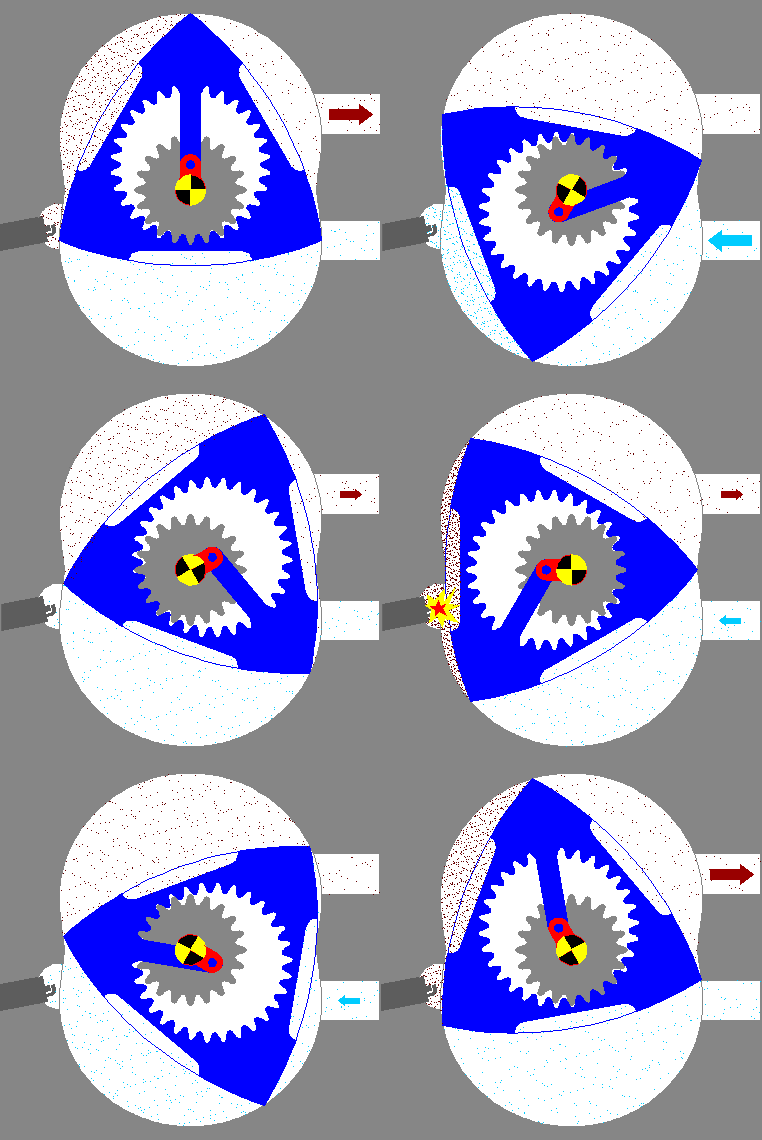
If observed carefully, the offset lobe on the output shaft spins three times for every complete revolution of the rotor. The Wankel engine is actually a variable-volume progressing-cavity system, with three cavities per housing, all repeating the same cycle. Points on the rotor and the eccentric shaft (e-shaft) turn at different speeds: the e-shaft moves three times faster than the rotor, so one full orbit of the rotor equates to three turns of the e-shaft. As the rotor moves through the housing, the three chambers change size, producing a pumping action.
Intake
The intake phase begins when the tip (apex) of the rotor passes the intake port. At that moment, the chamber volume is close to its minimum. As the rotor moves past the intake port, the chamber volume expands, drawing the air/fuel mixture in. When the rotor peak passes the intake port, the chamber is sealed off and compression begins.
Compression
As the rotor continues, the chamber volume decreases and the air/fuel mixture is compressed. By the time the rotor face reaches the spark plugs, the chamber volume is again near its minimum, and the mixture ignites.
Combustion
Most modern rotary engines have two spark plugs because the combustion chamber is elongated, and the flame would spread too slowly with only one. When the spark plugs ignite the mixture, pressure builds rapidly, forcing the rotor in the direction that enlarges the chamber. The combustion gases continue expanding, moving the rotor and creating power until the rotor peak passes the exhaust port.
Exhaust
Once the rotor apex passes the exhaust port, the high-pressure combustion gases flow into the exhaust. As the rotor continues, the chamber contracts, forcing remaining exhaust out. By the time the chamber volume nears its minimum, the rotor peak passes the intake port and the cycle begins again.
Each of the three rotor faces is always working on one part of the cycle. In one complete revolution of the rotor, there are three combustion strokes.
Key Components
Rotor
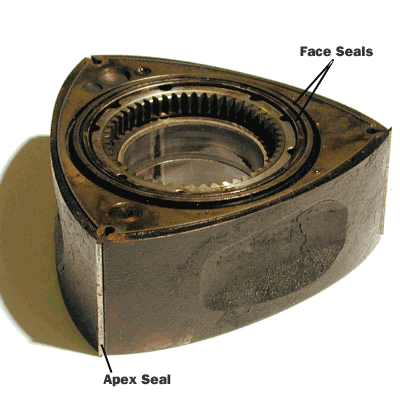
The rotor has three convex faces, each acting like a piston. Each face has a pocket that increases the engine’s displacement. At the apex of each face is a metal blade that forms a seal to the housing. Metal rings on each side of the rotor seal against the sides of the combustion chamber. Internal gear teeth cut into the centre of one side mesh with a gear fixed to the housing, determining the rotor’s path and direction.
Housing
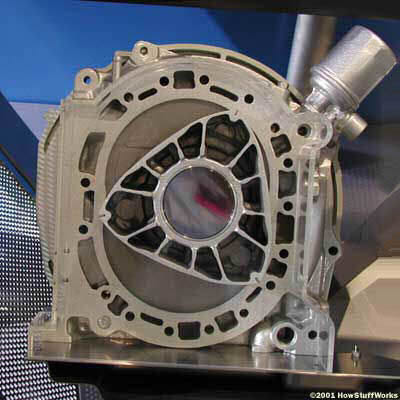
The housing is roughly oval in shape (technically an epitrochoid). It is designed so that the three rotor tips always stay in contact with the wall, forming three sealed volumes of gas. Each part of the housing is dedicated to one phase of the combustion process: intake, compression, combustion, and exhaust. The intake and exhaust ports are located in the housing. There are no valves – the exhaust port connects directly to the exhaust system, and the intake port connects directly to the throttle.
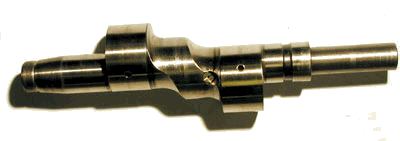
Output Shaft
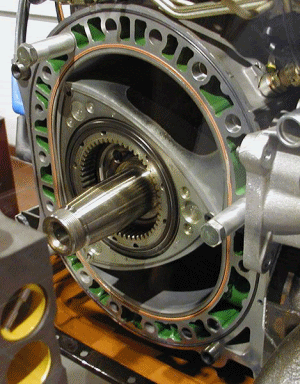
The central drive shaft, also called an eccentric shaft or e-shaft, passes through the centre of the rotor supported by bearings. The rotor both rotates around an offset lobe (crank) on the e-shaft and makes orbital revolutions around the central shaft. The spinning is caused by a stationary gear fixed to the side housing on which the rotor gear rides. Seals at the rotor corners seal against the housing periphery, dividing it into three moving combustion chambers. The output shaft has round lobes mounted eccentrically; each rotor fits over one of these lobes. As the rotor orbits, it pushes on the lobes, and because they are offset, the force creates torque in the shaft.
Engine Assembly
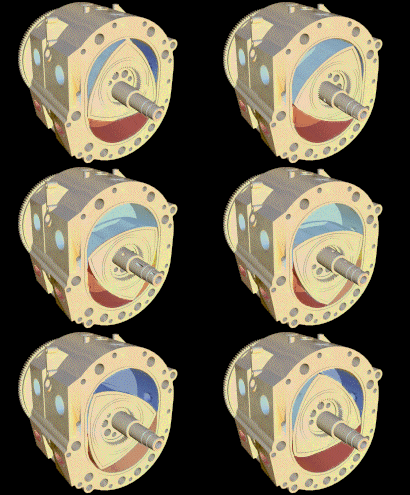
A rotary engine is assembled in layers. Each layer is one oval-shaped rotor housing. Coolant flows through passageways surrounding all the pieces. The two end layers contain seals and bearings for the output shaft and seal the two rotor housing sections. An intake port is located on each end piece.
Advantages Over Piston Engines
Wankel engines are considerably simpler and contain far fewer moving parts. Because valving is accomplished by simple ports cut into the housing walls, they have no valves or complex valve trains. Since the rotor is geared directly to the output shaft, there is no need for connecting rods, a conventional crankshaft, or crankshaft balance weights. This makes a Wankel engine much lighter (typically half that of an equivalent piston engine) and completely eliminates reciprocating mass, with its inherent vibration. This produces a smoother power flow and the ability to run at higher RPM.
Because of the quasi-overlap of power strokes and the avoidance of the four-stroke cycle’s dead spots, the Wankel engine responds very quickly to throttle changes, delivering a near-instantaneous surge of power, especially at higher RPM.
The engine is constructed with an iron rotor within an aluminium housing, which has greater thermal expansion. This ensures that even a severely overheated Wankel engine cannot seize – a substantial safety benefit in aircraft applications, since no valves can burn out.
Due to a 50% longer stroke duration compared to a four-stroke engine, there is more time to complete combustion, making the Wankel well suited for direct injection. It also produces stronger flows of air-fuel mixture and a longer operating cycle, resulting in thorough mixing – crucial for hydrogen combustion.
Three rotor Mazda wankel race motor
Disadvantages
The shape of the Wankel combustion chamber that prevents pre-ignition also leads to incomplete combustion of the air-fuel charge, releasing unburned hydrocarbons into the exhaust. While piston-engine manufacturers turned to catalytic converters, Mazda enriched the air-fuel mixture and supported complete combustion in a “thermal reactor” (an enlarged open chamber in the exhaust manifold) without a catalytic converter, producing clean exhaust at the cost of increased fuel consumption. The concurrent rise in world fuel prices made this trade-off unwelcome for consumers.
In the RX-8 with the Renesis engine, fuel consumption was brought within normal limits while meeting California State emissions requirements.
Power Output
While a four-stroke piston engine makes one combustion stroke per cylinder for every two crankshaft rotations, each combustion chamber in the Wankel generates one combustion stroke per driveshaft rotation – three power strokes per rotor rotation. Power output is generally higher than that of a piston engine of similar displacement or physical dimensions.
Wankel engines also generally operate at much higher RPM than comparable piston engines, partly because of the gearing from rotor to e-shaft and partly because the smoothness inherent in circular motion eliminates dangerous vibration.
Regulatory bodies in racing variously consider the Wankel equivalent to a four-stroke engine of 1.5 to 2 times the displacement. Some racing sanctioning bodies ban it altogether, including Formula 1.
Cooling Challenges
Unlike a piston engine, where the cylinder is alternately heated by combustion and cooled by the incoming charge, Wankel rotor housings are constantly heated on one side and cooled on the other. This places high demands on materials, though the Wankel’s simplicity makes it easier to use alternative materials such as exotic alloys and ceramics.
Other Applications
The basic Wankel design has also been used for air compressors and superchargers, though in these cases the size and weight advantages over piston engines are less relevant.
Apex Seal Limitations
Apex seals are not perfect seals – each has a gap to allow for thermal expansion. The less effective sealing of the Wankel is one factor reducing its efficiency, confining its success mainly to applications where neither maximum efficiency nor extreme engine longevity are primary concerns.
The trailing side of the combustion chamber develops a squeeze stream that pushes back the flame front. With conventional ignition systems and homogeneous mixtures, this prevents the flame from propagating to the trailing side at mid and high engine speeds, contributing to higher carbon monoxide and unburned hydrocarbon emissions. A side-port exhaust, as used in the Renesis, avoids this because unburned mixture cannot escape. The Mazda 26B, the famous Le Mans 24-hour endurance race winner, addressed this through a three-spark-plug ignition system. At Le Mans in 1991, the 26B had significantly lower fuel consumption than the competing piston engines, all of which had the same fuel allowance under the race’s limited fuel quantity rule.
Mazda wankel four rotor LeMans race motor
Unusual Applications
Perhaps the most exotic use of the Wankel design is in the seat belt pre-tensioner system of some Mercedes-Benz cars. When deceleration sensors detect a potential crash, small explosive cartridges are triggered electrically and the resulting pressurised gas feeds into tiny Wankel engines, which rotate to take up the slack in the seat belt system, anchoring the driver and passengers firmly in their seats before any collision.