Vortex
What Is a Vortex?
A vortex is a spinning flow of fluid – specifically, a spiral flow with closed streamlines. All vortices share certain properties. The air (or any fluid) pressure in a vortex is lowest at the centre and rises progressively with distance outward, in accordance with Bernoulli’s Principle.
Two or more vortices that are approximately parallel and circulating in the same direction will merge to form a single vortex. The circulation of the merged vortex equals the sum of the circulations of its constituent vortices. For example, a sheet of small vortices flowing from the trailing edge of an aircraft wing when generating lift will all merge into a single vortex.
Vortices contain considerable energy in their circular motion. In an ideal fluid, this energy can never be dissipated and the vortex would persist indefinitely. However, real fluids exhibit viscosity, which dissipates energy very slowly from the vortex core.
Wingtip Vortices
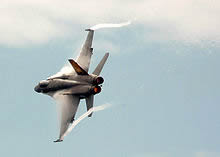
Wingtip vortices are circular patterns of rotating air left behind a wing as it generates lift. One wingtip vortex trails from the tip of each wing. Wingtip vortices are associated with induced drag, an unavoidable side effect of three-dimensional lift or downforce generation. They form because of the pressure difference between the upper and lower surfaces of a wing operating at a positive or negative lift angle. Since pressure is a continuous function, the pressures must equalise at the wing tips. Air tends to move from the higher-pressure surface around the wing tip to the lower-pressure surface. When the air leaves the trailing edge, the streams from above and below are inclined relative to each other, resulting in helical paths – vortices.
Vortices in Formula 1 Aerodynamics
Aerodynamically speaking, a Formula 1 car is an interconnected system of vortices and vortex layers. The vorticity is created by viscous shear in thin boundary layers adjacent to the car’s solid surfaces. The downforce generated by a wing is often attributed to the presence of circulation in the airflow around the wing, but the circulation itself is nothing more than the net vorticity in the boundary layers above and below the wing.
When a vortex layer separates from a solid surface, it becomes a free vortex layer, and a separated vortex layer can roll up into a volume of concentrated vorticity – a vortex. A vortex has a low-pressure core, in approximate balance with the centrifugal force of the fluid elements spiralling around it on helical trajectories. Oriented in the streamwise direction, such vortices can be particularly useful, both for the direct generation of downforce and to act as air curtains, sealing off other low-pressure areas such as the underbody.
|
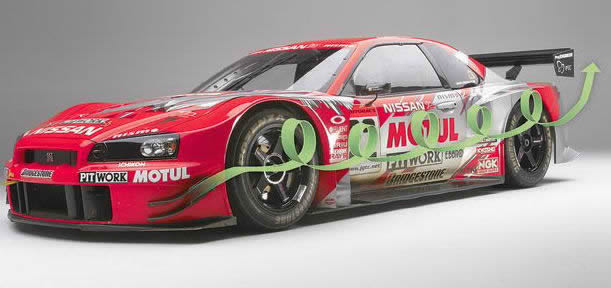
Canards, together with vortex generators, generate strong vortices that travel down the sides of the car and act as a barrier. If the canards are positioned correctly, these strong vortices act in way to keep high-pressure air around the car from entering the low-pressure underbody region, thus maintaining more downforce.If air was allowed to enter the underside, the pressure would inevitably rise, reducing downforce. Therefore, these strong vortices act like a virtual curtain or dam, restricting higher-pressure air around the car’s sides from entering the underbody region. |
Vortex Generators and Boundary Layer Control
Because of their high energy, vortices can also be used as vortex generators to prevent early flow separation from aerodynamically imperfect bodies by energising the boundary layer. There are reported examples of aircraft wings using vortex generators to successfully delay flow separation even when the critical Reynolds number is exceeded.
Vortex generators themselves create drag, but they also reduce drag by preventing flow separation downstream. The overall effect can be calculated by totalling the positive and negative contributions. Selecting the appropriate shape and size of vortex generator – one that generates streamwise vortices most efficiently with the least self-drag – is important for achieving the desired objectives.
Front Wing Vortex Generation
The front wing of a Formula 1 car encounters the air first and therefore sets the conditions for the rest of the car, making the vortices it generates particularly important. Front wing vortices are produced by lateral pressure gradients within the front wing assembly, existing across the endplate, at the transition between the wing section and the neutral inner section dictated by regulation, at the inner tips of the front wing flaps, and at the arched sections. The position and number of vortices are precisely calculated and positioned relative to the downstream bodywork, especially the exposed rotating wheels. An incorrectly calculated or positioned vortex stream can undo months of work and millions of dollars in development.
In Formula 1, bargeboards are used to guide turbulent air from the front wing wake away from the vital airflow underneath the car. Additionally, the lower trailing edge of a bargeboard creates a vortex that travels down the outer lower edge of the sidepod, acting as a skirt or dam that helps seal the lower-pressure area under the car. These techniques demonstrate the continued utility of ground effect in Formula 1.
This article is reproduced from Mulsanne’s Corner website, website about Technical analysis of contemporary sports prototype racing cars (Group C, IMSA GTP, WSC, LMP), delving into how they are.
Vortex Lift: The Toyota GT-One Case Study
**Toyota GT-One, 101?****
**Toyota GT-One image courtesy and copyright Toyota Team Europe
Text copyright Michael J. Fuller
Many thanks to Juha Kivekas for consultation on this piece
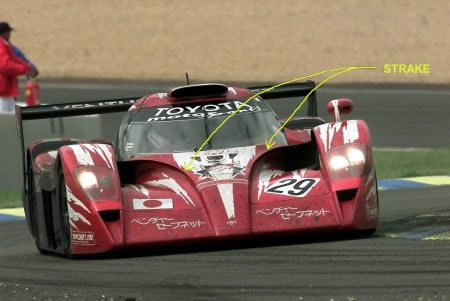
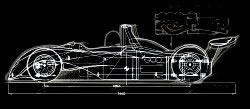
A number of years ago, an analysis was published describing vortex lift and its possible application on the Toyota GT-One. Since that time, conversations with a number of aerodynamicists and email exchanges with Juha Kivekas led to some different conclusions regarding the principle in general and the Toyota GT-One specifically. The original thought was that the Toyota GT-One was utilising the strake detail to generate a vortex that would travel the length of the cockpit and flow under the wing, enhancing the low-pressure side efficiency.
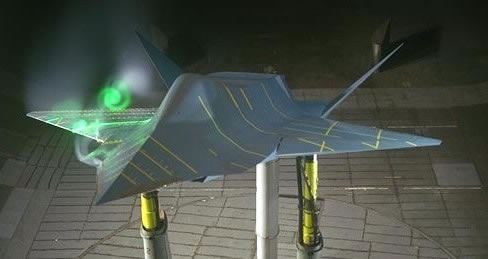
Vortex lift is observed in several applications in aircraft and in nature. This principle is, among other things, what enables insects to fly. Aerodynamic theory states that as an aerodynamic surface gets smaller, it becomes less efficient at generating lift. An insect’s wing generates a vortex on its upper surface (the low-pressure side), which greatly increases the surface’s ability to produce lift.
Modern supersonic combat aircraft use this concept to increase subsonic aerodynamic performance. The strakes near the cockpit of an F-16 or F/A-18 generate vortices that run over the top of the wing, creating more efficient lift by inducing higher speed and therefore lower pressure. However, these vortices are not present in normal flight and are only generated when the aircraft achieves a high angle of attack during manoeuvring or landing. As Juha Kivekas points out, in these conditions the flow stays attached at extreme angles because of the vortex energy mixing phenomenon – or more simply, flow separation is delayed by the rotating vortices mixing the boundary layer flow with the main stream flow, imparting energy to the more stagnant boundary layer.
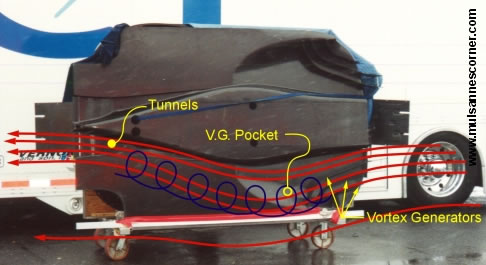
Vortex lift is not unique and is used throughout motorsport, primarily to enhance underbody downforce generation. One problem is that vortices carry an inherent drag penalty that can dramatically reduce their effectiveness, especially when used in the upper-surface flow regime. Vortices are also very fragile and therefore difficult to utilise.
Regarding the Toyota GT-One specifically, the strake is located upstream of a low-pressure area created by the cockpit shape. Any vortex generated would likely be very small to start with and would easily reattach due to that suction point. Furthermore, the vortex length necessary to affect the rear wing would be problematic, as longitudinal vortices burst very quickly. Given the distance and the environment – with various low-pressure areas created by the cockpit and bodywork – it is doubtful that any vortex generated at the front of the car would survive to influence the rear.
|
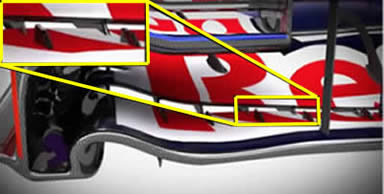
Vortex generators on Red Bull Racing front wing are there to help to regulate vortices and air streams aroud and behind front tires and they can isolate high from the low pressure zones. Picture is from middle of the year 2013. |
Potential for Drag Reduction
Ultimately, vortices could be used for the benefit of upper-surface race car aerodynamics, specifically in drag reduction. As Juha Kivekas summarised: it is certainly possible to use longitudinal vortices to fill the wake of the cockpit bulge. This could be done using delta wings on the sides of the cockpit. Studies on lorries have shown that angled delta wings near the trailing edge of the cab can increase base pressure and reduce drag. The vortices draw energy from the main flow and mix it into the wake flow, reducing the effective length of the wake – or, simply put, reducing drag.
Overhead shot of the Mercedes W09 with six vortex generators on each sidepod