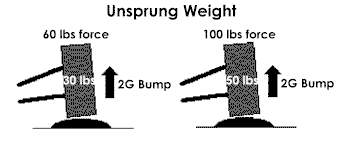
Unsprung Weight
Sprung vs. Unsprung Weight
“Sprung” weight refers to the parts of a car that are supported by the front and rear springs. These components – the vehicle’s frame, body, engine, driver, all liquids, and the powertrain – are suspended above the wheels and represent considerable mass.
“Unsprung” weight includes the wheels and tires, brake assemblies, the rear axle assembly, and other structural members not supported by the springs – essentially, all parts outboard of the suspension springs.
Why Unsprung Weight Matters
Unsprung weight is an important concept. It encompasses weight that is not supported by the car’s suspension, including a proportion of the suspension components themselves, such as control arms, pushrods, and struts. In the case of a Formula One car, the term “semi-sprung” is more accurate than “unsprung” because each tire acts as a spring in its own right.
The Lotus 72: A Pioneering Design
The Lotus 72 was still winning races five years after its launch. It is hard to imagine a time when one of Formula 1’s biggest teams would run the same chassis for six seasons. Between 1970 and 1975, Lotus did just that, winning 20 races, two drivers’ titles, and three constructors’ championships. In all, there were six specifications of the Lotus 72, but the fundamental design remained unchanged throughout. It is one of the most iconic Formula One cars of all time, and its success and longevity are a testament to its brilliant design. Some of the concepts behind the Colin Chapman and Maurice Philippe design were at least two years ahead of their time. Its side-mounted radiators and overhead airbox provided engineering solutions that are still in use on modern F1 cars, and its inboard brakes were a prime example of Lotus’s approach to reducing unsprung weight.
The Physics of Reducing Unsprung Weight
Reducing unsprung weight is the key to improving handling. The lower the unsprung weight, the less work the shocks and springs have to do to keep the tires in contact with the road over bumpy surfaces. Most of these problems are caused by inertia. Greater weight means higher inertia, and higher inertia means a greater workload for the shocks and springs to keep the tires on the ground. If unsprung components have a high mass, they are harder to accelerate and decelerate, making it more difficult for the suspension to maintain consistent tire load.
An easy way to reduce unsprung weight and improve traction on road cars is to replace stock wheels and tires with lightweight magnesium wheels. Note, however, that as wheel diameter or width increases, the weight of the overall wheel-and-tire package increases, thereby increasing unsprung weight.
F1 and racing cars combat high unsprung weight with sophisticated and expensive lightweight materials and extensive engineering effort.