Understeer
What Is Understeer?
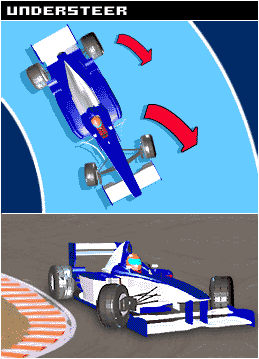
Understeer is the lack of responsiveness of the car’s front end when turning into a corner – the car resists turning. Generally, front-wheel-drive and four-wheel-drive cars exhibit understeering characteristics.
Managing Understeer
The goal is to eliminate understeer and oversteer as much as possible, since both degrade lap times and increase tire wear. In practice, however, a very slightly understeering car is always faster than an oversteering one. Increasing front wing angle on an F1 car that suffers from excessive understeer can reduce the problem, but at the cost of added drag. Similarly, reducing the rear wing angle can lessen understeer, but this also reduces drivability and overall downforce.
Understeer and oversteer problems are best addressed through fine-tuning of the suspension elements or by adjusting the ballast position.
Stability vs. Speed
Oversteer and understeer are fundamental to understanding the way a car corners.
Understeer is inherently stable: once the car reduces speed sufficiently, grip is restored. This is why almost all road cars are set up to understeer at the limit of adhesion. However, understeer also slows the car, which is why Formula One chassis engineers try to avoid it.
Oversteer, by contrast, is highly unstable. Unless a driver corrects it quickly with skilful use of steering and throttle, it can result in a spin. Yet an oversteery chassis helps the driver turn into a corner and, at the limit of adhesion, enables a skilled driver to carry far more speed through a corner than understeer would allow. For this reason, to a greater or lesser extent, all Formula One cars are set up with an oversteer characteristic.