What Is the Most Important Part of a Racing Car?
The Tyre as the Foundation
Michelin’s top engineer reveals some of the secrets of racing rubber and the importance of understanding tyres.
“What is the most important part of a racecar?” asked the university lecturer. “The aerodynamics!” cried one student. “The engine!” cried another. To both responses the lecturer slowly shook his head. “The most important part of a racecar is the tires,” he revealed. An oversimplification perhaps, but true nonetheless. Getting the best out of a given tyre can be the difference between winning and being lapped, and this has never been more true than in the current era of control tyres and spec series. No major open-wheel racing series anywhere in the world allows completely free tyre choice, and in fact the only place teams still have a true choice is in endurance sportscar racing. It is therefore no surprise to find Michelin at its most active in the paddock of a Le Mans Series race, one of the last series to still run many different chassis, engine, and gearbox types, as well as allowing constant development.
Designing Cars Around Tyres
“When we work with a customer chassis manufacturer like Lola or Courage, they don’t ask us to make a special tire for their cars,” explains Michelin’s competition manager for four-wheel activities, Matthieu Bonnardel. “Instead they try to design the car to suit the tires. So they look at what tire sizes we have and get some physical data, then they get data from us on the characteristics of our tires, which will help them optimize the aerodynamic design and the suspension. Then when the car is complete they can bring it to our test track in France where we can gain real understanding of the car’s behavior – the downforce for example. We have a few devices that allow us to take a closer look at what happens on the car, as well as on the tires, and the teams like that.”
Tyre Complexity
One thing sometimes overlooked by chassis designers is that the tyres are a critical part of the machine, not merely something to bolt on and go racing with. Some acknowledge that the sidewall of a tyre has an effect on that corner’s spring rate and damping, but Bonnardel reveals that the situation is far more complicated.
“There are a lot of complex things going on in a tire when it’s running on a track. For example, the tire spring rate does not just depend on the sidewall – that would be too easy. The sidewall construction is a factor, but so are many other things. It can vary with tire type, size, temperature, load, and pressure. It will even change depending on how much camber a car is running. The more you run, the more it leans on the shoulder and that puts more load into the sidewall. A tire that is overloaded has less spring rate than a tire that is not loaded, for example. And finally, spring rate changes with speed, so one tire does not have one spring rate – it has billions of spring rates in the same tire. We know a basic rate and communicate that to our partners, of course, but we also have to communicate the range of different rates and how it changes through various usage of the tire.”
Spring Rate and Design Interaction
Even if spring rate is considered at the design phase, there are numerous other complex interactions to account for, as Bonnardel explains: “Spring rate is just one thing. It gives you a loaded radius, which tells you how high the car will be, so it’s crucial when you design the suspension that you know that figure, though some of that is influenced by other factors too. For example, you need to take into account the expansion of a tire as it changes shape depending on the situation – downforce and car weight try to reduce the tires’ radius, but speed is trying to increase it. In fact these two situations sort of offset each other, because as the speed drops so does the downforce.”
Data Sharing Between Teams and Tyre Makers
Teams also benefit from the tyre developers’ know-how, as they too must consider trade-offs on a race-by-race basis. “When I started to discover the world of tires, I found it very odd and I believed some very stupid things,” says Bonnardel. “For example, when you have a tire with a two metre circumference, I believed that when I rolled through 360 degrees it would have travelled two metres. Of course, if you take the tire on its own it will, but when you load it with 500kg and start again the distance it travels might be 1.8m. I thought, ‘what’s going on here?’ but I soon realized that the rolling circumference changes with load, and that changes with speed by a differing amount depending on the car. The amount it changes is very important for the gearbox, so teams ask us to give them a sheet with all this data on it to help tune the aero and find the right gear ratios.” In fact, this information is so crucial that some teams work directly with track support engineers and tyre companies on maximum lateral force, braking force, and combined forces for simulations.
Optimisation
“Are we active in the design of the car, where the engine goes, what the inertia should be? No. What we do is about optimization,” Bonnardel continues. “We give out ideas about how to optimize the tire, but there’s a lot more factors in making a car go fast – like making sure the downforce is at its maximum. If you did everything to the ideal for the tires and optimized the contact patch you would lose all the downforce, as the car’s floor would pitch around and not generate it so well. But if the team set up the car to keep the ride height perfect the car would be so stiff the driver wouldn’t be able to see and the tire wouldn’t work well, so there’s no point either. There is an optimum point, but normally that is more toward getting the best out of the tires than the aero.”
However, some teams – usually better-funded or works outfits – liaise with tyre makers much earlier. “Some partners involve us from the birth of the project, then ask us how we would like to see the car designed which, in the end, should be the most efficient car possible. Recently I had a meeting with Hughes de Chaunac about the new Courage-Oreca LMP, and we looked at how we could be working to get the tires working at 100 per cent of their potential.”
Whatever the approach, the old adage still holds true: the most important part of a racecar is its tyres.
The Essence of Grip
Michelin engineers explain the basic science behind what makes a tyre stick to the road.
Without grip, endurance cars simply would not work. They would be incapable of going in a straight line, let alone braking. A racing car’s every movement is conditioned by the level of grip generated by its tyres – its only points of contact with the circuit. Polymers, sulphur bonds, moduli, and stress frequency are all matters of routine for the specialists who understand the essence of grip. These are fairly simplistic terms within the realms of an art that often borders on alchemy. Tyres stand on a tread that contains elements of rubber, among other things.
These rubbers are visco-elastic materials (the kind of substance also found in chewing gum), giving them a level of deformability that lies somewhere between a viscous liquid (such as oil) and a flexible solid (like a spring). While a spring changes shape instantly – and proportionally – to an applied force, viscous fluids behave differently: the faster one attempts to drive a piston into an oil-filled cylinder, the greater the resistance. And when pressure is first exerted on the piston, there is a delay before any perceptible movement. The liquid’s viscosity is caused by friction between its constituent molecules.
Tyre Compound Science
Rubber used in the tyre-manufacturing process comprises a blend of polymers – long chains of molecules that spontaneously adopt a spherical form and knit themselves together. To create a tyre, these rubber structures are vulcanised – cured in an oven after the addition of sulphur. The baking process generates numerous sulphur bonds between the polymer chains.
The level of viscosity varies according to the selected polymers (polyisoprene, polybutadiene, butadiene styrene, etc.) and the number of sulphur bonds generated during vulcanisation. Depending on these parameters, the final compound might be relatively soft (giving it a lower “modulus”) or relatively hard (generating a higher modulus).
In order to optimise grip, tyre tread components are designed to combine a median modulus (acceptable suppleness) with maximum viscosity.
For any given compound, these two characteristics vary according to the intensity of the tyre’s workload (the frequency of contact with the track, a corollary of the car’s speed) and the prevailing temperature. These two criteria have directly opposing influences.
If the contact frequency is too high, the rubber compound stiffens (to the point that it becomes brittle) and loses all viscosity. Temperature has the opposite effect: in cool conditions, the compound is stiff and brittle; as the temperature rises, it becomes soft and supple.
There is consequently an inversely proportional relationship between an increase in rubber temperature and a reduction in the frequency of loads to which it is subjected. At low frequencies, increasing the contact by a factor of 10 has the same effect on rubber behaviour as a 7 to 8 degree C drop in temperature. When manufacturing a tyre, it is important to select tread compounds that remain suitably supple and have a higher level of hysteresis according to the workload, characteristics, and ambient temperatures at each circuit.
Grip Mechanisms
A little bit of black magic
Two distinct phenomena govern a tyre tread’s level of grip. The essence of grip lies in two mechanisms that intervene when a tyre is sliding on the track:
Indentation: this is where the tyre deforms as it slides across small bumps in the circuit. The compound’s supple characteristics allow it to mould its shape to accommodate surface imperfections. When the rubber slides on the track, it deforms in a flowing manner (thanks to its viscous properties). Having passed over a bump, the rubber deforms and does not immediately regain its original shape. By dealing with surface fluctuations in a dissymmetrical manner, the tyre builds up a degree of force that counters any tendency to slide.
For this type of indentation to occur, the track must feature small ripples ranging from a few microns to several millimetres in size. Even when it rains, the phenomenon works in exactly the same efficient manner. Grip is a consequence of molecular contact that can be measured to an incredibly small degree – about one hundredth of a micron – and is amplified when a car slides.
Grip is created by molecular interaction at the point of contact between a tyre and the track. When the tyre is moving, part of the tread is physically touching the surface at a given point and its molecules extend until contact is broken. The rubber’s molecular chains are subjected to a constant cycle of extension and release that creates a visco-elastic effect inside the tyre (generated by friction of the molecular chains within the carcass). This can multiply the force of contact by a factor of between 100 and 1,000, depending on ambient temperature and the speed at which the rubber is sliding on the track.
To grip, you need to slide (just a bit).
With each of the aforementioned mechanisms, the reactive forces that govern deformation and molecular liaison would be purely vertical, rather than tangential, if the tyres were not sliding slightly on the track surface. A small degree of sliding must be provoked to generate counter-sliding forces that enable a car to stick to the track. At a microscopic level, these grip phenomena are all the more remarkable when they happen in incredibly short bursts: for a racing car travelling at 300 km/h (186 mph), the molecules within a tyre’s contact patch touch a point on the track for two hundredths of a second. The molecular rubber generates surface grip – that little bit of black magic – at lightning speed.
Key Points to Remember
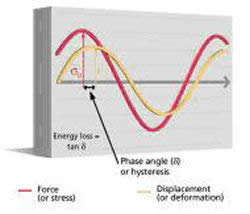
Rubber is a visco-elastic material whose behaviour can be symbolised as a cross between that of a spring and that of a piston. It has reversible deformability but, once its shape has altered in a particular direction, it does not resume its original form until a period of time has passed. This phase differential is accompanied by a loss of energy – a phenomenon known as hysteresis.