Corners and Cornering
To know more, check my cornering technique article.
Forces in a Corner
This section explains why a heavier car corners slower but aerodynamic downforce (pressure between tire and tarmac) helps a car corner faster.
Consider a racing car driving through a corner – for simplicity, a circle. Let V stand for the velocity of the car, R for the radius of the circle, and m for the mass (weight) of the car. Sir Isaac Newton (1642-1727), the British philosopher and mathematician famous for his work on gravity, formulated basic relationships between mass, forces, and the acceleration of bodies that form the foundation of all engineering sciences. Newton showed that if an object turns in a circle, it must be subjected to a force pointing to the centre of the circle (if there were no centripetal force, the object would travel in a straight line). Denoting the centripetal force as Fc, this force is given by:

On a racing car, this force is provided by the tires. The side force that a tire can deliver depends on the tire compound and construction and on how hard it is pressed against the ground. An approximate equation for the maximum frictional force is:

In this equation, the symbol m stands for the friction coefficient between tires and the ground, and N is the normal force on the tires – how hard they are pushed against the ground. In mathematical terms, tires with high grip have a high value of m.
Newton made the extraordinary observation that a body at rest will remain at rest unless some force acts upon it. That is Newton’s First Law of Motion. His Second Law says that a body will accelerate when acted on by a force. The acceleration is larger if the force is larger and smaller if the mass of the body is bigger. The Second Law is represented by the equation:

This reads F equals M times A, where F is the force, M is the mass, and A is the acceleration caused by the force.
For racecars turning corners, race tires generate lateral forces that cause the car to accelerate toward the centre of the arc of the turn. If the mass (M) is moving on a circular arc, A can be expressed as the square of the speed (V squared) divided by the radius of the curve. The equation for Newton’s Second Law then becomes:

The force, Fc, is popularly called the centrifugal force. It is what keeps the string tight when swinging a weight on a string. The force goes up the faster the weight is spun and goes down as the string is made longer. The weight of the car is analogous to the weight on the string, and the tires on a cornering car are the string.
Looking at the equation Fc = MV squared / R and thinking about a car going around a corner: if M gets bigger, Fc has to be bigger for the equation to balance. That means the heavier the car, the more force it takes to hold the car in the arc. The faster the car goes, the bigger V gets and Fc increases for the same arc. A tighter corner means a lower value for R, which means Fc has to be bigger.
This is simply a mathematical expression for what is already intuitive. A lighter car corners faster, and a smaller arc (tight turn) is a slower corner. Cornering force is proportional to the square of the speed: for the same arc, cornering at 60 km/h takes four times the force as 30 km/h (60 times 60 = 3,600, which is four times 30 times 30, or 900).
These equations encapsulate what modern racing is all about. F = M x A, or its arc equivalent Fc = M x V squared / R, dictates the need for a light car with a powerful engine.
Ffric = m x N says that sticky tires, good suspension (to keep the tires in constant contact with the road), and all the downforce that can be generated are essential.
Corner Phases and Types
Corner Phases
Every corner has three distinct phases: corner entry, corner apex, and corner exit. It is vital to recognise each phase per corner when describing the car’s handling characteristics through that corner.
Corner Entry or Turn-in is the point at which the car begins to turn in. “Turn-in” is the broad term given to pointing the car into the corner. Braking usually, but not always, precedes this phase. Sometimes braking is continued into this phase and in specific cases carried through to the following phase. During this phase, weight begins transferring from the inside tires to the outside tires and, because of braking, from the rear to the front tires. This encourages oversteer during the phase, which some drivers use to help make the turn. If braking happens during this phase, the weight transfer is actually more concentrated across a diagonal from the inside rear tire to the outside front tire.
During the Corner Apex phase, also known as the clipping point, the car has reached the midpoint that separates corner entry and corner exit. The apex is the corner’s neutral point, the place where the transition between entry and exit is made. This phase can be very brief, as in the case of a quick kink or chicane, or rather extended, as in long constant-radius corners such as Curve 2 at Brazil’s Interlagos circuit or Turn 13 at the Indianapolis Motor Speedway. During this phase, weight transfer stays relatively steady from front to rear and is concentrated on the outside tires. The corner apex is the slowest part of a corner. Different corners may have different natural apexes, whether early or late (before or after the midpoint of the corner), and individual drivers may also use different apexes according to their personal technique. A late apex can allow power to be applied earlier and can help to “straighten out” the corner.
Corner Exit begins at the point where steering input starts to decrease as the driver unwinds the wheel. This phase is where the driver blends the throttle back in as the steering is progressively wound off, ideally keeping the car right on the edge of the traction circle through an acute sense of balance. Acceleration is usually, but not always, involved in this phase. During this phase, weight transfer begins its restoration back towards the car’s centre of gravity by unloading from the outside tires. The more acceleration is involved, the more this transfer shifts towards the rear, and again a diagonal may be drawn from outside front to inside rear. This continues until the car’s forward travel straightens and the weight equalises to both rears.
Corner Types
I want to list here only some of the most frequent corner types. There are many more of them, and combos of them, but when you want setup to be done properly, you will concentrate on these few basic and most demanding types. By the way, maybe you want to check my article about racing car setup. There you can learn how to setup a car for every type of corner listed here.
Constant radius corner, “Parabolica”, Monza | A constant radius corner is one that has a quick gentle turn-in, a long consistent apex, and a gentle exit. Providing the track is fairly level, setup for the corner can be tackled in a fairly routine manor. As in all corners, how vital it is towards the overall laptime and how many corners like this are on the circuit should be analyzed before determining how much the corner should effect the car setup. | |||
An increasing radius corner is one that features a longer corner exit than corner entry, and is usually accompanied by a small corner apex. In this type of corner, the idea is to brake late and turn in sharp, advancing the corner apex early, then quickly and progressively accelerate for maximum exit speed. Because the corner exit line usually has no reference points, it becomes difficult to judge. Due to the extended corner exit, if one cannot accelerate properly this becomes a section where a relatively large amount of time may be lost. Therefore traction under acceleration is important to minimize time. This is crucially important if the corner exits onto a primary fast straight. | Increasing radius corner, “La Caixa Corner”, Circuit de Catalunya | |||
Decreasing radius corner, Magny-Cours, “180 Degrees” | A decreasing radius corner is indeed one of the most difficult corners to setup for. As you can see from the above picture left, your braking zone follows an arc leading to the late apex. It’s imperative that the car be able to brake deep and turn in simultaneously. A well-honed trail-braking technique will defiantly aid in making the pass here. | |||
A fast esse is typically a combination of two or more corners. At these speeds, aerodynamic balance is a key factor. But probably equally important is the correct line which allows the fastest cumulative sector time. Missing the best line during a phase by just a meter can cost massive time loss as it disrupts the flow for the next phase, or worse yet, the entire following corner. For this reason, frontend steering response is crucial. One also driver must have faith in setup as the speeds traveled here repay mistakes with big spins. | Fast speed esse’s, Nurburgring Nordschleife | |||
Medium speed esse’s, SaoPaolo Brasil," S do Sena" | Like a fast esse, the medium-speed esse is typically a combination of two or more corners. Here, however the springs and dampers are more important than aerodynamics, mainly due to the fact that the car is either increasing or decreasing speed as it traverses these corners. Also a more aggressive driver might use the kerbs here, so damper fast settings become a factor as well. | |||
Chicanes are essentially slow esses, so all of the medium esse characteristics apply here. Also, because the phases happen in rapid succession (do to the overall smaller size of the chicane), car imbalances tend to be magnified at the point of weight shift during the change of direction. Also, the overall slower speeds mean aerodynamics is less of a factor in car balance and mechanical grip has a great deal of influence. Due to the tight nature of most chicanes, riding over kerbs is an acceptable risk. Many times, a chicane will be the slowest corner on a particular circuit. This means it is many times preceded by a heavy braking zone, making it a great point to fine-tuning the braking bias. As this makes the chicane a prime overtaking location, focus should be given to car setup through the preceding corner as to allow the most efficient exit. This will, in turn give the car maximum speed on the previous straight leading to the chicane, making overtaking much easier. | Chicane, Spa Frankorschamps, Belgium," Bus stop chicane" | |||
Hairpin Magny Cours “Adelaide corner” | Hairpin corners stress the cars braking capabilities to their maximum. Typically, the car is being coaxed into slowing from top speed down to anywhere from 60kmh to 100kmh. Good front-end grip is essential to allow a driver to be competitive here, particularly when passing. The turn-in comes early and the short apex is at the middle of the inside kerb. While qualifying the line will vary. The braking will be kept to as late as possible (allowing the car to travel at top speed a few hundredths on a second longer), followed by a late turn-in. This will shift the apex back later in the turn (the skid marks represent a good fast line). By moving the apex later, the radius of the exit is lessened, allowing power to be applied sooner and more importantly, at a more aggressive rate. | |||
From time to time, two successive corners will line up in such a way that it enables a driver to attack them both as a single corner. This means the first corners’ exit (phase 3) and the second corners’ entry (phase 1) become essentially both corners phase 2, or the overall corner apex. In this instance, the 2nd phase is rather large and may contain some throttle adjustments. The car must be set to allow mid-corner throttle adjustments to not effect the car in a negative way. Because of these things, these types of corners have the same characteristics of the constant radius corner. | Double apex corner, Sepang, turns 7 & 8 | |||
Apex
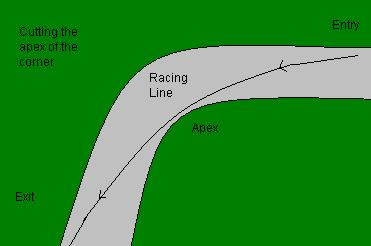
The apex is the middle point of the inside line around a corner at which drivers aim their cars. At this point, the car comes closest to the inside edge of the track. At the apex, the driver stops entering and starts exiting the corner. This is considered the ideal racing line.
On-Camber and Off-Camber Corners
On-Camber and Off-Camber corner
|
|
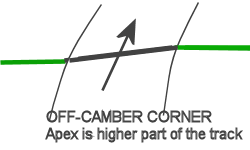
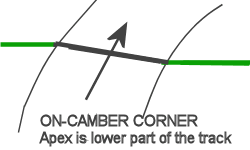
To visualise track camber, think of an oval racing track with banking towards the inside to aid cornering. An opposite track angle, away from the inside radius of the corner, is known as “off-camber” or “adverse camber”. Part of what engineers and drivers take note of during track walks on setup day is identifying which corners are off-camber and to what degree. Several Abu Dhabi Yas Marina track corners are off-camber, while banked corners like those on most American speedway tracks are examples of on-camber corners.
Monaco Grand Hotel Hairpin |
|
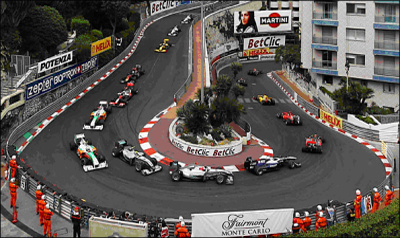
Kerbs
Kerbs
Raised kerbstones line corners or chicanes on racing tracks. The kerbs provide additional safety, as drivers must reduce their speed when driving over them.
Kerbs - rumble strips | Kerbs |
Kerbs - rumble strips |
Traction and Grip in Corners
Cornering is vital to the business of racing cars, and Formula One is no exception.
The most important concept is the traction circle. The tires of a racing car have only a finite amount of grip to deliver. This can be the longitudinal grip of braking and acceleration, the lateral grip of cornering, or – most likely in bends – a combination of the two.
Racing drivers overlap the different phases of braking, turning, and applying power to try to make the tire work as hard as possible for as long as possible. It is the skilful exploitation of this overlap – releasing the brakes and feeding in the throttle to just the right degree not to exceed available grip – that makes the best use of the traction circle. The very best drivers are those who can extract the maximum amount from the tires for as long as possible.
Oversteer and understeer are vital to understanding the way a car corners.
Understeer is inherently stable: once the car reduces speed sufficiently, grip will be restored, which is why almost all road cars are set up to understeer at the limit of adhesion. But it also slows the car down, which is why Formula One chassis engineers try to avoid it. Oversteer is, by contrast, highly unstable. Unless a driver acts to correct it quickly with skilful use of steering and throttle, it can result in a spin. But an “oversteery” chassis helps the driver turn into a corner and, at the limit of adhesion, enables a skilled driver to carry far more speed through a corner than understeer would allow. This is why, to a greater or lesser extent, all Formula One cars are set up with an oversteer characteristic.
Corner Naming Conventions
The naming of corners on racetracks is handled differently at many circuits. At Catalunya and the Nurburgring, the corners are named after sponsors. At Magny-Cours, they are named after other circuits. At many other circuits, they are named after locations that existed before the circuit was built. Albert Park in Melbourne is one of the circuits that has named most corners after drivers – specifically, retired multiple World Champions.
A quick scan of some circuits gives the following drivers after whom corners have been named:
Ayrton Senna - 3 (Interlagos, Montreal, Hockenheim)
Alberto Ascari - 2 (Albert Park, Monza)
Niki Lauda - 1 (Albert Park)
Jim Clark - 2 (Albert Park, Hockenheim)
Jack Brabham - 1 (Albert Park)
Alan Jones - 1 (Albert Park)
Graham Hill - 1 (Albert Park)
Jackie Stewart - 1 (Albert Park)
Alain Prost - 1 (Albert Park)
Gilles Villeneuve - 1 (Imola)
Michael Schumacher - 1 (Nurburgring)
Michael Schumacher - 1 (Bahrain International Circuit) (in 2014, after his accident, to honour him and the input he gave in the construction of the circuit).
Check out the article “Mosley’s Equation”