Traction Circle
Tire Loading and Camber
To control the car’s handling, one must control the tire’s contact with the ground. There are two main elements that affect the tire’s contact with the ground: tire loading and camber.
The Concept
The traction circle is a way of thinking about the grip that a particular tire has on the road – how much of it there is and how it can be used.
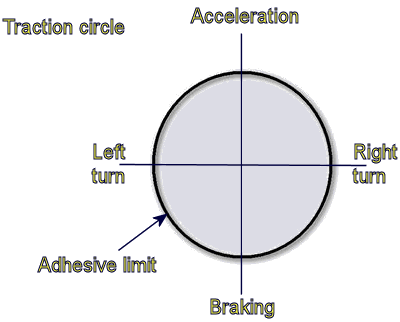
Tires will always provide a given amount of traction. The tire does not care in what direction the force is applied. It only has a given amount of traction. In the picture above, a circle is shown with an x-axis and y-axis running through the centre. The edges of the circle denote 100% utilisation. The x-axis represents lateral grip (or cornering grip), and the y-axis represents longitudinal grip (or braking/accelerating grip). The area within the circle represents the domain of the tire’s grip. Points inside the circle are possible combinations of acceleration, braking, and turning; points outside cause the tire to lose grip and slide. In technical terms, this is a vector whose magnitude is always less than 1.
The traction circle teaches the basics of tire grip – the essential limiting factor in performance driving. Within the traction circle, a driver can be turning left, turning right, accelerating, braking, or any combination of these. The important lesson the traction circle illustrates is that turning and speeding up or slowing down can be combined, but the less of one being done, the more grip is available for the other. This also explains why cornering technique generally calls for braking first, then turning, then accelerating, rather than braking through the turn or accelerating through it. The full radius of the circle is 1 unit, equal to 100% of the adhesion limit of the tire.
The Mathematics
Traction circle
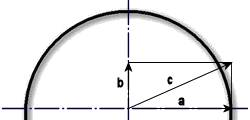
The diagram helps illustrate the given amount of traction as a circle where force “a” represents a side force (the centrifugal, cornering force) and force “b” represents acceleration or braking force, but the tire will only handle a given amount of force represented by “c.” The circumference of this circle represents the given amount of tire traction – 0.8 g or 1.1 g, etc. The point is that the tire will only handle a given amount of traction, which is the sum of braking (or acceleration) and side force. This can be proven mathematically using the Pythagorean Theorem. Drawing a right triangle with the horizontal leg representing lateral (turning) acceleration and the vertical leg representing acceleration/braking force, the hypotenuse can be found using the theorem. If too much acceleration is applied or the car turns at too high a speed, the tires will skid.
This is how force a and b are summed together to find the overall force c.
Equation for Traction Circle:

In real situations, a traction circle may be less than a perfect circle, and flattened at one or more axes. For example, a rally car tends to oversteer, so the lower end of the circle may be only 0.8 units from the centre. Or the tire could have slightly more side grip versus forward grip, or vice versa. But the summing of “a” and “b” to get “c” will still be done as explained above.
Adjusting the Traction Circle
This given amount of traction is altered by adjusting car settings. Tire loads and camber are just two of the things that can be changed to affect the available traction. The amount of traction is also altered by changes in tire compound, tire treads, track surfaces, and other factors. But it will always be a given amount of traction at any moment in time. When the given amount of traction “c” is exceeded by the forces acting on the tire, the available traction drops – the size of the circle grows smaller quickly. On asphalt, a thin layer of the tire melts because of the friction, and this layer then acts as a lubricant for the tire to slip on. On dirt, the tire’s surface breaks up the dirt of the track, and this loose dirt acts like bearings for the tire to slip on. On either surface, the given amount of traction decreases the moment it is exceeded.
Practical Examples
For example, consider driving a four-wheel-drive car through a corner at the car’s maximum cornering force. The throttle is positioned so that the car is coasting.
Question: What can be done to the throttle to make the car go faster while maintaining the same radius?
Answer: Nothing. Whatever is done to the throttle will cause the tires to break loose. The figure below shows “a” as the maximum cornering power, because it extends to the circle. The modified throttle position is shown by line “b,” which sums with “a” to make force “c” – clearly outside the circle. Therefore, the tire slips.
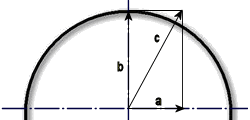
Here is another example. A two-wheel-drive car is travelling down a straight. The car is accelerating at the maximum grip the tires will hold, so the acceleration force extends to the circle.
Question: How much steering can be applied?
Answer: None. Whatever is done to the steering will make the tires break loose. The figure below shows “b” as the maximum acceleration force, because it extends to the circle. The modified steering position is shown by line “a,” which sums with “b” to make force “c” – clearly outside the circle. Therefore, the tire slips. The car will spin nearly instantly.
Racing Application
Of course, the best strategy is to follow very closely to the edge of the traction circle at all times so as not to be taken off guard by sudden changes, though this risks being passed by someone using 98% of their grip. Traction becomes an issue when following behind someone, as the following car will most likely be forced into the line the leading car chooses, so outbraking and pushing the car becomes the strategy to pass. However, because the difference between 100% and 95% is never more than a few seconds at the end of a race, it is more important to focus on cutting good racing lines and following the track than to focus on pushing the car to the 100% limit of grip.
Related Articles
For a complete picture of performance driving, take a look at Corners, Setup, Using tires, Left foot braking, braking, advanced braking, WRC braking technique, Slipstreaming, drifting, cornering, shifting, Heel and toe driving technique and steering technique articles