Traction
Definition
Traction is defined as adhesive friction – another name for static friction (non-sliding friction). Specifically, traction refers to the maximum static friction that can be produced between two surfaces without slipping.
In the design of cars, higher traction between wheel and ground is generally more desirable than lower traction, as it allows better acceleration, cornering, and braking without wheel slippage, giving the driver more control over the vehicle. One exception in racing is the motorsport called “Drifting,” in which rear-wheel traction is purposely lost during high-speed cornering. Higher traction also allows for steeper ground inclines without wheel slippage, whether the vehicle is moving or is parked.
Factors Affecting Traction
In simple terms, traction can be defined as the maximum amount of torque force the tire can apply against the ground (or that the ground can apply against the tire – they are the same thing). The following factors affect traction:
Weight on the tire – The more weight on a tire, the more traction it has. Weight always shifts as a car drives. For instance, when a car makes a turn, weight shifts to the outside wheels. When it accelerates, weight shifts to the rear wheels.
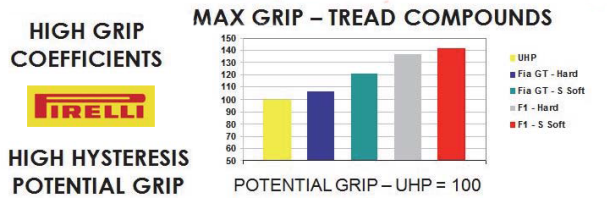
Coefficient of friction – This factor relates the amount of friction force between two surfaces to the force holding the two surfaces together. In this case, it relates the amount of traction between the tires and the road to the weight resting on each tire. The coefficient of friction depends mostly on the tire compounds on the car and the type of surface the vehicle is driving on. A harder tire is more durable but gives less traction, and a softer tire gives more traction but is less durable. A racing car slick tire has a very high coefficient of friction when driving on dry tarmac. That is one of the reasons why race cars can corner at such high speeds. The coefficient of friction for that same tire in mud would be almost zero. By contrast, huge, knobby, off-road tires would not have as high a coefficient of friction on a racing track, but in the mud, their coefficient of friction is extremely high.
Wheel slip – There are two kinds of contact that tires can make with the road: static and dynamic.
relative to each other. The coefficient of friction for static contact is higher than for dynamic contact, so static contact provides better traction.
- Dynamic contact - The tire is slipping relative to the road. The coefficient of friction for dynamic contact is lower, so you have less traction.
|
Comparing potential tyre grip for Ultra High Performance, FIA GT and F1 cars.(courtesy of Pirelli Motorsport Services Ltd., courtesy of Willem Toet, Head of Aerodynamics, Sauber F1 Team, Sauber Motorsport AG) |
Wheel Slip
Wheel slip occurs when the torque force applied to a tire exceeds the traction available to that tire. Force is applied to the tire in two ways:
Longitudinally – Longitudinal force comes from the torque applied to the tire by the engine or by the brakes. It tends to either accelerate or decelerate the car.
Laterally – Lateral force is created when the car drives around a curve. It takes force to make a car change direction – ultimately, the tires and the ground provide the lateral force.
Consider a fairly powerful rear-wheel-drive car being driven around a curve on a wet road. The tires have plenty of traction to apply the lateral force needed to keep the car on the road as it goes around the curve. If the throttle is floored mid-corner, the engine sends much more torque to the wheels, producing a large amount of longitudinal force. If the sum of the longitudinal force (produced by the engine) and the lateral force (created by the turn) exceeds the traction circle available, wheel slip occurs.
Most everyday drivers do not come close to exceeding available traction on dry pavement, or even on flat, wet pavement.
Four-Wheel Drive and Traction
Four-wheel or all-wheel-drive systems are most useful in low-traction situations, such as in snow and on slippery hills. The benefit of four-wheel drive is straightforward: by driving four wheels instead of two, there is the potential to double the amount of longitudinal force that the tires apply to the ground.
This can help in a variety of situations:
In snow – It takes a lot of force to push a car through snow. Each tire has only a small amount of traction in snow. A four-wheel-drive car can utilise this limited traction of all four tires.
Off road – In off-road conditions, it is fairly common for at least one set of tires to be in a low-traction situation. With four-wheel drive, the other set of tires still has traction.
Climbing slippery hills – This requires a lot of traction. A four-wheel-drive car can utilise the traction of all four tires.
There are also situations in which four-wheel drive provides no advantage over two-wheel drive. Most notably, four-wheel-drive systems do not help with stopping on slippery surfaces. Braking is entirely up to the brakes and the anti-lock braking system (ABS).
Slip Percentages
Whenever a torque is applied to a wheel (whether braking or accelerating), the wheel slips slightly. In a road car, peak acceleration occurs at around 17-18% slip. This means the wheel is turning that much faster than the road surface is passing underneath it. Even acceleration at traffic speeds exhibits some slip (approximately 0.5%). While static friction might be “stronger” than dynamic friction, any torque applied to the wheel means that the surfaces will be experiencing dynamic friction. There is no such thing as no slip with acceleration.
In a rear-wheel-drive car, if wheel speed is monitored on a test bench under acceleration conditions, the rear wheels will always be turning faster. The faster the acceleration, the bigger this difference will be. Once the difference reaches approximately 17-18% (on dry asphalt), acceleration will begin to decline.
Differentials and Traction
Differentials and Traction
The open differential always applies the same amount of torque to each wheel.
There are two factors that determine how much torque can be applied to the wheels: equipment and traction. In dry conditions, when there is plenty of traction, the amount of torque applied to the wheels is limited by the engine and gearing. In a low-traction situation, such as driving on a wet road or ice, the amount of torque is limited to the greatest amount that will not cause a wheel to slip under those conditions. Even though a car may be capable of producing more torque, there needs to be enough traction to transmit that torque to the ground. If more throttle is applied after the wheels start to slip, the wheels will just spin faster.
Torque, Traction, and Wheel Slip
Torque, Traction and Wheel Slip
Torque is the twisting force that the engine produces. The torque from the engine is what moves the car. The various gears in the transmission and differential multiply the torque and split it between the wheels. More torque can be sent to the wheels in first gear than in fifth gear because first gear has a larger gear ratio by which to multiply the torque.
The interesting thing about torque is that in low-traction situations, the maximum amount of torque that can be transmitted is determined by the amount of traction, not by the engine. Even with a racing engine in the car, if the tires will not stick to the ground, there is simply no way to harness that power.
Related Articles
See the article on the Traction Circle for more detail.