Torsion Bar
Torsion Bars vs. Coil Springs
Most racing car suspension systems are similar, but they take two forms. The first is the traditional coil spring setup, common in most modern cars. The second is the torsion bar setup. A torsion bar does the same job as a spring but is more compact. Both forms of suspension system are mounted on the chassis above and in front of the driver’s legs at the front of the car, and on top of the gearbox at the rear. Torsion bars are now used in all Formula 1 cars.
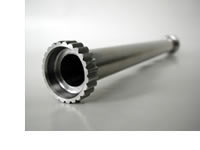
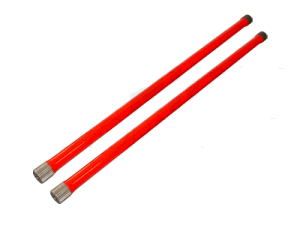
A torsion bar is in fact a tube or bar that acts as a spring, replacing the conventional coil spring. Torsion bars are made of metal (generally a form of steel) with short splined ends to connect to the rocker on one end and the chassis on the other. Where a coil spring provides stiffness when compressed, a torsion bar provides stiffness when twisted. The rate of stiffness depends on the material, length, and inner/outer shaft diameters.
|
|
|
Effect on Handling
The springs or torsion bars are the parts of the suspension that actually absorb bumps. In simple terms, the softer the suspension on the car, the quicker it will travel through a corner. However, this has the adverse effect of making the car less sensitive to driver input, causing sloppy handling. A harder-sprung car will have less mechanical grip through the corner, but the handling will be more sensitive and more direct – ideal for circuits such as Monaco where drivers must be inch-perfect between the barriers.
Torsion bar in gray color
Front Mounting
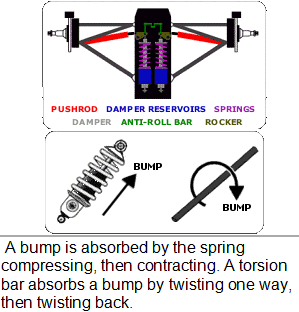
On the front, torsion bars are almost always mounted along the car, one for each side of the suspension. The springing motion is provided by the metal bar’s resistance to twisting. In the typical torsion bar pushrod setup described in the picture above, the torsion bars pass through the centre of the rockers and fix to the front of the chassis. The rocker pivots on the torsion bar. The push rod pushes the rocker and twists the torsion bar to provide the spring in the suspension; the rocker then compresses the damper and operates the antiroll bar if the car is in roll.
F1 dampers and torsion bars are made by specialist companies like Eibach, Koni, and Sachs, with springs often designed in part by the F1 teams to suit certain characteristics.
Audi R15 Example
Sebring 2009, LMP1 Prototype Audi R15’s horizontally mounted torsion bars in red circles, and the electronic power steering unit in blue circle
Mike Callahan, of the ALMS spotter’s guide, provided a look at the Audi R15’s front end. The horizontally mounted torsion bars (red circles) and the electronic power steering unit (blue circle) are visible. Front suspension members are individually shrouded as they are at the rear. Brake ducting is via upright-mounted backing plates with ducts mounted to the backing plates. The layout is similar to Formula 1 front suspension.
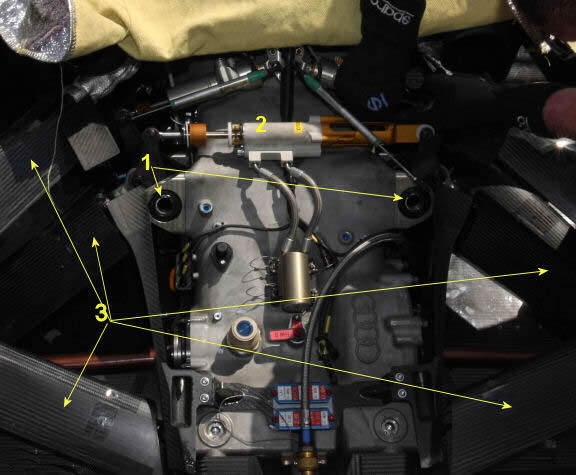
Numbered as 1 you can se rear vertically mounted torsion bars on Audi R15, with Number 2 horizontally mounted third damper, and with number 3 suspension members, similar as in Formula 1 car
The R15’s rear suspension is somewhat similar in general layout to the older R10’s. The near-vertical torsion bars (1), the through-shaft “3rd-spring” damper on top (2), and all rear suspension members (3) made of carbon fibre are visible. The duct ahead of the rear wheel draws air into this area of the car and out the back to reduce base drag. The shrouded suspension members help to streamline the airflow through the duct. The sides of the gearbox appear to be shrouded as well to reduce internal drag. The layout is similar to Formula 1 rear suspension.