Toe
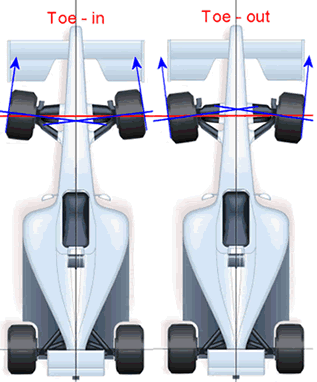
| /--\ = positive toe / Toe In (view from Top of car) --/ = negative toe / Toe Out (view from Top of car) |
How Toe Affects Handling
Positive toe on the rear wheels reduces oversteer because the wheels are angled inward (/–\ when viewed from above). This is beneficial for corners but reduces acceleration on exits and straights because there is less tire contact with the ground compared to zero toe (|–|).
As with most suspension settings, there is a compromise involved.
The Physics of Toe
Looking at the diagram above, when going around a left-hand corner, the weight of the car shifts to the right-side tires. Negative front toe makes the car turn more sharply to the left, while positive rear toe swings the rear further out to the right, making the car point into the left-hand corner.
Toe and Tire Wear
The compromise of correcting understeer or oversteer using toe adjustments is that tire wear will increase. There is always a trade-off in every adjustment. Engineers always try to reduce oversteer and understeer using adjustments to springs, shocks, stabilisers, and wings first. Toe adjustments should be considered a last resort, since any toe value added will increase tire wear.
Measuring Toe
The amount of toe can be expressed in degrees as the angle to which the wheels are out of parallel, or more commonly, as the difference between the track widths measured at the leading and trailing edges of the tires or wheels. Toe settings affect three major areas of performance: tire wear, straight-line stability, and corner entry handling characteristics.
Toe-In (Positive Toe)
For minimum tire wear and power loss, the wheels on a given axle should point directly ahead when the car is running in a straight line. Excessive toe-in or toe-out causes the tires to scrub, since they are always turned relative to the direction of travel. Too much toe-in causes accelerated wear at the outboard edges of the tires, while too much toe-out causes wear at the inboard edges. So if minimum tire wear and power loss are achieved with zero toe, why have any toe angle at all? The answer is that toe settings have a major impact on directional stability.
Positive toe permits both wheels to constantly generate force against one another, which reduces turning ability. However, positive toe creates more stable straight-line driving characteristics.
Toe-Out (Negative Toe)
Negative toe is often used in front-wheel-drive vehicles for the opposite reason. Their suspension arms pull slightly inward, so a slight negative toe compensates for the drag and levels out the wheels at speed. Negative toe increases a car’s cornering ability. When the vehicle begins to turn into a corner, the inner wheel is angled more aggressively. Since its turning radius is smaller than the outer wheel due to the angle, it pulls the car in that direction. Negative toe decreases straight-line stability as a result – any slight change in direction will cause the car to veer towards one side or the other.