Fuel Thermal Efficiency
What Is Thermal Efficiency?
Thermal efficiency is a way to measure the efficiency of an internal combustion engine. Internal combustion engines in general are inherently inefficient, and even advanced modern F1 engines are no exception. They are very inefficient when it comes to converting the power available from the fuel/air mixture into power at the rear wheels.
For an F1 engine before the 2014 technical rules change, this value was typically around and below 30%. This means that if a typical F1 engine produced slightly under 560 kW (approximately 750 bhp) on the dyno, something like 1,500 kW (or potentially 2,000 bhp) of energy was lost, mainly through heat.
After the 2014 rule change, the figure of 30% improved dramatically, going from the old naturally aspirated 2.4-litre V8 engines at about 30% thermal efficiency to 40% with the new 1.6-litre V6 engines – a huge step forward.
The Push Beyond 50%
After 2015, the technology advanced the efficiency of engines to 47%, producing historic highs of power – and all with an ICE restricted to consuming fuel at a rate of just 100 kg/hr, meaning that close to 50% of the potential power that can be derived from a unit of petrol was being converted.
The goal is 100%, but that remains far in the distance. At the outset of the internal combustion engine, efficiency of 12% was standard. Over 130 years, that improved to 29%, which is where F1 V8 engines were in 2013. In the period since then, it has risen to approximately 50%.
The turbo-hybrid V6 power units introduced into F1 in 2014 are masterpieces of technology that have produced a revolutionary step forward. In 130 years, efficiency increased from 12% to 29%, a yearly increase of 0.68%. In the first three years of these new power units, efficiency increased to near 50%. That means the rate of progress with regards to efficiency has been over 98% faster since F1 engineers have been involved.
Mercedes Power Unit Performance
Mercedes has dominated Formula One since the introduction of the current regulations in 2014, and for most of that period has held a significant power advantage over its rivals. Andy Cowell, Mercedes engine boss, explained that the current 1.6-litre V6 turbo hybrid is now producing more power than the 3.0-litre V10 Mercedes engine of 2005, in excess of 900 bhp, and stated there is no reason to believe its development rate will slow in the next few years.
Cowell revealed that the Mercedes power unit achieves more than 45% and close to 50% thermal efficiency – meaning 45-50% of the potential energy in the fuel is delivered to the crankshaft – and efficiency of more than 50% when the ERS is operating at full power.
By comparison, the V8 engines pre-2014 achieved thermal efficiency of 29%, and the first iteration of the Mercedes V6 turbo in 2014 managed 40% thermal efficiency.
Benchmarks for Thermal Efficiency
Generally speaking, to find peak efficiency in an internal combustion engine, one would look at diesel engines on huge ships that work at around 100 rpm. They are so slow that they have very little friction, and they are so steady in the way they operate that they can be set up and optimised to work on one cycle for optimum efficiency. These purpose-built engines work continuously without anyone touching them, and they have large heat recovery plants. That is the benchmark for a thermally efficient internal combustion engine.
Recovering Energy from Exhaust
Energy lost through exhaust constitutes a very important source of energy to tap into in order to increase efficiency and hence the power output of the engine. To make engines more energy-efficient and more relevant to the production car industry, the FIA and the engine manufacturers agreed to change the engine format for 2014 and beyond. The configuration agreed upon is a 1,600 cc V-90-degree 6-cylinder engine with a rev limit of 15,000 rpm. With the desire to keep power levels similar to the 2013-spec engines, turbocharging and energy recovery systems are permitted. These engines are among the most impressive in the history of the industry, with unheard-of thermal efficiency figures and impressive horsepower numbers for the amounts of fuel used. To learn more about the 2014 Power Units, see the article here.
Adopting such technology in Formula One has gone a long way to enhance the green credentials of motorsport and develop technology that is beneficial in road car applications.
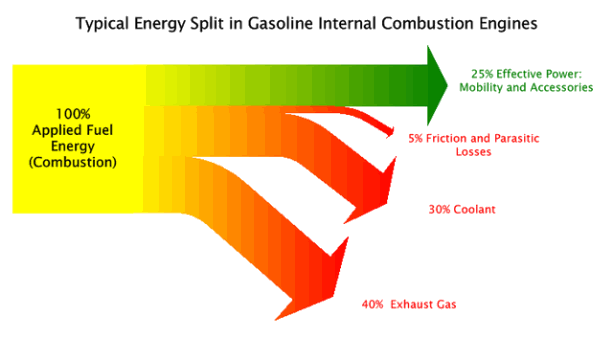
This picture and energy path is for modern gasoline road cars. F1 car is about 25% more effective! (green part of diagram).
Where the Energy Goes
For example, lubrication oil heat dissipates around 120 kW of energy, the water cooling system around 160 kW, and the hydraulics around 30 kW.
30% of the remaining lost energy is lost through exhaust and heat, while up to 10% of the available energy can be accounted for by unburnt fuel. A small percentage is converted into the distinctive sound of an F1 car. Noise is, by definition, wasted energy, and the whole point of hybrid engines is to regenerate as much of what would traditionally be wasted energy as possible.
Cooling Challenges
To dissipate this heat into the surrounding air is a real challenge for designers. While the heat exchangers on a racing car are extremely efficient, their ability to cool the engine is a function of the “air-side capacity” – essentially, how large a mass of air can be made to flow through the radiator for a given area at a given moment. This depends on generating high air velocities in the radiator intake ducts. However, air velocity in the radiator ducts (sidepods of an F1 car) will typically be only 10-15% of the car’s velocity. So even if the car is travelling at 300 km/h, the air in the ducts is probably only at 30-40 km/h.
If designers make cooling duct intake openings too large, that will improve cooling but will add to drag. If they are too small, overheating will be a problem. The correct balance between cooling and aero performance must be found, because the more air channelled through the radiators, the less efficient the overall aerodynamics become. More air through the radiators means less air remains for the underfloor, diffuser, and rear wings to work with.
Internal aerodynamics cannot be made as clean and efficient as external aerodynamics. In fact, changing between minimum and maximum cooling can reduce downforce by as much as 5%, which translates to a lap-time deficit of around 0.4 seconds on an average circuit. Because the air inlet is defined mostly during the early stages of designing an F1 car and cannot be changed easily during the season (the air inlet is often designed as part of the side impact area), airflow passing through the sidepods is controlled by different configurations of radiator outlet, and the F1 car has many possible configurations to cope with all kinds of conditions. The configuration used at a particular circuit is defined according to ambient temperatures, circuit factors such as full-throttle percentage, and the temperature limits for the engine.
Operating Temperatures
Typically, oil temperature is around and above 100 degrees Celsius, and water is pressurised at 3.75 bar (limited by the FIA) to allow the boiling point to be pushed to around 120 degrees Celsius. Running these higher water temperatures means that less airflow through the radiators is required, and in this way aerodynamic performance can be improved.
This choice carries a penalty: each extra 5 degrees Celsius of water temperature run, allowing the radiator outlets to be smaller, robs the engine of over 1 bhp. However, the importance of aerodynamics in modern F1 means teams continue devoting significant resources and wind tunnel time to cooling and internal aerodynamics. The penalty in terms of aero efficiency for a 10 degree Celsius drop in car temperatures is 80% smaller than it was just four years ago. This proves that internal aerodynamics of an F1 car are as important as external aerodynamics – they are simply not visible to the viewer.
The Hybrid Technologies
After the 2014 engine formula change, two separate hybrid technologies are used in F1 engines. One recovers energy from the rear axle during braking, stores it in a battery, and reapplies it under acceleration. The second, completely new technology recovers energy from the turbocharger shaft and is used for two purposes: it can be applied directly to the rear wheels to boost acceleration, and it can be used to spin up the turbocharger so that immediate boost is available as soon as the driver presses the accelerator. This almost completely eradicates the delayed throttle response inherent in turbocharged engines, known as “turbo lag.” This is where F1 engines are most road-relevant.
Combining these two hybrid technologies means F1 engines now have a thermal efficiency of more than 40% – better than a road-going diesel engine.