Racing Car Suspension
The Role of Suspension
Good handling on the road depends on more than a car’s steering system. The steering works hand in hand with the suspension and tires to create a smooth ride and reliable steering. The suspension acts to improve a car’s ride and handling. Since the first days of motor racing, suspension has been a means to control the tire on the track, and considerable clever geometry and science can predict how this should be done best.
The suspension has several components that work together to accomplish these goals: the frame, springs, and dampers (shock absorbers).
Sprung and Unsprung Mass
The frame is the rigid structure that supports the main weight of the car. This part of the car is referred to as the sprung mass because it rests on springs. These springs absorb the increased vertical velocity of the wheels as they travel over bumps. The unsprung mass is the weight of the car below the frame: wheels, tires, axles, suspension arms, brakes, and so on.
The stiffness of the springs affects the performance of the vehicle. If a car is loosely sprung, it will easily absorb bumps in the road, providing a very smooth ride. However, the handling will not be as good, as the vehicle body will be prone to moving forward, backward, and side to side. Tightly sprung cars, while offering bumpy rides, manoeuvre more effectively. Car manufacturers aim to find a balance between these qualities.
Springs absorb energy easily; however, they do not dissipate it well. As
soon as a compressed spring is released, it snaps back in the reverse direction and continues to oscillate until all the energy has been dissipated. If suspensions relied entirely on springs, the ride would be very bumpy and uncontrollable.
Dampers (Shock Absorbers)
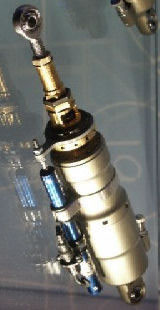
To account for this, springs are usually paired with dampers, or shock absorbers. These devices use hydraulics to turn kinetic energy (motion) into thermal energy (heat). This way, the energy stored in the spring dissipates quickly, without causing unnecessary motion in the body of the car.
A typical shock absorber is, in essence, a piston inside an oil-filled tube. The piston is attached to a casing, which is in turn attached to the spring. As the spring moves, it pushes the piston up or down, compressing the oil inside the pressure tube. Tiny valved perforations in the pressure tube allow the oil to slowly escape into the reserve cylinder. The system is designed to provide enough resistance to absorb all of the energy from the spring without moving too much.
Independent Suspension Types
Today, all modern cars use independent suspensions, in which the wheels are each allowed to move on their own. If both the front and back wheels use an independent suspension, the car has four-wheel independent suspension. One of the most common designs for front suspension is the McPherson strut, named after its inventor, Earle S. McPherson of General Motors. Invented in 1947, this design is still common today.
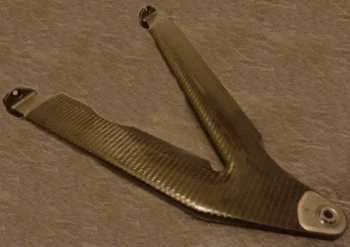
Another common design is the double-wishbone or double-A-arm suspension. In this design, two wishbone (Y-shaped) supports are attached to each wheel, joining the wheel at one point and the frame at two points.
Each of these basic designs has been modified in a number of different ways to produce a range of suspension options. All of these designs, however, employ the same basic principles to produce a safe and comfortable ride.
Double-Wishbone Suspension in F1
From the early 1960s to the present day, virtually all serious racing cars have used the classic double-wishbone suspension arrangement or a close variation.
This type of suspension has the advantages of light weight, impressive strength, and a well-controlled ride. The purpose of an F1 car’s suspension is to keep all four wheels glued to the track despite aberrations in the pavement. A racing car’s suspension also has to be lightweight, compact and, in any serious open-wheel racing class, aerodynamically well designed.
F1 cars operate substantially similar suspension front and rear; the packaging varies at each end, but the main components are the same.
| 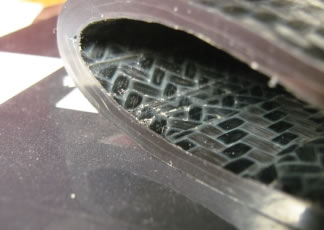 |
Cutout of one of suspension arms. To make it lighter, arm is hollow and trough the “tube” designers can now pass different auxiliary control wires and everything needed around brakes and wheels. |
Aerodynamic Considerations
An F1 car has a very small degree of suspension travel compared to a road car. Its purposes are not just to make the car ride well over bumps, but to improve traction and aid aerodynamic performance. Aerodynamics play a huge role in Formula 1, and all external parts of the suspension are designed by aerodynamicists, since the wake of air coming off them has such an important role in airflow management. The suspension must handle huge aerodynamic loads from the car body and hold the chassis at the correct height relative to the track to harvest every last bit of downforce. Because of these huge loads, elements are made of carbon fibre composites. If a constant ride height can be maintained, the car’s aerodynamics work better. That is why Mercedes AMG F1 and Lotus F1 introduced the FRIC (Front and Rear Inter-Connected) suspension system, which helped the Lotus E21 and Mercedes W04 to be competitive during the 2013 season.
Loads on the Suspension
Racing drivers brake deep into the corner, and it is generally in these combined conditions (braking and steering) that the highest loads occur. Add bumps into the equation and loads can approach 30 tonnes. Suspensions must handle these loads repeatedly without failure. A suspension designer can influence how these loads are distributed through the various legs of the wishbone. Unfortunately, geometry that favours aerodynamics rarely presents good geometry from a load point of view. In performance terms, rigidity is equally important. There is no sense in spending months and millions of dollars to ensure perfect geometry, only to have flexing of some part of the system throw the ideal geometry far from the desired values.
Front Suspension
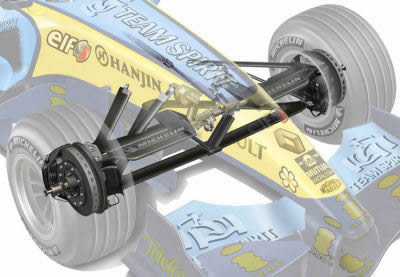
The front suspension consists of two triangular supports (wishbones) that mount to the front hubs. The springs and shocks, as well as the equivalent of the anti-roll bar, are all mounted inside the nose cone, just in front of the driver’s legs.
Rear Suspension
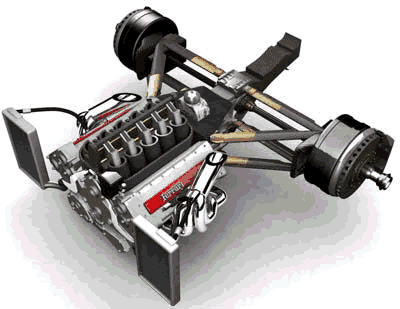
The rear suspension is similar to the front by design. The main differences are the lack of the steering mechanism, the addition of the driveshaft, and the greater weight that the rear suspension must carry. The springs and shocks follow an arrangement similar to the front suspension, but they are larger and fold alongside or inside the gearbox.
Suspension Components
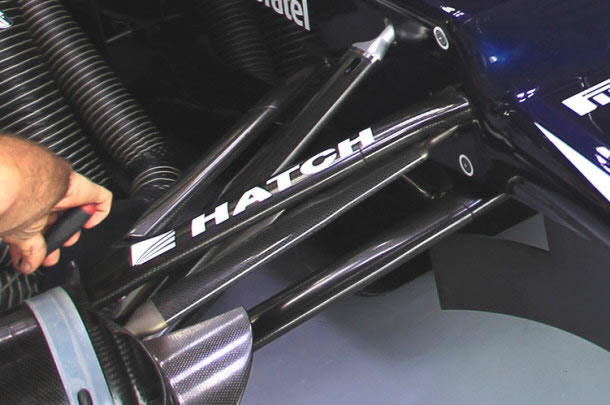
Double wishbones control the wheel’s attitude. From the outer end of the wishbone, a rod controls a rocker that activates the various elements that manage the suspension’s compliance. First, the springs take the form of torsion bars – straightened coil springs whose resistance to twist provides the springing medium to support the car’s mass. Dampers, one for each wheel, control the movement of the wheel as it rises and falls (bump and droop). The antiroll bar controls the amount of weight transfer from one side of the car to the other. Finally, the third spring, also known as a heave damper, controls the pitch movement (both wheels bumping or drooping simultaneously). This is especially important to prevent the downforce load from pressing the car against the track and bottoming the car on the ground at high speed. Teams may also fit an inerter in this position to offset uncontrolled tire bounce affecting the chassis.
Geometry
The geometry of the suspension must be kept as close to ideal as possible to exploit the tires. The beauty of the double-wishbone suspension arrangement is that by carefully designing the pivot points and arm lengths, the camber of the wheel can be maintained close to the optimum even while the body rolls during cornering.
Not only that, but the roll centre – a term for the abstract point around which the car rolls when cornering – can be held consistent, helping the car race with stable handling characteristics. Then there are ways of further refining the handling by angling the axes of the wishbones in various ways. For instance, wheel toe-in, camber angle, and castor angle can be made to vary with body roll to enhance steering feel, or upward (bound) suspension deflection can be made to resist the forward weight transfer under braking to oppose front-end dip. This is known as anti-dive, and a similar arrangement in reverse, known as anti-squat, can be applied at the rear.
Aerodynamic Shaping
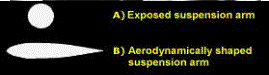
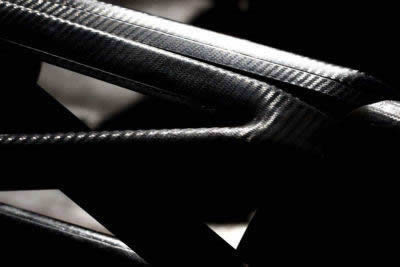
In recent years, suspension members have been streamlined into an aerofoil shape. According to the rules, they are not allowed to produce downforce and are simply shaped that way to reduce drag and to keep the flow heading for the sidepods relatively undisturbed. The suspension arms are a good example, as they are often made in the shape of a wing, although the upper surface must be identical to the lower surface. Diagram A represents an unstreamlined suspension arm, and B a suspension arm with an aerodynamic covering. Both have roughly the same cross-sectional area, but B has a drag force ten times less than A.
FRIC Suspension
The new development during the 2013 season is the FRIC suspension. FRIC stands for Front and Rear Interlinked suspension, which is being used by Mercedes and Lotus as far as I can tell. The basic principle behind FRIC suspension is to essentially keep the car at a constant ride height under braking, acceleration, and during cornering. With rake being ever important to the car’s aero setup, such linked systems are increasingly being investigated by the teams. To know more about FRIC check my article here.