Packers (Bump Rubbers)
Function
|
|
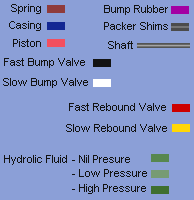
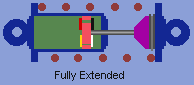
Packers, also known as bump rubbers, are used to prevent the springs or torsion bars from compressing too far. This allows the suspension to remain soft while ensuring that the bottom of the car can only descend to a certain distance above the ground before the springs contact the bump rubbers.
Cars often ride on these bump rubbers under high-speed aerodynamic loads, but they must not come into play during cornering. If the suspension is soft enough for the car to ride the bump rubbers through a corner (not just a flat-out curve), the resulting lack of suspension movement prevents the wheel from achieving the desired grip, compromising the car’s handling.
Protecting the Plank
Packers are particularly useful on modern Formula 1 cars for preserving the wooden plank underneath the car, since the rules stipulate that no more than 1mm may be worn during the race. Michael Schumacher’s exclusion from the 1994 Belgian Grand Prix was a direct consequence of his wooden plank being worn beyond the permitted limit.
The Eau Rouge Example
The most famous part of the Spa circuit is the Eau Rouge/Raidillon combination. Having negotiated the La Source hairpin, drivers race down a straight to the point where the track crosses the Eau Rouge stream before being launched steeply uphill into a sweeping left-right-left combination of corners with a blind summit. Eau Rouge demands a high degree of skill and is a crucial corner for lap time, since a long uphill straight follows where any mistake can cost dearly.
The corner also produces an enormous compression of several g-forces on both driver and car at the bottom of the dip. During this compression, the car’s suspension bottoms out, and without packers the underbody can scrape along the track surface. This leads to excessive plank wear and a loss of aerodynamic grip as the diffuser loses its air seal.
The challenge for drivers has always been to take Eau Rouge-Raidillon flat out. Regular touring cars can negotiate the corner at 160-180 km/h, prototype racing cars at around 250 km/h, and Formula 1 cars at over 300 km/h.