Strut Tower Brace or Strut Bar
Why Handling Matters More Than Horsepower
The best kinds of performance modifications are those that are simple and inexpensive. While it is easy to get lost in the costly pursuit of squeezing more horsepower out of an engine, another and often more effective route is to improve handling and put existing horsepower to better use. Horsepower that goes up in smoke or causes uncontrollable handling while driving in anything other than a straight line serves little purpose.
Upgrading stock springs for sport springs with a more aggressive rate keeps the car from diving too much under braking, creating an overall stiffer ride. Matching them with heavy-duty shock absorbers helps keep the car feeling tight over elevation changes and through rapid direction changes. Even with these modifications, body roll on the track or even on the street may still be an issue.
What other options are left to explore?
One of the easiest ways to tighten up vehicle suspension performance and handling is with a strut brace bar.
What Is a Strut Brace?
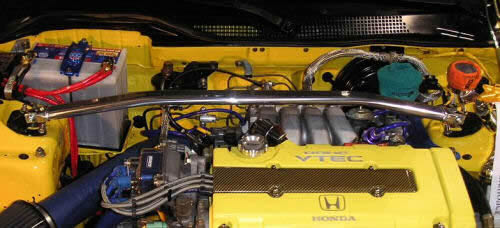
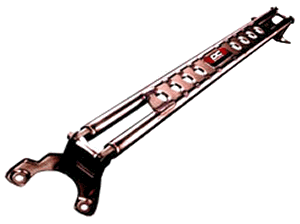
Simply put, a strut brace is a metal bar (or carbon fiber for the exotic, high-end range of parts) bolted to the top of two opposing strut towers, which is used to horizontally brace the frame of the car.
How It Works
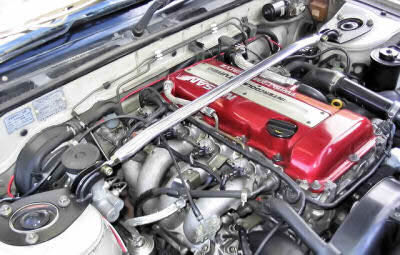
The strut tower is the mounting point for the top of the shock absorber, and it is directly connected to the vehicle’s chassis. By using the brace to attach the left and right strut towers together, frame rigidity is increased from the top, instead of the bottom as a sway bar does.
A strut bar, strut brace, or strut tower brace (STB) is a mostly aftermarket car suspension accessory usually used in conjunction with MacPherson struts on monocoque or unibody chassis to provide extra stiffness between the strut towers.
The MacPherson style strut suspension is standard on most modern cars, especially those of the economical or compact variety.
The struts themselves are the key to the simplicity of the MacPherson system. With a MacPherson strut suspension where the spring and shock absorber are combined in a single suspension unit, the entire vertical suspension load is transmitted to the top of the vehicle’s strut tower, unlike a double-wishbone suspension where the spring and shock absorber may share the load separately.
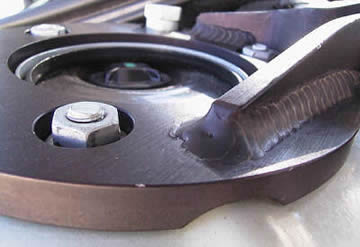
Body Flex
The towers are part of the body structure of the car. The bottom side of the strut towers bolts up to a ball joint and lower control arm, which is also bolted to the body. The downside is that the body of the car acts as the chassis. Since the suspension is connected directly to the body, a certain amount of body flex is to be expected. A car’s strut towers normally flex during hard cornering or when hitting a bump – some estimates suggest up to 10 to 15 millimetres. This flexing can cause traction loss, rattles, and changes to steering geometry as the body flexes.
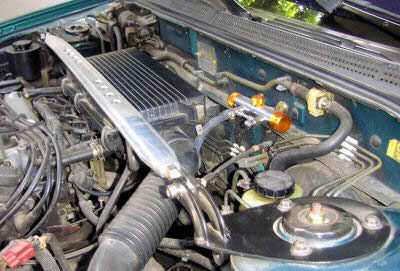
The Cardboard Box Analogy
Think of the strut tower bar like taping up a cardboard box. The box is flexible before the top is closed and taped. Once the sides and top are taped together, the box structure becomes rigid and strong. The strut tower brace “boxes up” the upper part of the MacPherson strut suspension, forming a full circle of bracing to help prevent unwanted suspension flex.
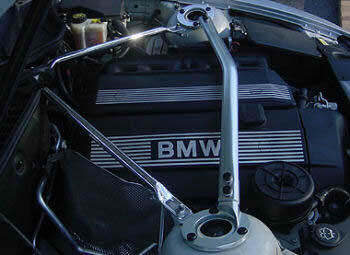
Installation
Installation is rather straightforward.
The strut tower at the front of the car is found in the engine bay. First, remove the nuts from the top of the strut, then place the bracket over the studs, reinstall the nuts, and tighten. Do the same with the other side, then adjust the bolts in the bar to the required length, tighten the lock nuts, and install the bar. There should not be any tension or compression on the bar when the car is at rest. The purpose of a strut brace is only to hold the strut towers where they are, not to pull them in or push them out. It is important to ensure that any strut tower brace being considered has enough clearance to make it over the top of the engine valve cover, and that the hood can still close.
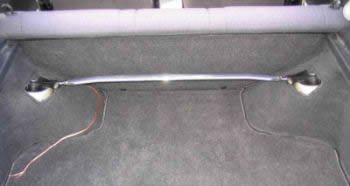
The rear strut tower is a little trickier. On some cars, it can be found in the trunk or cargo area for hatchbacks. However, many sedans have the strut towers hidden under the rear deck or seat, meaning the seat must come out before they can be accessed. The rear brace is installed in the exact same way as the front one.
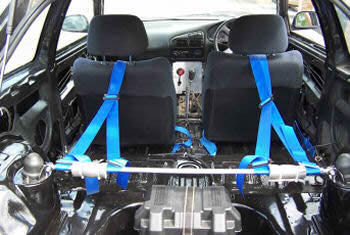
The Difference It Makes
Once a strut tower brace is installed, the car has a much more solid feel. With the tightened chassis, the car feels like it is on rails, and corners that used to have passengers holding onto the door handle feel calmer and more controlled.
The reason every car does not come with a strut tower brace is that most economy cars are built with economy in mind. Most people do not choose economy cars for performance. For those who push their cars to the limit on a racetrack, or enjoy spirited driving on open roads, a strut tower bar is an easy modification that can bring noticeable improvement in handling.
Performance cars like the Mitsubishi Lancer Evolution come from the factory with a strut tower bar, but if not, chances are good that an aftermarket version is available.
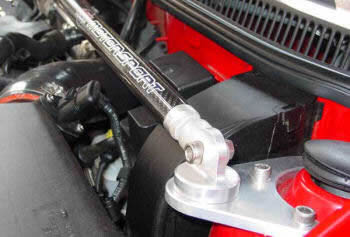
Carbon Fibre Braces
High-performance and expensive strut braces are made of carbon fiber composites. They have the extreme rigidity to minimise front-end flex during the hardest cornering, which keeps the tires squarely on the road and delivers traction when it is needed most. At the same time, they are exceptionally light due to their hollow profile. The entire piece weighs only 0.5 kilograms.
When asked about suspension modifications, Larry Nissen (a BMW technician) said: “I would start with a good strut brace. It will help the handling now, but where you will get your money back is three years down the road when your car is still as tight as it is now.”