Steering Technique
Overview of Steering Methods
There is no single “best” steering technique – this has been an ongoing debate since the invention of the steering wheel. Many techniques and styles of gripping and turning the steering wheel exist, whether on the road or in advanced driving schools. However, experienced drivers and racing professionals often find many common methods to be insufficient in applying accurate steering input. Push-pull, fixed-arm steering, shuffle steering, palming, and rotational (hand-over-hand) steering methods are all acceptable when employed properly to aid responsible car control.
The art lies in being able to choose the right technique at the right moment. This requires knowing the vehicle type and road conditions, and ensuring the method allows a safety margin for unforeseen situations.
Rather than focusing on the negatives, it is best to remember the positive benefits of each style and experiment by employing them all and assessing the results.
Adaptability and flexibility are essential. There is no single way to steer. Switching between rotational, palming, push-pull, and fixed-arm techniques as needed is ideal. Racing drivers agree that different techniques are required at different times. Good steering technique is crucial for smooth driving, as it prevents sudden lateral weight transfers which allow the corner to be taken at a higher speed.
There are always exceptions to the rule. However, those exceptions can turn into habits that lead to costly accidents.
The evolution of the car has had much to do with steering methods. F1 drivers like Lewis Hamilton and Felipe Massa use a fixed-hand steering method, while NASCAR champions may use an entirely different approach. Adaptability and a proper approach to the car and the situation at hand are always key.
The Fangio Shuffle
Here is in-car footage of Juan Manuel Fangio, showing how he prepares the position of his hands for the next turn. This driving style is known as the “Fangio Shuffle.”
| In Fangio Shuffle your hands are mainly on 15 to 3 position ready for any emergency situation. You can keep hand in this position during non demanding corners |
| Before corner you can shuffle one hand to prepare entering. Normally you don’t need to shuffle hands any more during corner, you have always one hand on the steering wheel ready for emergency. On the picture you can see preparing movement for right corner. |
| As you can see, right corner is now very easy. You have enough space for further movement if it’s necessary, and enough freedom to go back in case of emergency. |
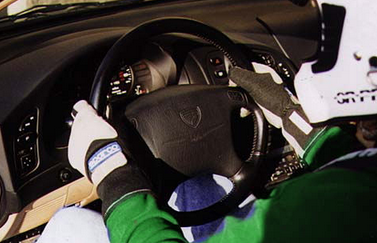
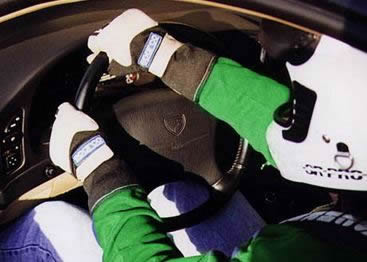
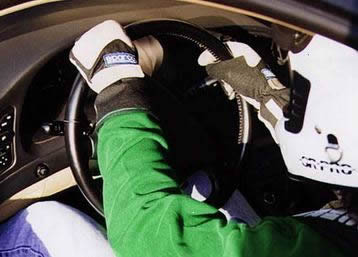
The Fangio Shuffle is a blended hybrid style that incorporates bend assessment and pre-selective hand positioning with leverage and security mid-bend in mind. The hands are shuffled into a better position before cornering begins. This allows the driver to anticipate the turn and achieve a position that is “ahead of the curve.”
Here is another video of Stirling Moss at Brands Hatch 1964, showing a similar technique and how he prepares the position of his hands for the next turn.
The 10-to-2 vs. 15-to-3 Hand Position
The 10-to-2 position is more comfortable for relaxed driving, since in that position the weight of the hands rests partially on the steering wheel. However, this comfort becomes a disadvantage when larger steering inputs are required. The amount of steering possible from a fixed 10-to-2 position (without shuffling or crossing hands) is limited, since both hands “collapse” into the turn and one hand cannot cover for the other. This position also utilises the shoulder muscles, requiring more effort and shifting the body out of balance.
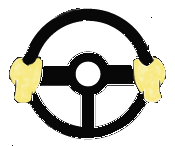
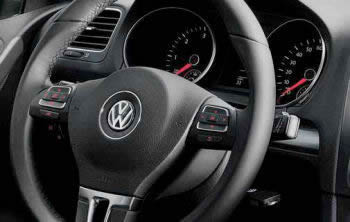
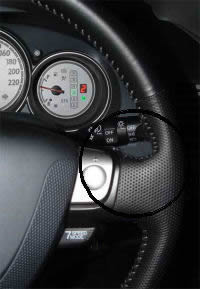
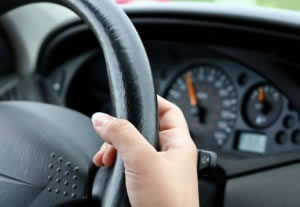
The 15-to-3 position provides a clearer sense of balance and control. The steering wheel is usually designed to be held this way: the links between the steering hub and wheel are intentionally located at 15 and 3 on most cars, so that the thumbs wrap around them, providing more stability and easy access to light switches and indicators. Some steering wheels have small bumps on the inside of the rim.
|
|
| These are meant to create a "gap" to place the thumbs in it, while the steering wheel is correctly held in 15 to 3. |
Airbag Safety Considerations
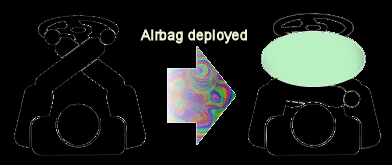
There is also a safety consideration: the airbag. The airbag deploys at approximately 300 km/h. If the steering wheel is held at 10-to-2, the airbag can crush the arms and send them flying into the face. This risk is reduced when holding the rim at 15-to-3.
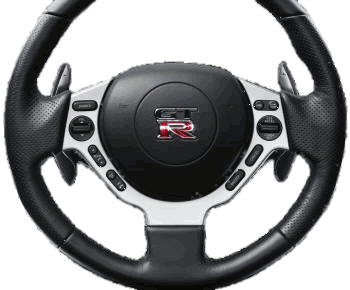
| You can see this bumps or thumbs holders on the inside of the Nissan GT-R steering wheel. All high performance car have it, so it’ mean there is sense in it. |
| Correct hand position holding the wheel |
Fixed Position and Emergency Manoeuvres
From the 15-to-3 position, a significant amount of steering can be applied without shuffling. In some driving schools, the first rule is that when driving on the open road, or in small and progressive bends, the hands should remain in the fixed 15-to-3 position, and steering adjustments should be made from this position. It is sufficient even for emergency evasive manoeuvres. For an emergency lane change, all that is needed is to steer from the fixed position to the right, then all the way left, and back straight. If done quickly enough (just over a second) and without excessive throttle or brakes, this results in moving the car exactly one lane over.
For more demanding open roads, track driving, or tighter bends, the Fangio Shuffle is more appropriate. This means a general 15-to-3 position with shuffling the hands into a better position before cornering begins, when necessary depending on the corner.
Choosing the Right Method
There are many driving schools and instructors, and each supports a different method of holding and using the steering wheel. The important thing is to use common sense. If the push-pull method does not feel right, it should not be used. If the shuffle method does not feel secure, it should be avoided. Shuffle steering is not always the smoothest method, as it still requires many continuous hand movements. The key is to use a method that suits the driver and the situation. Push-pull is too slow for fast cornering and advanced driving because grip on the wheel is not constant, and the changing hand positions prevent consistent feedback.
As in-car footage of rally driver Marty McCormack in his Citroen C2 R2 demonstrates, he does not shift his hands and keeps them at 15-to-3 approximately 95% of the time.
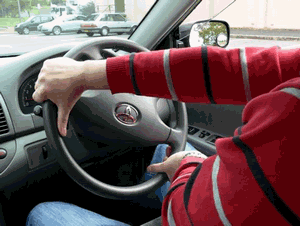
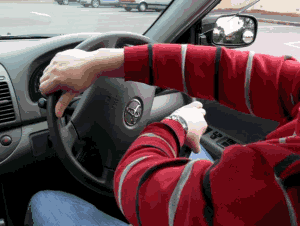
| This move must be painful for his left hand. In this case, left hand should be shuffled in better position, as in lover picture. It will give you better comfort and more control. During position change of left hand (in this case), do not move your hand of the wheel. Try to keep your palm on the wheel for better control in case of emergency. |
|
Grip and Sensitivity
The grip itself should be relaxed – just tight enough to maintain control and good contact for sensory input. A tight grip on the wheel will tire the hands and arms quickly, and more importantly will significantly reduce sensitivity to the vibrations needed to sense and control the limits of the car. While it is a natural tendency to grip the wheel tightly while cornering, no amount of squeezing will increase the traction of the tires. However, the more relaxed the grip (without losing contact with the wheel), the more traction awareness the driver will have.
It is a learned response to relax the hands (and the entire body) during high g-force cornering, but it is something that must be developed as quickly as possible. It will increase sensitivity to the car’s traction limits and improve awareness of the car’s handling. Grip the wheel with a firm but relaxed grip, but not so hard that the knuckles turn white. Maintain this position unless the corner does not allow it, as this gives the advantage of instantly knowing where the straight-ahead position is, and the ability to steer rapidly yet smoothly.
Understanding Steering Mechanics
A lack of understanding of the mechanics of driving and too little precision in operating the vehicle controls will always lead to trouble when the pressure is on. Many functions involved in driving a car are closely linked. If a bend is misjudged and entered slightly too fast, it can usually be managed provided the driver has good discipline and knowledge of the controls and the car’s behaviour. With poor steering knowledge, recovery is much more difficult. The same applies to stamping on the brakes.
The steering wheel is the most important item among vehicle controls because it has such a profound effect on vehicle behaviour. It can drastically change the balance of the car in terms of where weight is shifted. It can cause a cascade of forces in every direction.
Smooth Steering Inputs
When steering around a corner, the ideal steering movement is progressive, smooth, and controlled. Applying and removing steering lock should be done in a fluid movement, without taking either hand off the wheel where possible. “Push and pull” may be fine for general road driving, but it does not allow the smooth motions needed when driving near the limits of grip or in emergency situations.
Avoid letting the steering wheel slide through the fingers when releasing steering lock, and adjust hand position accordingly for the next corner or straight. In some situations where lock needs to be removed very quickly – such as after a dramatic oversteer correction – it may be easier to let the wheel slide slightly, but this should be avoided where possible.
When taking a corner, aim for the apex and turn in a smooth, controlled arc rather than using aggressive steering unless deliberately trying to unsettle the car (for example, for a handbrake turn). Once the apex is clipped, unwind the steering lock progressively while increasing the throttle.
Steering and Weight Transfer
When a car is travelling straight ahead and the steering wheel is turned, the momentum (centrifugal force) within the car still wants to carry it straight ahead. The front wheels must fight that straight-ahead force by creating a counter-force through the front tires if they are going to cause the car to deviate. That counter-force must be stronger than the straight-ahead force to be effective. Loading up the steering gently and gradually will cause the car to corner far more effectively than jerking it around. The article on the traction circle explains this in more detail.
Feedback from the Steering Wheel
The steering wheel is the primary source of feedback about the road or track surface from the front tires, suspension, and brakes. For maximum control and smoothness, how the steering wheel feels in the hand is important. Depending on hand size, a thicker or thinner wheel may be preferred. If considering a change from the stock steering wheel, choose one that is comfortable to grip with or without driving gloves.
When getting ready for the road, the seat should be adjusted to a more upright position than might normally be used.
Airbag Awareness
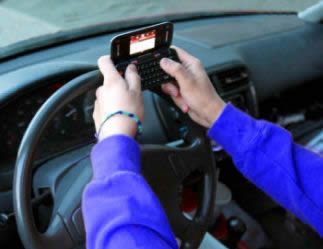
A final note about steering concerns the steering wheel itself. All modern cars have a driver’s airbag fitted within the steering wheel centre. That airbag contains a detonator and an explosive charge within its system. If the airbag deploys when the arms are across the steering wheel centre, it can cause serious injury.
Related Articles
Here you can learn more about the steering wheel and steering column.
For a complete picture of performance driving, take a look at Corners, Setup, Traction circle, Using tires, Left foot braking, braking, advanced braking, WRC braking technique, Slipstreaming, drifting, cornering, shifting, Heel and toe driving technique articles