Steering Column
Primary Function
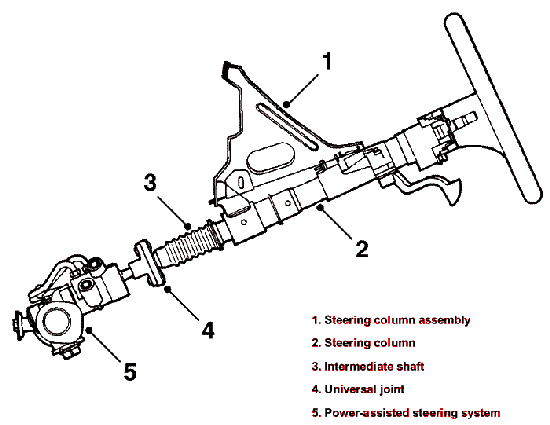
The automotive steering column is a device intended primarily for connecting the steering wheel to the steering mechanism by transferring the driver’s input torque from the steering wheel.
A steering column may perform several secondary functions:
Energy dissipation management in the event of a frontal collision
Provide mounting for: the multi-function switch, column lock, column wiring, column shroud(s), transmission gear selector, gauges or other instruments, as well as the hydraulic or electro-motor and gear units found in power steering
Offer height and/or length adjustment to suit driver seating position preference
Construction and Safety
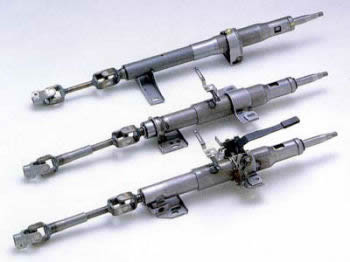
The steering column consists of a collapsible housing containing a collapsible rotating shaft. As a safety measure, the steering column is designed to collapse in the event of a front-end collision. If a steering column has collapsed, it must be replaced. The steering shaft is a two-or-more-piece component located inside the steering column, supported at the top and bottom by bearings. The steering column housing may also contain gear shift components.
In normal road cars, the steering column is used to mount several accessories. The turn signal switch, headlamp dimmer switch, wiper switch, and ignition switch can be located on or inside the steering column. Care should be taken when the steering column is removed for service. The column should not be dropped, leaned on, or subjected to blows at either end. Internal components of the column can shear off, causing the column to partially collapse.
Steering Column in Racing
For a motorsport in which hundredths of a second can mean the difference between pole position and a mid-field grid slot, a car’s ability to handle well is paramount. The steering system provides the driver with the first indication of how well the car is handling. The steering column is an essential link in the chain of events that sees a twist of the steering wheel turn the car’s wheels. The column is joined to the steering wheel at one end and the rack and pinion at the other. This means that the steering column stretches from the edge of the cockpit down to the front survival cell bulkhead.
Steering column rack and pinion components in road cars
Rack and Pinion
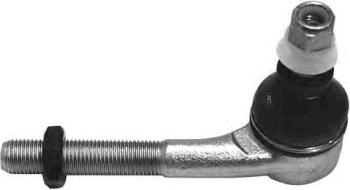
Quite simply, when the driver turns the steering wheel, the column rotates the pinion gear and the rack moves laterally. The track rods are put into action, shifting the wheels. The tie rods link the steering gear to the steering knuckle. The tie rod ends are a ball-and-socket design that allows the tie rod to flex up and down with the movement of the front suspension. Tie rods should be inspected for excessive movement, grease seal tears, or any visible wear. The ball-and-socket assembly should not be compressible by hand – any inward movement should be considered excessive wear.
Steering column rack and pinion assembly
Rack and pinion animation
Tie rod ends are a ball and socket design that allows the tie rod to flex up and down with the movement of the front suspension
Many modern cars use rack-and-pinion steering mechanisms, where the steering wheel turns the pinion gear; the pinion moves the rack, which is a linear gear that meshes with the pinion, converting circular motion into linear motion along the transverse axis of the car (side-to-side motion). This motion applies steering torque to the kingpin of the steered wheels via a tie rod and a short lever arm called the steering arm.
The rack-and-pinion design offers a high degree of feedback and direct steering “feel”; it also does not normally have any backlash or slack. This is why this system is the first choice for racing car designers. A disadvantage is that it is not adjustable, so when it does wear and develop lash, the only remedy is replacement.
Materials and Construction
A high-performance steering column is constructed primarily from carbon fibre or high-quality steel, titanium, and aluminium, and is made of two tubes. They are linked together by a constant-velocity joint, which ensures that the two parts move at the same speed. It also provides high stiffness and low friction. If there is too much friction or not enough stiffness, it will adversely affect the way the driver can handle the car.
Electronics and Quick Release
In Formula 1 and some other classes, the column features an electrical plug which connects the steering wheel’s electronics to the electronic control unit via a wiring harness. This end of the column also has a quick-disconnect mechanism, which means the driver can remove the steering wheel rapidly. An FIA rule stipulates that the F1 driver must be able to exit the car in five seconds, so the quick disconnect is very important.
Power Steering
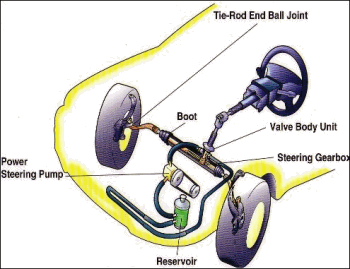
Hydraulically assisted power steering column
At the steering rack end of the column, a splined joint links the two together, then connects to the power steering valve and on to the pinion. The power steering pump provides the hydraulic pressure used for steering assistance. The pump is driven by a gear attached to the crankshaft. The pump gear rotates a vane assembly inside a pump ring. Pressure is created by compressing fluid between the vanes and the surface of the pump ring. The pump pressure output is maintained by a flow control valve that contains an internal pressure relief valve.
There are two types of power steering pumps used: submerged and non-submerged. Both are similar in operation, with the only difference being the type of fluid reservoir used. A submerged type contains the pump and fluid reservoir in one unit. A non-submerged type uses a remote fluid reservoir.
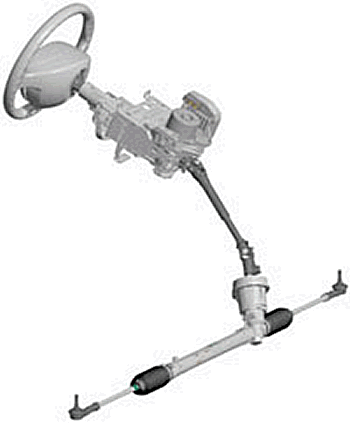
Without power steering, which in racing environments uses a high-pressure hydraulic supply, the driver would have to work the steering twice as hard.
Some modern road cars use an electric motor instead of hydraulic power steering. Electric power steering (EPS) is designed to use an electric motor to reduce effort by providing assist to the driver. Most EPS systems have variable assist, which allows for more assistance as vehicle speed decreases and less assistance during high-speed situations. EPS is more efficient than hydraulic power steering, since the electric motor only needs to provide assistance when the steering wheel is turned, whereas the hydraulic pump must run constantly. In EPS, the assist level is easily tunable to the vehicle type, road speed, and even driver preference. An added benefit is the elimination of the environmental hazard posed by leakage and disposal of hydraulic power steering fluid.
Crash Test Requirements
Another requirement for Formula 1 steering column designers is a component specified by the FIA. This is the aluminium crush tube. Teams must perform a crush test in which a weight is dropped on the end of the steering column and the deceleration is measured. The peak deceleration must be less than 80g in a crash.
For safety reasons, all modern cars feature a collapsible steering column (energy-absorbing steering column) which will collapse in the event of a heavy frontal impact to avoid excessive injuries to the driver. Non-collapsible steering columns very often impaled drivers in frontal crashes. Collapsible steering columns were invented by Bela Barenyi.
Maintenance and Specifications
The Formula 1 steering column takes around ten hours to make, and the team takes three or four spares to each race. They are inspected after completing 1,500 km and serviced after 3,000 km. A typical service involves complete disassembly, followed by a crack check of the safety-critical parts. It is then reassembled – with new parts where necessary – and finally tested on the test rig before being signed off for use on the circuit.
Having arrived at a design that is both light and stiff yet reliable, the steering column is not changed regularly. However, frequent design reviews are carried out and a new design will be put in place if the monocoque changes sufficiently.
Technical Specification for Formula 1 steering column:
Length: Approx. 950 mm
Diameter: Approx. 35 mm
Material: Carbon fibre, titanium, steel, aluminium
FIA Technical Regulations
10.4 Steering :
10.4.1 Any steering system which permits the re-alignment of more than two wheels is not permitted.
10.4.2 Power assisted steering systems may not be electronically controlled or electrically powered. No such system may carry out any function other than reduce the physical effort required to steer the car.
10.4.3 No part of the steering wheel or column, nor any part fitted to them, may be closer to the driver than a plane formed by the entire rear edge of the steering wheel rim. All parts fixed to the steering wheel must be fitted in such a way as to minimise the risk of injury in the event of a driver’s head making contact with any part of the wheel assembly.
10.4.4 The steering wheel, steering column and steering rack assembly must pass an impact test, details of the test procedure may be found in Article 16.5.
16.6 Steering column crash test :
The parts referred to in Article 10.4.4 must be fitted to a representative test structure; any other parts which could materially affect the outcome of the test must also be fitted. The test structure must be solidly fixed to the ground and a solid object, having a mass of 8kg (+1%/-0) and travelling at a velocity of not less than 7 metres/second, will be projected into it.
The object used for this test must be hemispherical with a diameter of 165mm (+/-1mm).
For the test, the centre of the hemisphere must strike the structure at the centre of the steering wheel along the same axis as the main part of the steering column.
During the test the striking object may not pivot in any axis and the test structure may be supported in any way provided this does not increase the impact resistance of the parts being tested.
The resistance of the test structure must be such that during the impact the peak deceleration of the object does not exceed 80g for more than a cumulative 3ms, this being measured only in the direction of impact.
After the test, all substantial deformation must be within the steering column and the steering wheel quick release mechanism must still function normally.
Related Articles
Here you can learn more about the steering wheel and steering technique.