Formula 1 Speed
Top Speed on Circuit
In Formula 1, top speeds are in practice limited by the longest straight at the track and by the need to balance the car’s aerodynamic configuration between high straight-line speed (requiring low downforce) and high cornering speed (requiring high downforce), in order to achieve the fastest lap time.
During the 2006 season, the top speeds of Formula 1 cars were a little over 300 km/h at high-downforce tracks such as Albert Park, Australia and Sepang, Malaysia. These speeds were down by some 10 km/h from 2005 speeds, and 15 km/h from 2004 speeds, due to performance restrictions.
On low-downforce circuits, greater top speeds are registered at the Gilles-Villeneuve circuit (Canada) at 325 km/h, and at Indianapolis (USA) at 335 km/h. For most of the year, Monza’s Villa Reale park, 25 kilometres from Milan, provides a picturesque route for joggers and cyclists. But buried deep within the woodland lies Formula 1’s fastest challenge. The historic circuit is dubbed the “cathedral of speed” and holds the records for the highest speed – 371.7 km/h – recorded by an F1 car, the fastest ever lap, the quickest Grand Prix in history, and the closest finish, with just a hundredth of a second separating the first two cars back in 1971. At the 2004 Italian Grand Prix, Antonio Pizzonia of BMW WilliamsF1 recorded a top speed of 369.9 km/h.
The newly reconfigured Autodromo Hermanos Rodriguez in Mexico City replaced Monza as the temple of top speed in 2015, with the high altitude of 2,220 metres above sea level producing the highest recorded season-high speeds. Pastor Maldonado’s staggering 366.4 km/h (227.7 mph) through the speed trap on Sunday was significantly faster than the pre-V6 era. Second on the list was Sebastian Vettel with 366.2 km/h.
In 2016, the new Baku (Azerbaijan) Formula 1 city track produced record top speeds at the end of the straight. Valtteri Bottas was officially clocked across the start/finish line at 366.1 km/h during qualifying in Baku, as the result of a slipstream off Max Verstappen’s Red Bull. However, as the braking zone for Turn 1 is well past the start/finish line, Williams’ data showed that his car continued to accelerate after that reading and reached a peak of 378 km/h shortly afterwards. This figure exceeds speed trap figures from F1’s other high-speed venues, Mexico and Monza. Baku’s top speeds were particularly surprising given the tight and twisty nature of the city track once cars leave the 2.1 km long straight.
In 2018, on his final season with Ferrari, Kimi Raikkonen could certainly hold his head high, this time on Ferrari’s home turf at Monza. At the time, it was Juan Pablo Montoya who held the record for the fastest lap in F1 history, but Raikkonen ended the Colombian’s 14-year reign with a blistering lap to secure pole with a time of 1:19.119. The Finn was 0.406 seconds faster than Montoya, who 14 years earlier had achieved his time with a V10 engine of more than 900 horsepower – similar power to that of the current hybrid V6 (combustion and electric combined). Raikkonen, on that run, loosely exceeded 300 km/h on the straights and recorded the fastest lap average in the history of Monza at 263.587 km/h.
(Edit: In 2020, Lewis Hamilton took pole position with the fastest lap average in F1 history, with a time of 1:18.887 at 264.392 km/h, marking Hamilton’s 94th pole position.)
Bonneville Speed Record
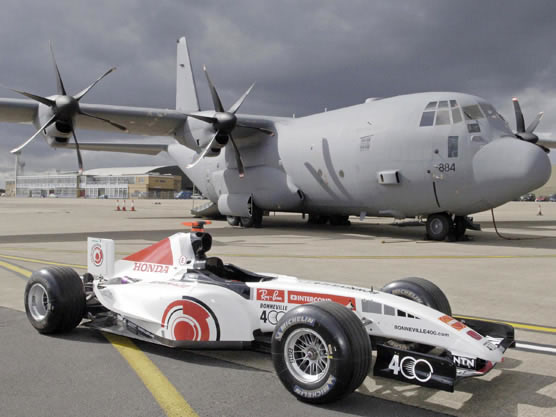
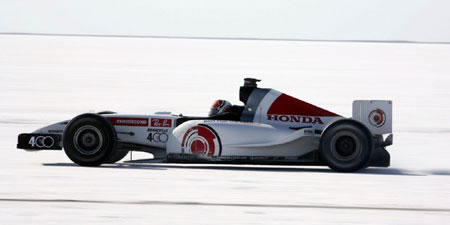
Away from the track, the BAR F1 Honda team used a modified BAR 007 car, which they claimed complied with FIA Formula One regulations, to set an unofficial speed record of 413.205 km/h (265.754 mph) on a one-way straight-line run on 6 November 2005, during a shakedown ahead of their Bonneville 400 record attempt. The car was optimised for top speed with only enough downforce to prevent it from leaving the ground.
The car, badged as a Honda following their takeover of BAR at the end of 2005, set an FIA-ratified record of 400 km/h on a one-way run on 21 July 2006 at the Bonneville Salt Flats. On this occasion, the car did not fully meet FIA Formula One regulations, as it used a moveable aerodynamic rudder for stability control, breaching article 3.15 of the 2006 Formula One technical regulations, which states that any specific part of the car influencing its aerodynamic performance must be rigidly secured.

Forward Acceleration
The 2008 F1 cars had a power-to-weight ratio of around 1,250 hp (932 kW) per tonne (0.9 kW/kg).
Theoretically, this would allow the car to reach 100 km/h (62 mph) in less than 1 second. However, the massive power cannot be converted to motion at low speeds due to traction loss, and the usual figure is 2 seconds to reach 100 km/h.
After about 130 km/h, traction loss is minimal due to the combined effect of the car moving faster and the downforce, so the car continues accelerating at a very high rate.
The figures for the 2007 Renault R27:
0 to 100 km/h (62 mph): 2.0 seconds
0 to 200 km/h (124 mph): 3.9 seconds
0 to 300 km/h (186 mph): 8.6 seconds
Figures may alter slightly depending on the aerodynamic setup.
The acceleration figure is usually 2.46 g (24.1 m/s) up to 200 km/h, which means the driver is pushed back into the seat with 2.46 times his body weight.