Spark Plugs
Basic Principles
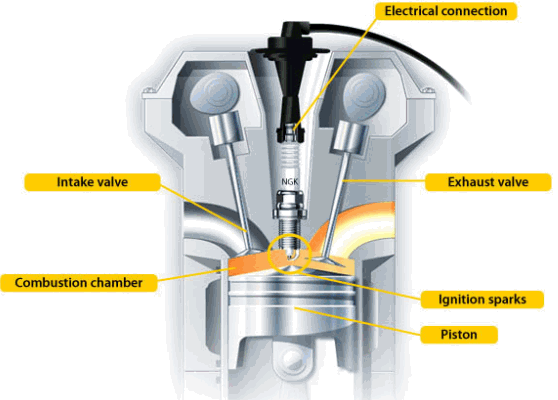
The spark plug is quite simple in theory. It ignites the air-fuel mixture in the engine cylinder by generating sparks between the centre electrode and earth electrode. The electricity must be at a very high voltage in order to travel across the gap and create a good spark. Voltage at the spark plug can be anywhere from 40,000 to 100,000 volts. A petrol engine without a spark plug is useless. There are many different spark plugs available, and they all perform the same basic job, but higher-quality plugs offer better performance. All spark plugs share the same basic design and construction.
The Connector and Ignition Coil
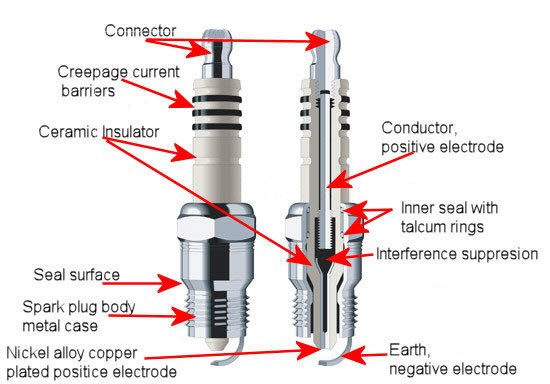
The connector is designed as an SAE connection or a 4 mm thread. This is where the ignition cable coming from the high-voltage coil, or a rod coil, is plugged in. High voltage coupled here must be transported to the other end of the spark plug.
The high-voltage coil is the device that generates the high voltages required to create a spark. It is essentially a high-voltage transformer made up of two coils of wire. One coil of wire is called the primary coil. Wrapped around it is the secondary coil. The secondary coil normally has hundreds of times more turns of wire than the primary coil.
Current flows from the battery through the primary winding of the coil. The primary coil’s current can be suddenly disrupted by the breaker points, or by a solid-state device in an electronic ignition.
The coil functions as both an electromagnet and an inductor. The key to its operation is what happens when the circuit is suddenly broken by the points.
The magnetic field of the primary coil collapses rapidly. The secondary coil is engulfed by a powerful and changing magnetic field. This field induces a current in the coils – a very high-voltage current (up to 100,000 volts) because of the number of coils in the secondary winding. The secondary coil feeds this voltage to the distributor via a very well-insulated, high-voltage wire and special protected connector.
Formula 1 Ignition Coils
The high-voltage coil on a Formula 1 car differs from those in road cars, where one coil typically serves four or more spark plugs. In Formula 1, one high-voltage coil serves only one spark plug. The four-pronged carbon fibre cased units are press-fitted atop each spark plug and connected through a CAN-bus electronic interface to the ECU unit.
Insulation and Sealing
The spark plug must have an insulated passageway for the high voltage to travel down to the electrode, where it can jump the gap and, from there, be conducted into the engine block and grounded. The spark plug also has to withstand the extreme heat and pressure inside the cylinder, and must be designed so that deposits from fuel additives do not build up on the plug.
Spark plugs use a ceramic insulator to isolate the high voltage from the electrode, ensuring that the spark happens only at the tip of the electrode and not anywhere else on the plug. Ceramic does double duty by helping to burn off fuel deposits. Ceramic is a fairly poor heat conductor, so the material gets quite hot during operation. This heat helps to burn off deposits from the electrode. The wave-shaped creepage current barriers on the outside of the insulator prevent the leakage of voltage to the vehicle mass. In doing so, they extend the path to be travelled and increase the electrical resistance.
The inner seals create a gas-tight connection between the insulator and the metal housing. For this purpose, a talcum ring is enclosed between two additional seal rings. During production, the talcum breaks down, ensuring an optimal seal.
Construction Details
Spark-plug sizes vary, but a basic one used in a current production car is about 85 millimetres long, with a maximum diameter of roughly 15 to 20 millimetres. The bottom third of a plug’s length is covered by a sleeve of steel threads, there is a metal stud on the top, and the white ceramic insulator in between. If a plug is cut in half lengthwise, an internal metal rod extends from the top to a point near the bottom of the steel threads. Sometimes this rod is separated by an interference suppressor. In order to ensure electromagnetic compatibility (EMC) and fault-free operation of the on-board electronics, a glass melt is used inside the spark plug for interference suppression.
From there, high voltage passes to the middle electrode. This electrode on a standard spark plug is comprised mostly of a nickel alloy and copper core, which improves heat dissipation. From the end of this electrode, the spark must jump over to the earth electrode.
A small piece of metal that looks like a hook extends from the bottom of the threads and comes close to – but does not touch – the lower end of the internal metal rod. That space is called the “gap,” and it is across this area that the sparks occur to ignite the fuel-and-air mixture in the cylinder. The metal surfaces on either side of the gap are “electrodes,” and the hook is commonly referred to as the “ground electrode.” The spark induced by the high-voltage coil jumps from the centre rod to the ground electrode.
Heat Range
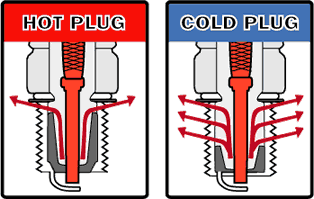
Something that is often overlooked in spark plugs is their heat rating or heat range. The term “heat range” refers to the relative temperature of the tip of the spark plug when operating. The hot and cold classifications often cause confusion because a “hot” spark plug is normally used in a “cold” (low horsepower) engine and vice versa. The term actually refers to the thermal characteristics of the plug itself, specifically its ability to dissipate heat into the cooling system.
The difference between a “hot” and a “cold” spark plug is in the shape of the ceramic tip. The carmaker selects the right temperature plug for each car. A cold plug can dissipate heat very quickly and should be used in engines that run hot and lean. A hot plug takes longer to cool down and should be used in lower-compression engines where heat needs to be retained to prevent combustion by-product buildup. Some cars with high-performance engines naturally generate more heat, so they need colder plugs. If the spark plug gets too hot, it could ignite the fuel before the spark fires, so it is important to use the correct type of plug for the application.
Spark Plugs in Formula 1
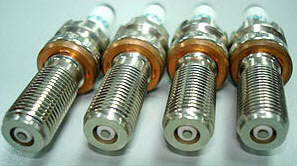
A modern Formula 1 engine has an extraordinary specification. From just 2.4 litres and 8 cylinders – without horsepower-enhancing turbocharging or supercharging – an F1 engine produces about 800 horsepower. It achieves this by revving to an incredible 18,000 rpm, more than double what a rev-happy Honda S2000 engine reaches. After the 2014 rules change, the 1.6-litre V6 engine again delivers over 800 horsepower at 15,000 rpm, with the help of ERS.
To keep the pistons and connecting rods from flying apart at those revolutions, an F1 piston travels only about 40 millimetres. The bore is roughly 90 millimetres (called a supersquare bore).
It is impossible to acquire the specifics of current Formula 1 engines because those details are well-guarded secrets within each team.
Federal-Mogul’s global director of ignition technology, Richard Keller, has spoken openly about F1 spark plug technology and research. Federal-Mogul is the owner of Champion.
|
Sparkplugs, left to right- F1, GP bike, Ford Focus |
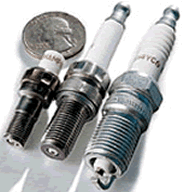
Champion’s basic Formula 1 plug that was used in the 1990s was similar in length to the normal one described above, but half the diameter. Then in 1999, one of the teams told Champion that for the amount of space the spark plug inhabited, it was the heaviest part on the car (that plug weighed only 25.9 grams) because it was located very high on the engine. Unless Champion could reduce the weight of the plug by 20 percent every year until told to stop, Champion was going to be replaced.
The plug Champion produced in response is smaller than a little finger. It is only 35 millimetres long, and the diameter of its threads is 7.6 millimetres, or roughly half the diameter of a conventional plug. It also requires a special tool for installation so that the spark-plug hole in the cylinder head can be made as small as possible. Empty space in an F1 combustion chamber is precious because any space taken by the spark plug leaves less room for the valves, and larger valves mean greater airflow and greater potential power output. The plug weighs 10.7 grams.
Surface-Gap Design
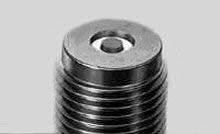
Besides its tiny size, another interesting feature of the F1 plug is that there is no protruding hook on the bottom. There is simply no room for one. A normal ground J-shaped electrode would not survive in an F1 engine – it would get crushed by the piston or shaken loose by the intense vibration. When an F1 piston is at the top of its stroke, it almost touches the cylinder head. The combustion-chamber volume is mostly made up of the recessed parts in the piston tops that provide room for the valves.
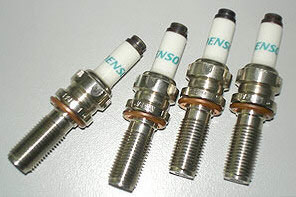
Without that hook, the ground electrode is simply the bottom edge of the threads. This design is known as a surface-gap spark plug – a spark plug designed to produce sparks along the insulator surface at the ignition end. This spark plug type is classified as either semi-superficial discharge or superficial discharge type. This spark plug has a smaller heat-exposed insulator, and therefore it gets dirty easily. To overcome dirt buildup, a capacitor discharge system is used which rapidly reaches the required voltage to produce the sparks. It is used in high-performance engines such as those in Formula 1.
|
Surface-gap spark plug is a spark plug designed to produce sparks along the isolator surface at the ignition end. More 50.000 volts…… firing at 20,000 RPM |
Manufacturing Precision
To get an idea of the precision of the components of an F1 engine: when Champion builds its F1 spark plugs, the length varies minutely from plug to plug. This is known as manufacturing tolerance; for the F1 plugs, the difference from the longest to the shortest plug is only 0.05 millimetres, or about the same as the thickness of a human hair. If a spark plug is on the long side, the piston might hit it, so teams machine a divot in the piston or shim the spark plugs with washers.
Over the course of a year, Champion produces about 10,000 of these special units, and they are not cheap. Whereas a standard spark plug might cost two dollars, an F1 team spends between $35 and $50 each, or as much as $500 per engine.
|
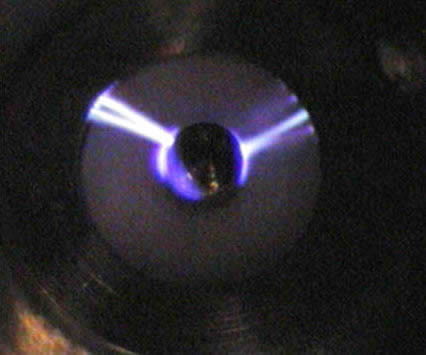
Denso surface discharge spark plugs used in F1 engines |
F1 Spark Plug Suppliers
Main suppliers for F1 teams are US-based Champion, Italian Magneti Marelli, and Japan-based NGK and Denso.
NGK Spark Plugs first took up the challenge of Formula One together with Honda in 1964 and achieved their first victory the following year.
At the start of the second golden age of Honda Formula One, the performance of NGK spark plugs in Honda engines was recognised, and soon these plugs were fitted in many other Formula One engines. In 1998, a car with a Mercedes engine fitted with NGK spark plugs took NGK to its 100th victory in Formula One, and in 2007, cars fitted with NGK spark plugs achieved wins in all 17 races, stretching the total to 200 wins.
In 2011, NGK supplied spark plugs to two engine manufacturers, Mercedes and Ferrari. NGK spark plugs were fitted in the engines of 12 cars belonging to a total of 6 teams.
FIA Technical Regulations
5.9 Ignition systems :
5.9.1 Ignition is only permitted by means of a single ignition coil and single spark plug per cylinder. The use of plasma, laser or other high frequency ignition techniques is forbidden.
5.9.2 Only conventional spark plugs that function by high tension electrical discharge across an exposed gap are permitted. Spark plugs are not subject to the materials restrictions described in Articles 5.14 and 5.15.