Slip Angle
Definition
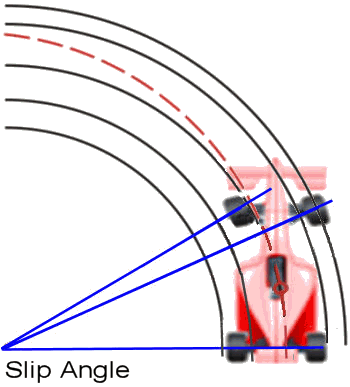
The slip angle of a vehicle describes the ratio of forward and lateral velocities in the form of an angle, normally represented by the symbol Beta. Slip angle is the angle between a rolling wheel’s actual direction of travel and the direction in which it is pointing. In other words, it is the difference between where the car is heading and where it is actually going.
This slip angle results in a force perpendicular to the wheel’s direction of travel, known as the cornering force. This cornering force increases approximately linearly for the first few degrees of slip angle, then increases non-linearly to a maximum before beginning to decrease as the wheel starts to slide.
How Slip Angle Arises
A non-zero slip angle arises because of deformation in the tire. As the tire rotates, friction between the contact patch and the road causes individual tread elements to remain stationary with respect to the road surface. This tire deflection gives rise to the slip angle, and consequently to the cornering force.
Effect on Vehicle Behaviour
Because the forces exerted on the wheels by the weight of the car and downforce are not distributed equally, the slip angles of each tire will differ. The ratios between the slip angles determine the vehicle’s behaviour in a given turn. If the ratio of front to rear slip angles is greater than 1:1, the vehicle will tend to understeer, while a ratio of less than 1:1 will produce oversteer.
Actual instantaneous slip angles depend on many factors, including road surface condition, tire condition, acceleration and braking inputs, tire profile size, and tire camber. However, a vehicle’s suspension can be designed to promote specific dynamic characteristics.
A principal means of adjusting developed slip angles is to alter the relative roll stiffness front to rear by adjusting the amount of front and rear lateral weight transfer. This can be achieved by modifying the height of the roll centres, or by adjusting roll stiffness through suspension changes or the addition of an anti-roll bar.
From Slip to Slide
What changes a slip angle into a slide angle is excessive slip. The part of the contact patch on the outside of the turn moves faster than the wheel itself in the direction the contact patch is pointing, while the part on the inside moves more slowly (exactly like camber thrust). Since the outside part moves faster than the tire, it must be slipping. The inside part grips better than it would when moving in a straight line. For this reason, the contact patch effectively “walks” itself into the turn.
The greater the slip angle, the larger the portion of the contact patch that is slipping. At some point, so little of the contact patch retains grip that traction is lost and the tire begins to slide. Importantly, traction is generally not lost all at once; rather than an abrupt loss, it tends to diminish gradually.
Optimal Slip Angles
Tires tend to operate at peak performance under a few degrees of slip angle, generating the most grip at that particular angle. For race and high-performance tires, this optimum slip angle is around 6 to 10 degrees, while the figure is somewhat lower for street tires.
Due to low-traction surfaces, rally drivers regularly reach even larger angles. In drifting, some of the largest slip angles in all of motorsport can be observed, sometimes as high as 40 degrees.
Slip Angle Measurement
There are many reasons to measure the slip angle of vehicles. Slip angle is used in a variety of objective vehicle dynamics measurements, including checking vehicle stability, evaluating steering feel, and comparing tire performance. One of the most important applications is ESC (Electronic Stability Control) tuning. Because the sensors in vehicles cannot accurately derive the slip angle directly, a model is needed to estimate it. Such models require tuning with accurate data, and regardless of the eventual application, accuracy is the universal requirement.
The main challenge in measuring slip angle is that it is a very small quantity. A change of 0.5 degrees is already significant, and slip angle can vary quickly, so changes above 1 Hz are meaningful.
There are two main ways to measure tire slip angle: on a vehicle as it moves, or on a dedicated testing device. Several devices can measure slip angle on a moving vehicle, using optical methods, inertial methods, GPS, or a combination of all three.
Slip angle accuracy also changes with speed. To calculate an object’s track angle, GPS and inertial measurement systems take the arc tangent of the wheel’s forward velocity (Vx) and lateral velocity (Vy).

Bearing in mind that these instruments measure velocity with a relatively fixed accuracy of, say, 0.1 km/h, a small error like this is proportionally more significant at low speeds. That is why slip angle accuracy improves with speed.
If the test speed is known, the expected accuracy of any system can be calculated with the following function:

Other sources of error relate to the installation of the measuring equipment in the vehicle, or the device’s inability to compensate properly. Engineers therefore invest considerable time ensuring that an installation is accurate enough to capture the required data.
Road camber is another source of error that directly affects slip angle and cannot be controlled, but can be observed if the measurement device describes exactly how the vehicle body moves through space. This is one reason why inertial navigation-based systems offer superior performance in real-world testing – they give users a complete and accurately timed picture of how the vehicle is moving in all axes.
Various test machines have also been developed to measure slip angle in a controlled environment.
Slip Angle and Steering Angle
Assuming grip is maintained, the body of the vehicle will tend to follow the direction the steered tires are pointing, but the momentum of the vehicle means that there will always be some degree of tire slip, however minimal. The tire will deform slightly as it contacts the road, and this deformation may also need to be considered. Tire slip angle can be calculated by measuring the overall slip angle at the wheel and the actual wheel steering angle (obtainable via CAN), then subtracting the slip angle from the wheel steering angle. Note that wheel steering angle must be measured at each wheel, due to the effects of Ackerman steering.
To learn more about car movement in 3D space, read the article about Formula 1 car motions.