Motions of a Formula 1 Car
Degrees of Freedom
A three-dimensional body can rotate and translate in three orthogonal axes. These six degrees of freedom are divided into three rotational motions and three translational motions. For bodies with only rotational freedom of motion, there are three degrees of freedom. For bodies with both rotational and translational freedom, there are six degrees of freedom. Because movement and rotation along the three axes are independent of each other, such motion is said to have “six degrees of freedom.”
The Three Axes
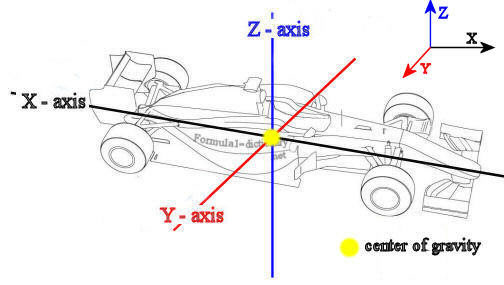
All rotations in a 3D environment occur around three axes of rotation: the vertical, lateral, and longitudinal axes.
Vertical axis (Z-axis or yaw axis) is an axis drawn from top to bottom, passing through the centre of gravity and perpendicular to the other two axes. It is usually, but not always, perpendicular to the track surface.
Lateral axis (Y-axis, transverse axis, or pitch axis) is an axis running from left to right, passing through the centre of gravity. The lateral axis passes through the car from side to side and, with the car stationary, is always parallel to the track surface.
Longitudinal axis (X-axis or roll axis) is an axis drawn through the body of the vehicle from front to rear in the normal direction of movement, or the direction the driver faces, also passing through the centre of gravity. It is usually, but not always, parallel to the track surface, depending on the rake angle.
An important point is that in ideal conditions, all three axes intersect at a single point: the centre of gravity. This is the theoretical ideal, but in practice it is very difficult – almost impossible – to achieve perfectly. This is why some teams report that a car is nose-heavy or suffers from excessive understeer or oversteer. If one of the axes is offset from the centre of gravity, these handling imbalances result.
Although this discussion focuses on racing cars, particularly Formula 1 cars, these principles apply equally to road cars, aircraft, ships, submarines, and all systems moving in 3D space. A car may not appear to have vertical freedom of movement (heave), but this is a misconception – ground clearance changes constantly as the suspension works.
Summary of Motions
Rotational motions:
Roll
Pitch
Yaw
Translational motions:
Heave
Surge
Sway
Rotational Motions
Roll
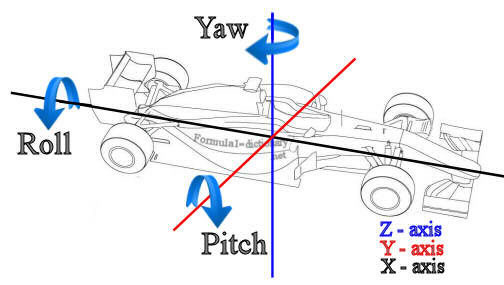
Roll is the side-to-side rotation of a car about an axis extending from the front to back of the vehicle, passing through the centre of gravity. In other words, roll is the rotation of a car about its longitudinal (front/back) X-axis. To better manage roll intensity, teams must calculate a roll centre point. The roll centre is an imaginary, but precisely defined, point on the centre-line X-axis of the car around which the car rolls.
Roll is typically taken to be positive (+) for upward movement on the right side and negative (-) for upward movement on the left side of the car. Rotation about this axis is sometimes also called bank.
Roll occurs in response to cornering centrifugal forces. Teams counter this movement with various anti-roll devices such as anti-roll links, dampers, or bars.
Pitch
Pitch is the front-to-rear rotation of a car about an axis extending from the left to right of the vehicle and through the centre of gravity, the transverse (side-to-side) Y-axis.
Pitch is typically taken to be positive (+) for upward movement of the vehicle nose and negative (-) for downward movement of the nose. The effects of pitch increase as a function of vehicle altitude. Pitch occurs in response to acceleration and deceleration forces and is difficult to counteract. Some advantages can be gained through different suspension set-ups. In recent years, particularly during the 2013 season, Mercedes AMG F1 and Lotus F1 achieved notable results in this area with the FRIC suspension system.
Yaw is the rotation of the nose of a car left or right about its vertical Z-axis, an axis running from the top to the bottom of the vehicle and passing through the centre of gravity.
Yaw angle is taken to be positive (+) when the nose rotates to the right and negative (-) when the nose rotates to the left. Yaw occurs in response to cornering but also to crosswinds. Teams can combat it with different suspension settings and aerodynamic work.
For clarity, roll, pitch, and yaw have been considered independently here, but in reality all three types of movement affect vehicle attitude simultaneously. Each rotation always influences two axes. For example, yaw rotation essentially performs a 2D rotation with respect to the X and Y axes while leaving the Z-axis unchanged. Pitch rotation leaves only the Y-axis unchanged, and roll leaves the X-axis unchanged. Together, yaw, pitch, and roll rotations can place a 3D body in any orientation.
Translational Motions
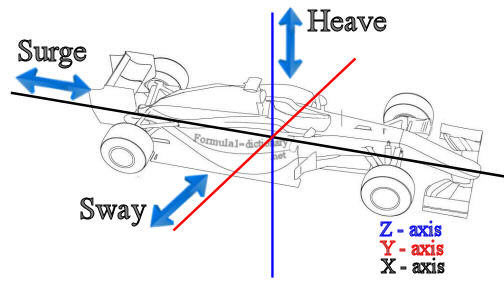
Translational movement is the motion of the car parallel to one of the axes. This movement is linear rather than rotational, unlike yaw, roll, and pitch.
Heave
Heave is the linear vertical up/down motion of a vehicle in response to suspension action, parallel with the Z-axis. Heave occurs in response to downforce, lift, or bumps. Managing heave is critically important because it always affects ride height, which is in turn extremely important for the downforce generated by the undertray and diffuser. Significant gains can be achieved through different suspension settings, and again Mercedes and Lotus demonstrated this with the FRIC suspension system.
Sway
Sway is the linear lateral side-to-side motion in response to centrifugal forces during cornering or drifting, parallel with the Y-axis. The only force causing sway on cars is centrifugal force. Good tyres, smooth power delivery (torque curve), and appropriate suspension setup can all improve car stability. The traction circle is also relevant, but sometimes the laws of physics simply cannot be overcome. Strong sway is particularly demanding on tyre durability.
Surge
Surge is the linear longitudinal front-to-back motion in response to reversing, acceleration, deceleration, and braking, parallel with the X-axis. This term is rarely used in racing; the more common expressions are acceleration, deceleration, or braking. Teams do not specifically design against this motion.
Combined Motions
There are circumstances when two or more motions are combined, as during drifting or trail braking. When drifting at constant speed, sway, roll, and yaw are combined. When trail braking into a corner, surge, roll, pitch, and yaw are combined (this type of motion is sometimes referred to as warp), with sway sometimes adding to the complexity for engineers.
Measurement
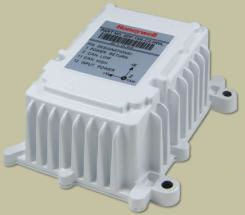
All of these movements are precisely measured during testing and races. Special electronic units – small, compact motion sensors – feature six degrees of freedom to sense translational movement in three perpendicular axes (surge, heave, sway) and rotational movement around three perpendicular axes (roll, pitch, yaw). The unit must provide motion, position, and navigational sensing. To operate in the extreme environment of Formula 1, the unit must be a small, durable single device capable of sensing all six degrees of freedom. Using MEMS (microelectromechanical system) technology, the unit measures the car’s motion and delivers data to the ECU using industry-standard communications protocols. By analysing this data, team specialists can determine which movements need to be suppressed and how best to improve car handling.