Side Skirts
Function
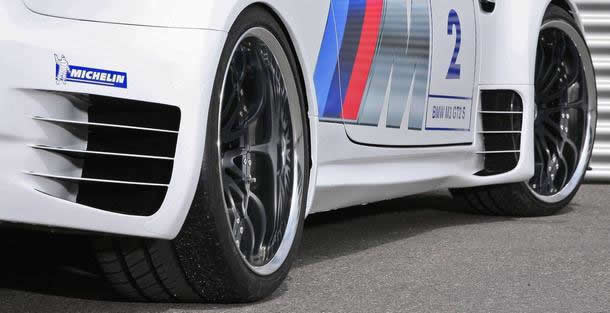
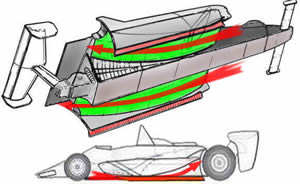
Side skirts are used to reduce the amount of high-pressure air from the sides of the car flowing underneath it. If an air splitter is used, the air under the car is at low pressure, which causes the higher-pressure air on the outside and sides of the car to rush in, diminishing ground effect and downforce.
The effectiveness of the skirts depends primarily on how close to the ground the lower edge can be maintained. That edge should be less than 2 centimetres from the ground; otherwise, the skirts’ effectiveness diminishes rapidly as the gap increases.
Vortex Generators as an Alternative
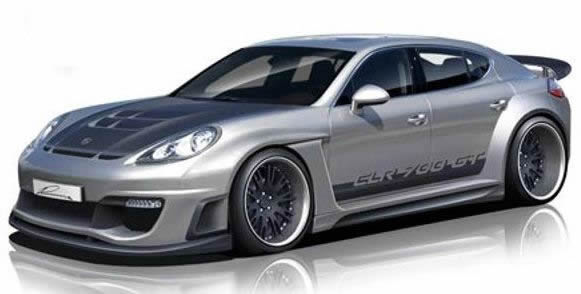
There is another aerodynamic device that helps prevent air from flowing under the car: the front vortex generator. Canards, together with vortex generators, produce strong vortices that travel down the sides of the car and act as a barrier. If positioned correctly, these vortices prevent high-pressure air from around the car from entering the low-pressure underbody region, thus maintaining more downforce.
Road Car Applications
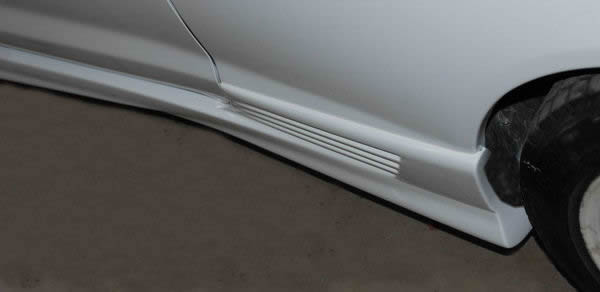
On road-going cars, side skirts are primarily a cosmetic addition to a performance-oriented vehicle. Body kits can dramatically alter the appearance of a car and sometimes improve handling by enhancing aerodynamics. When purchasing side skirts for a road car, it is advisable to look for models with vents on the rear portion of the skirts to ensure that the rear brake discs are adequately cooled.
Low skirts and sills can increase cornering speeds, but a poorly fitted kit can cause grounding on speed bumps or dramatically affect engine cooling. It is important to check the temperature gauge after fitting a kit to ensure the engine is not running hotter.
Body kits should usually be paired with stiffer suspension to maintain ground clearance, although this can affect the everyday usability of the car.
Side Skirts in Formula 1
To know more about ground effect, check out my article here.
Ground effects were first implemented in Formula 1 by Lotus designer Colin Chapman during the 1970s. Teams using Cosworth power plants were seeking a viable solution to compensate for the performance deficit compared to wealthier F1 manufacturers. Maximising the efficiency of their engines through clever aerodynamics was the only approach available to them.
Side skirts in yellow on Lotus79b ground effect car
The term “ground effects” was given to the innovative aerodynamic package designed to create a suction-like effect beneath an F1 car. The cars were practically “glued” to the track through sophisticated undercar styling, leading to extraordinary cornering speeds.
The principle behind ground effect is straightforward. The engineers sought to create a low-pressure area beneath the car which, combined with the high pressure above it, would create a tremendous downward force. In Formula 1, the solution devised by Chapman was to create a revolutionary design for the car’s underside. Its curved styling – like inverted aerofoils – allowed air entering the car’s underbody to accelerate through a narrow mid-section between the car and the ground, thereby creating a low-pressure suction zone.
However, this design alone was not sufficient to generate the expected ground effect, as air entering from both sides of the car would have disrupted the vacuum effect. To prevent this, the Lotus engineers fitted the cars with flexible side skirts, sealing the underside section. While initially made from brushes or plastic, the most effective solution proved to be rubber-built skirts, as they did not wear out during races.
Colin Chapman, with the help of fellow engineers Peter Wright and Tony Rudd, developed the entire concept through the 1976 season and eventually implemented it on the famous Lotus 78 (also known as the John Player Special Mk III), starting at the 1977 Argentine Grand Prix.
Chapman did not initially understand all the effects caused by the innovation, and the 1977-build Lotus 78 suffered from several reliability problems. The airflow from beneath the car interacted with the large rear wing, causing considerable drag at high speeds. In practice, all the advantage gained in corners was counteracted by the poor straight-line performance of the Cosworth engines. The next step, made by Ford, was to improve their V8 power plant. However, race-to-race engine adjustments often led to poor reliability, and the season ended with no fewer than five engine failures for the second-placed Mario Andretti.
The Ban on Side Skirts
Due to the increased cornering speeds in Formula 1 during the 1979 season – which produced lap times some 6 seconds faster than in previous years – the FIA decided to introduce a mandatory flat underside and ban side skirts from F1 cars.