Roll Centre
Definition
The roll centre is an imaginary, but accurately defined, point on the centreline of the car around which the car rolls on its suspensions. The roll centre can be located above the ground, at ground level, or even below the ground (it is only imaginary, after all). A line connecting the rear suspension roll centre with that of the front is called the roll axis. If the axis runs nose-down, the car tends to oversteer. If the axis runs nose-up, the car tends to understeer. The roll centre of a car is the point around which the car will roll when cornering, as viewed from the front or rear.
The location of the geometric roll centre is solely dictated by the suspension geometry. The official FIA definition of roll centre is:
“The point in the transverse vertical plane through any pair of wheel centers at which lateral forces may be applied to the sprung mass without producing suspension roll”.
Significance of the Roll Centre
The significance of the roll centre can only be appreciated when the vehicle’s centre of mass is also considered. If there is a difference between the position of the centre of mass and the roll centre, a “moment arm” is created. When the vehicle experiences lateral acceleration due to cornering, the roll centre moves up or down, and the size of the moment arm – combined with the stiffness of the springs and roll bars – dictates how much the vehicle will roll while cornering.
Finding the Geometric Roll Centre
The geometric roll centre of the vehicle can be found by following basic geometrical procedures when the vehicle is static:
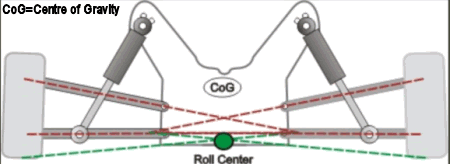
Draw imaginary lines parallel to the suspension arms (shown in red). Then draw imaginary lines between the intersection points of the red lines and the bottom centre of the wheels, as shown in the picture (in green). The intersection point of these green lines is the roll centre.
Dynamic Behaviour
The roll centre moves when the suspension is compressed or extended, which is why it is technically an instantaneous roll centre. How much the roll centre moves as the suspension is compressed depends on the suspension arm length and the angle between the upper and lower suspension arms (or turnbuckles).
As the suspension is compressed, the roll centre rises and the moment arm (the distance between the roll centre and the car’s centre of gravity, labelled CoG in the picture) decreases. This means that as the suspension compresses (when taking a corner, for example), the car has less tendency to continue rolling, which is beneficial – excessive roll is undesirable.
When using higher grip tires, the suspension arms should be configured so that the roll centre rises significantly as the suspension is compressed.
Parallel Suspension Arms
Running parallel, equal-length suspension arms results in a fixed roll centre. This means that as the car leans over, the moment arm will force the car to roll more and more. As a general rule of thumb, the higher the centre of gravity of a car, the higher the roll centre should be to avoid a rollover.