Mass Damper
Background
It’s the year 2006. During this year there were a lot of controversies, and the one which created the most fuss was about the Renault “mass damper.” What is a mass damper and how does it work? What advantages do you get from it?
From Wikipedia:
“A tuned mass damper, also known as an active mass damper (AMD) or harmonic absorber, is a device mounted in structures to prevent discomfort, damage or outright structural failure by vibration. They are most frequently used in power transmission, automobiles, and in buildings.
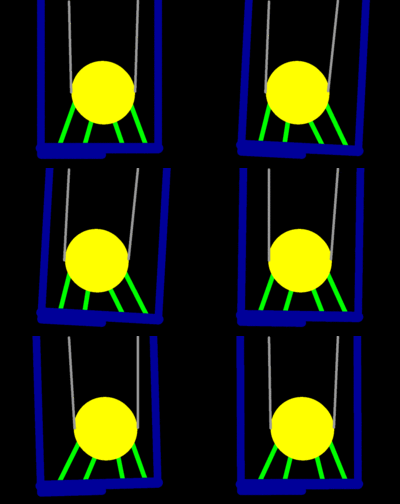
Tuned mass dampers stabilize against violent motion caused by harmonic vibration. The presence of a tuned damper allows the inertia of a great mass to be balanced by a comparatively lightweight structural component, such as a heavy concrete block placed in such a way that the block moves in one direction as the building moves in the other, and damping the structure’s oscillation. The counterweight may be mounted using massive spring coils and hydraulic dampers. If the axis of the vibration is fundamentally horizontal or torsional, leaf springs and pendulum-mounted weights are employed. Tuned mass dampers are engineered, or “tuned” to specifically counter harmful frequencies of oscillation or vibration.”
Introduction to Formula 1
In Formula 1, this technology was first used by Renault at the 2005 Italian Grand Prix and raced relatively unnoticed. However, after the 2006 French Grand Prix, the sport’s governing body declared the device illegal and ordered all teams using it to remove it from their cars.
By 2006, Ferrari, Red Bull, Toro Rosso, and Midland MF1 had all adopted mass dampers, while Honda and McLaren were still testing the concept. Renault and Ferrari had also transferred the principle to the rear of their cars. At Hockenheim, Honda planned to run a system with one mass damper in the nose and another in the fuel tank area, but 13 days before the race the FIA banned the concept, arguing that it constituted a moveable aerodynamic device. This decision was somewhat surprising, given that the FIA had been aware of the device since the previous season and had allowed multiple teams to use it at the start of 2006.
How the Renault Mass Damper Worked
So, how did this stuff work in the Renault F1 car? We must be clear about one thing first: the Renault mass damper was not part of the car’s suspension.
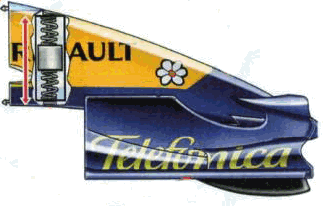
The device was invented by Renault engineer Rob Marshall and consisted of a mass, typically around 9 kg, suspended between two springs. It sat inside the nose of the car, out of plain sight.
Relationship to Suspension and Downforce
A suspension damper acts together with a springing system to influence the vertical movement of an unsprung mass – the respective wheel and tyre assembly and its attendant linkages. The combined motion of the four unsprung masses in turn influences the movement of the sprung mass (the car bodywork). In the case of a Formula 1 car, the term “semi-sprung” is more accurate than “unsprung,” because each tyre itself acts as a spring. Formula 1 cars are very stiffly sprung, since controlling the aerodynamic platform formed by the sprung mass is considerably more important than the enhanced mechanical grip that comes from a more compliant semi-sprung mass. This compromise explains why Formula 1 tyres are specifically designed to function as springs.
The car body may be kept reasonably stable, but the downforce it produces must act through the four tyre contact patches. Constantly changing ride height due to road irregularities, dive and squat causes constantly changing levels of downforce and therefore of grip. This makes the car harder to drive and slightly slower than it would otherwise be. The mass damper was designed to even out those fluctuations and stabilise ride height and downforce.
Internal Construction
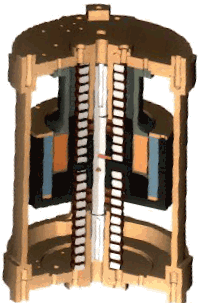
The mass damper was a sealed cylinder located upright in the front of the chassis (nose cone), at a midpoint between the two semi-sprung masses in conjunction with which it worked. Inside the cylinder was a disc sandwiched between two coil springs, and the unit was filled with damper oil. The disc, which in Renault’s case weighed approximately 9 kg, was free to move up and down inside the cylinder except as constrained by the low-rate springs and the fluid. The device was “tuned” either by changing the clearance between the disc and the cylinder bore or by two-way adjustable valving embedded within the disc itself.
Operating Principle
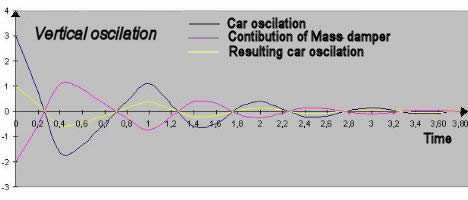
The disc reciprocated in its cylinder in response to movement of the cylinder, which was rigidly attached to the sprung mass (chassis). Track irregularities at a tyre’s contact patch cause continually changing movement of the semi-sprung and sprung masses in the vertical direction. The moving disc inside the mass damper reacted to that movement in the opposite direction, in a manner determined by its weight and by the action of the springs and damping oil. The movement of the disc, transmitted through the springs and oil, applied a calculated opposing force into the chassis to neutralise the effect of vertical movement caused by surface irregularities, counteracting the motion of the sprung mass.
Performance Benefits
In essence, the mass damper reduced vibrations and pitching (dive) of the car, helping to stabilise the front end, especially when the car passed over a kerb at high speed and most effectively through a bend. This maintained front-end ride height and grip levels by pulling the nose down every time the car crested a kerb or a bump mid-corner. As a result, the Renault R26 used its tyre contact patches more effectively and also benefited aerodynamically, as the front end pitched less and remained more stable.
Over the winter break, several engineers left Renault and took the technology to other teams. Rob Marshall, the device’s inventor, moved to Red Bull, where the system was applied to the RB2.
The Ban
It was McLaren who first drew attention to the device as a potential issue, having tried such a system in two tests but without being able to make it work properly. The FIA ultimately argued, in the same way that led them to ban tower-wings from BMW, that they feared teams would develop these concepts into something extreme. One team, for example, had enquired about trying a 30 kg mass damper oscillating not only vertically but also horizontally and diagonally. For those teams able to set the system up correctly, it was a significant advantage.
Ferrari was not opposing or arguing the ban, although they had had these dampers in their cars for some time and they worked well…
Impact on Renault vs Ferrari
There was, however, a crucial difference between Renault and Ferrari. The Renault R26 had been designed around the mass damper system from the outset. The aerodynamics, suspension set-up, tyre usage, and weight distribution were all optimised for a car that ran very smoothly over bumps and kerbs. If the car was suddenly unsettled, aerodynamic performance was lost and the car could not react properly to the disrupted airflow, resulting in reduced downforce and consequently higher tyre wear.
Ferrari, by contrast, had built its car independently of the system and added it afterwards, so the effect of removing it was far less dramatic. Ferrari may have lost one or two tenths relative to McLaren (who never managed to develop the system), but they gained between three and five tenths over Renault – their main rivals that year.
Because the system was of such importance to Renault, Pat Symonds prepared documentation to demonstrate that the primary purpose of the mass damper was better tyre contact with the ground rather than an aerodynamic advantage:
“Whatever we might gain on the aero side is less than 10 percent compared to a simple measure to our conventional suspension setup.”
The FIA’s Legal Argument
The mass damper affair began in the week before the German Grand Prix on 26 July 2006. The FIA wrote to the teams to “clarify” its position on the use of the device. The letter stated:
“While its view in the past had been that they do not contravene the technical regulations, recent evidence and an escalation in development by some teams has made it clear to us that the principle purpose of these devices is to improve the aerodynamic performance of the car”.
The FIA insisted that the regulations demand any part of the car that influences aerodynamic performance must remain fixed and immobile in relation to the sprung mass. Mass dampers directly influence ride height and, with it, downforce and loading of the tyre contact patch. The device potentially permitted the use of stiffer suspension settings and could be seen to indirectly influence the aerodynamic performance of the car. The relevant FIA technical regulations are specific:
**3.15 Aerodynamic influence : **
With the exception of the cover described in Article 6.5.2 (when used in the pit lane) and the ducts described in Article 11.4, any specific part of the car influencing its aerodynamic performance :
- Must comply with the rules relating to bodywork.
- Must be rigidly secured to the entirely sprung part of the car (rigidly secured means not having any degree of freedom).
- Must remain immobile in relation to the sprung part of the car.
**Any device or construction that is designed to bridge the gap between the sprung part of the car and the ground is prohibited under all circumstances. **
No part having an aerodynamic influence and no part of the bodywork, with the exception of the skid block in 3.13 above, may under any circumstances be located below the reference plane
6.5.2 A (Fuel Tank) cover must be fitted over the car connector at all times when the car is running on the track. The cover and its attachments must be sufficiently strong to avoid accidental opening in the event of an accident.
11.4 Air ducts :
Air ducts around the front and rear brakes will be considered part of the braking system and shall not protrude beyond :
a plane parallel to the ground situated at a distance of 160mm above the horizontal centre line of the wheel ;
a plane parallel to the ground situated at a distance of 160mm below the horizontal centre line of the wheel ;
a vertical plane parallel to the inner face of the wheel rim and displaced from it by 120mm toward the centre line of the car.
Furthermore, when viewed from the side the ducts must not protrude forwards beyond a radius of 330mm from the centre of the wheel or backwards beyond a radius of 180mm from the centre of the wheel.
All measurements will be made with the wheel held in a vertical position.
Court of Appeal
The stewards at the German Grand Prix accepted Renault’s argument that the purpose of the mass damper was to influence the loading of the contact patch; consequently, it was not an aerodynamic device and should be considered legal. However, the FIA appealed against its own stewards and the matter went to an FIA Court of Appeal on 22 August. In the meantime, Renault ran the German and Hungarian Grands Prix without mass dampers to avoid the potential loss of points. The court ultimately declared mass dampers illegal.
The FIA stopped the use of mass dampers because of a fear that the devices would become heavier and thus pose a greater safety hazard. The ban harmed Renault, which had used the technology since 2004 and had designed its 2006 car around it, more than any other team.
The J-Damper Successor
To replace the mass damper, McLaren developed the so-called “J-damper.” This suspension device had been developed in secret by McLaren and Cambridge University for use in Formula 1 since 2005, under a confidential arrangement between the team and the university. The device was first conceived by its creator, Professor Malcolm Smith, as early as 1997.
It was raced for the first time by McLaren in 2005, when Kimi Raikkonen achieved a victory at the Spanish Grand Prix. The J-damper is used to improve mechanical grip and offers greater flexibility in a vehicle’s suspension system.
Ferrari appears to have been developing a similar system independently, first racing it during the 2007 Italian Grand Prix at Monza. During that weekend’s practice and race, both Ferrari drivers suffered accidents due to problems with the rear suspension where the J-damper was mounted in place of the third shock absorber.
Lingering Questions
I remain sceptical that Renault’s mass damper was ever illegal. It certainly wasn’t a “moveable aerodynamic device” since it wasn’t in the airflow, and it didn’t affect any aerodynamic surfaces any more than the suspension system itself does. Having the FIA make it illegal mid-season certainly did tighten up the championship race though…..