Refueling
From 2010 onwards, only tire changes are permitted during pit stops. Refueling is banned, and drivers must start with all the fuel needed for the entire race.
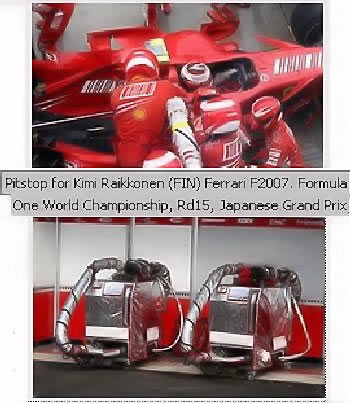
Fuel rig with its signal lamps
| Ferrari team in action |
Fuel rigs ready for action |
The Pit Stop Spectacle
Watching a pit crew work around a car during a pit stop and refueling operation was one of Formula 1’s great spectacles. The pit crew is a highly trained team, and even the smallest mistake could determine whether a race was won or lost.
Refueling was only permitted in team garages or the FIA garage, and only the FIA-approved system made by French company ATL (Aero Tec Laboratories) could be used. Teams were allowed to change fuel loads during any practice session and during qualifying, except for Q3 or after qualifying. Fuel remaining after qualifying had to be used for the race. During the race, refueling was permitted. If the race was suspended, refueling was forbidden.
Origins of Refueling Strategy
Juan Manuel Fangio won the 1957 German Grand Prix after deciding to make a pit stop for fuel and tires mid-race. It was the first time such a strategy had been intentionally used to win a Grand Prix, though that statistic is often forgotten amid the excitement surrounding Fangio’s final win, which he only secured on the last lap. That first pit stop had not gone particularly well, and Fangio would probably have won easily without it, which may explain why no other team attempted refueling as a strategy for another 25 years.
Refueling during races first took place in Formula 1 on 15 August 1982, when Gordon Murray of the Brabham team, run by Bernie Ecclestone, calculated that a quicker race time could be achieved by starting with only half a tank of fuel. That day was the Austrian Grand Prix, the 13th round of the season. Until then, the pit lane was a place to stop only when a car had a problem – for fixing punctures or sorting out broken wings – generally a place to be avoided.
Brabham were one of the first teams to use the thirsty turbo engines of the eighties, and they reasoned that a mid-race pit stop would help overcome the performance drawback of carrying extra fuel. Chief Designer Gordon Murray calculated that by purposely stopping halfway through the race to refuel, the car could run the two stints much lighter, and hopefully faster, than the rest of the field. It also meant that softer tire compounds could be used, since they could be changed at the halfway point. The idea of fuel stops caught on, and a number of teams adopted them the following year, despite Brabham being the only team with a car designed around an efficient half-sized tank.
The Ban and Return of Refueling
The FIA (then known as FISA) banned refueling from 1984. Fuel volume permitted for racing was reduced from 250 litres to 220 litres, with a further reduction to 195 litres intended for 1985. Since in-race refueling was also banned, teams adopted the widespread use of fuel cooling towers to freeze the fuel to approximately -30 degrees Celsius prior to filling the car, thereby reducing the volume and squeezing more fuel into the limited capacity. During this period, fuel and engine development resulted in massive power increases, especially for qualifying.
Exactly ten years later, the sport’s governing body reversed course, feeling compelled to enliven the competition after several years of Williams domination. Attention shifted from fuel and tire conservation to pit lane tactics. At the first race featuring the new regulations in 1994, Michael Schumacher was unable to pass Ayrton Senna on track but gained the advantage through fuel stops. It was a sign of things to come. The fuel load of a car is the single biggest factor affecting its overall speed, and when teams were given the freedom to vary it, a whole new range of strategic possibilities opened up. Pit stop tactics became just as important as speed itself.
Qualifying with Race Fuel
The strategic element of refueling gained even more significance in 2003 when the idea of making drivers qualify with their race fuel load was introduced to mix up the grid and the first stint of the race. This approach largely worked in subsequent years. Renault, Toyota, and Red Bull enjoyed front-row qualifying positions in 2008 thanks to running light fuel loads in qualifying. Although they never had a realistic chance of finishing those races so high up, they prevented Ferrari and McLaren from dominating the Grands Prix from start to finish.
Safety Equipment for Pit Stops
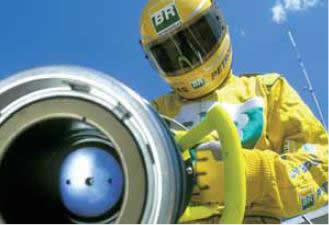
Team members working on the car during a pit stop were required to wear special fire-resistant suits made of Nomex, a lightweight fire-resistant material also used by firefighters. Special helmets with a separated breathing air supply had to be used by team members responsible for the refueling rig. Each team was required to ensure that an assistant equipped with a suitable fire extinguisher of adequate capacity was stationed beside the car throughout all refueling operations.
The Refueling Rig
The refueling rig was a specialist piece of equipment manufactured by a French company and approved by the FIA. Inside the rig tank, fuel was pressurised and lightly chilled to a temperature no less than 10 degrees centigrade below ambient temperature. The fuel was pressurised to allow a faster flow rate, with the maximum set at 12.1 litres per second. The use of mechanical pumps to further increase the fuel flow rate was not permitted.
The FIA could take a one-litre fuel sample from any car at any time during a Grand Prix meeting to check that the fuel being used was legal and matched the sample provided by the fuel supplier at the beginning of the event.
The 2010 Refueling Ban
From 2010, only tire changes are permitted during pit stops. Refueling is banned, and drivers must start with all the fuel needed for the entire race. This puts additional load on the tires, because previously cars were fueled with 50 to 60 kilograms of fuel per stint, whereas post-ban the fuel load is approximately 150 to 170 kilograms.
Engineers must now calculate the precise amount of fuel required for the complete race. Too much fuel means carrying unnecessary weight and losing time; too little fuel means the car will not finish. Fuel calculations per kilometre are developed from pre-season testing onwards, with the engine engineers monitoring consumption closely. Before each session, the race engineer informs the engine engineer how many laps are planned – for example, two runs of one lap in Q3, or 55 laps in the race – and the engine engineer calculates the required fuel load.
Impact on Pit Stop Strategy
With refueling, pit stop duration was approximately 6 to 9 seconds, leaving ample room for strategic manoeuvring and overtaking through the pits. Without refueling, pit stop duration dropped to around 2 to 3 seconds, requiring impeccable strategy. This brief window often proved too short for any meaningful strategic advantage.
Nevertheless, during pit stops in a typical Formula 1 race, positions can still be won and lost by mistiming a stop. The teams have a more sophisticated timing system than the one available to the public and media. It divides the lap into ten sectors, rather than the basic three available publicly, giving them a much faster evaluation of tire behaviour. Rather than waiting over 20 seconds to determine whether tire performance is declining, they can assess it approximately every 8 seconds.
Engineers and computers study the trends and make strategy calls based on the data. This works in two ways: it reveals the precise moment when a tire compound is losing performance, and by reading the sectors of cars already running a different compound, it shows what performance gain rivals are experiencing.
For example, if a driver pits and his lap times improve from 1m 19.7s (old tires) to 1m 17.6s (new tires of a different compound), rival engineers can immediately see the speed advantage from the new tires and decide whether and when to make their own pit stops.
The FIA’s 2010 Rule Changes
The FIA announced further details of changes to Formula 1’s technical rules for 2010. Chief among these was the widely expected banning of refueling. The minimum weight of the cars was also increased from 605 kg to 620 kg, and there were revisions to the rules governing KERS.
The F1 teams’ association originally proposed the refueling ban, though it was initially dismissed by Max Mosley, who felt it would interfere with “the show” too much. However, the teams subsequently convinced the FIA that a ban made sense on cost grounds, as it saved them from having to transport refueling equipment around the world at great expense. A ban had always made sense in pure sporting terms as well.
The consequences for the cars were clear: they would require larger fuel tanks to last a full race distance, and tire wear over a race distance would become more critical with the heavier cars.
It is often suggested that carrying more fuel makes the cars less safe. Logically that might seem to make sense, but given how infrequently F1 cars catch fire, it likely makes little practical difference. Indeed, the number-one cause of F1 car fires – the refueling process itself – would be eliminated, making the change beneficial for safety on the whole.
Reactions After the 2010 Season
By the end of the 2010 season, a clearer picture of the refueling ban’s consequences had emerged. There were varied opinions, with a general feeling among some that the ban was not a positive change for the sport, as it led to processional racing.
Alain Prost and others, however, welcomed the ban, believing it would lead to results being decided on track rather than on the pit wall, encouraging drivers to think more carefully about their racing.
The 2010 season proved to be an exciting one overall, encouraging drivers to take greater charge of their races. There was certainly an increase in the importance of intelligent driving and more on-track overtaking for position.
There was some caution from the teams early in the year, particularly given the lack of race simulations achieved during pre-season testing. However, as the season progressed, teams became comfortable with their fuel strategies and began taking more risks with tire strategy.
The ban had both advantages and disadvantages. Some races, such as Bahrain, Spain, and Monaco, were processional affairs with little on-track action. One advantage of refueling had been that less competitive teams could still qualify high up with low fuel loads. Additionally, with drivers across the grid carrying different fuel loads, the resulting speed differences had created more varied racing.
The main challenge was that if a driver could not overtake another car immediately, they often focused on protecting their tires from the turbulent air, since the tires had to last much longer than in previous years.
There was also the double-edged sword of having everyone on the same strategy. However, without refueling, races like the near-race-long four-way duel for the lead at Turkey and Canada in 2010 – dry races with no one qualifying out of position – would never have occurred.