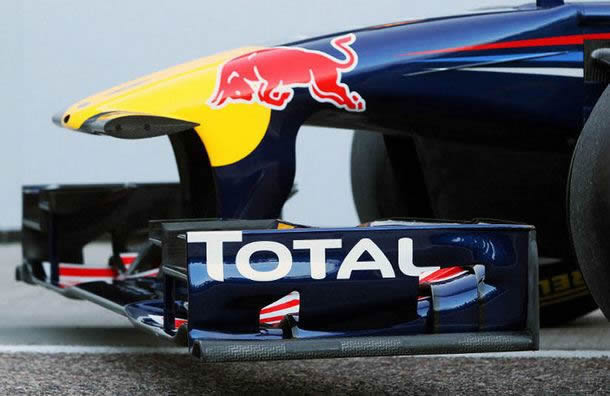
Red Bull Racing Flexible Front Wings
Season 2011
Historical Precedent
Moveable aerodynamics had been made illegal in 1969, but in 1972 the Lotus 72D was fitted with a rubber bush on the rear wing’s mount to allow it to change its angle at high speed. In the pits, a mechanic or scrutineer could put all his weight on it without the wing moving, but under the high aerodynamic loads on a long straight, the angle of the whole wing changed and reduced drag. The wing avoided detection until McLaren’s Denny Hulme spotted Fittipaldi’s helmet appearing above the wing on long straights. At the risk of being exposed, Lotus removed the rubber bush and no further action was taken.
The Red Bull Controversy
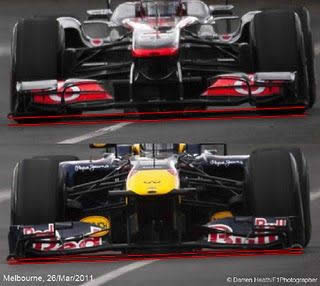
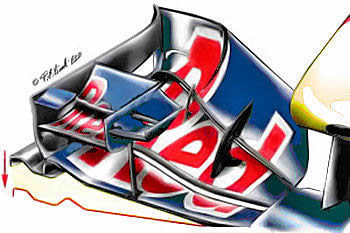
Since the previous season’s Australian GP, I started to notice that the front wings on the Red Bull cars appeared to bend, sometimes even touching the ground and creating sparks. Estimates suggested that the front-wing endplates were deflecting by up to 24 mm. This was later confirmed when McLaren urged an investigation of Red Bull’s front wings and the FIA changed the wing deflection test from a 50 kg load with 10 mm deflection allowed, to a larger 100 kg load with 20 mm permitted.
But why, if the wings passed the test, did they still bend? The answer lies in the properties of carbon fibre, which can be woven in a specific way to behave differently under different loads. The theory is that the wing flexes outwards and down due to a sophisticated layering process of the carbon composite material.
Bristol University’s Aerospace Engineering](http://www.bris.ac.uk/aerospace/research/dynamicsandsystems/aeroelastictailoring.html/view) department provides further details, explaining that:
“Laminated composite materials designed adequately can present elastic coupling properties that can be used to induce an adaptive change. For instance, a composite presenting in-plane elastic coupling that is loaded under normal loads experiences a shear deformation. The proposed morphing design consists of a wing made of laminated composite materials presenting elastic couplings so as to induce twist when the wing bends. This concept, if proven, could provide a passive actuation for the control of the wing twist.”
Why a Flexible Front Wing Matters
But why do we want the front wing to twist and bend? Front wing ground effect is the key. To understand it, we must know that the principal point is that front-wing ground effect depends upon two mechanisms: firstly, as the wing gets closer to the ground, a type of venturi effect occurs, accelerating the air between the ground and the wing to generate greater downforce. Secondly, a vortex forms underneath the end of the wing, close to the junction between the wing and the endplate, and this both produces downforce and keeps the boundary layer of the wing attached at a higher angle of attack.
In this regime, the downforce increases exponentially as the height of the wing is reduced. Beneath a certain critical height, however, the strength of the vortex reduces. Below this height, the downforce will continue to increase due to the venturi effect, but the rate of increase will be more linear. Eventually, at a very low height above the ground, the vortex bursts, the boundary layer separates from the suction surface, and the downforce actually reduces. That is the ideal case. However, the presence of a rotating wheel immediately behind the wing complicates matters further.
FIA Testing Procedures
The technical regulations state that a front wing must be no lower than 75 mm above the reference plane, which is the lowest point of the car excluding the plank. To check compliance with this rule, 1000 N (approximately 102 kg) loads are applied to the two ends of the front wing in scrutineering at a distance of 790 mm from the car centre line and 800 mm forward of the centre line of the front wheels. Movement of no more than 20 mm (10 mm from 2013) is allowed. The FIA brought into force a stricter test in which loads are applied either simultaneously or on one side at a time.
The 1000 N (approximately 102 kg) test remained the one in force in 2011, and although this was the best the FIA could do given the strength of the wing at the point of testing, it was woefully ineffective. By rule of thumb, an F1 car’s front wing produces approximately 35% of the total downforce, and with cars producing over 2,000 kg of downforce, front wings are subject to a massive load of almost 7,000 Newtons (700 kg).
|
For season 2013, the FIA overhauled testing procedures for front wings, introducing a more comprehensive and strenuous series of tests designed to root out the practice of exploiting flexible bodywork regulations. Front wings in particular were subjected to revised parameters, with a tolerance of just 10 mm (0.39 in) permitted when the wing is subjected to a load of 1000 N (102 kg). There is nothing in the rules about rotation of the wing, so the FIA moved the point of application of the load test from a single point roughly on the centre line of the wing, to loads at two points, one towards the front and one towards the back, to try to catch any wings moving in that way. The wings are allowed to deflect just 10 mm. Aware of the possibility that some teams could be using designs that passed the old tests but still rotated at high speed, the FIA tweaked its testing so that the area being tested is now 150 mm further out, 945 mm from the car centre line and at any point along a 300 mm section of the endplate (at points 675 mm and 975 mm forward from the front wheel centreline). This new test should ensure that any attempt by teams to utilise the rotating wing principle would be exposed. This limits the amount the main planes of the wings can rotate, but there is still no test for the flaps backing off. They can still flex, and they will. Controversy over front-wing flexing is likely to continue. |
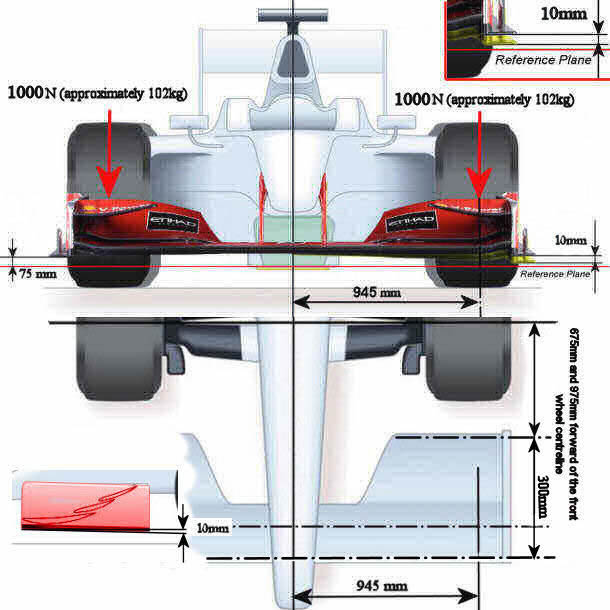
Despite the controversy about their flexible front wing, Red Bull passed this test, leaving their rivals striving to develop similar solutions.
Carbon Fibre Lay-Up
Realising the desired front-wing performance not only requires the development of a special type of simulation technology, but also an understanding of how to implement the requisite elasticity via the orientation of the carbon-fibre plies. A number of rival teams were caught out in terms of front wing development because they believed the tougher 2011 tests would rule out the idea of a flexible wing working. Because the test changed over the winter, teams did not put any effort into that area. But Red Bull demonstrated that a perfectly legal approach could yield a significant advantage.
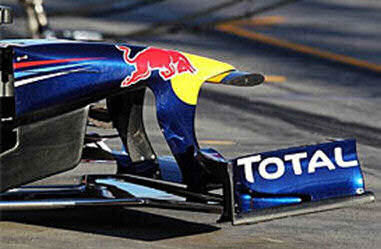
After all FIA tests performed on the Red Bull front wing, there was no question about Red Bull Racing’s legality. The only options going forward were either even more stringent FIA tests to tighten up that area of car design, or for rival outfits to copy it.
Gary Anderson’s Analysis
From Autosport:
Gary Anderson:
Red Bull Racing Flexible front wings explained
AUTOSPORT technical guru and former F1 designer Gary Anderson analyses the most controversial element of Red Bull’s car.
Flexible front wings; the one single thing that most F1 teams think is key to Red Bull’s current aerodynamic advantage. But there’s a little bit more to it than that.
The science
The key to creating overall car downforce is to manage the way air separates around the front wing. This component is the first to influence the air flow and if this is badly managed, the rest of the car will suffer. This becomes easier the closer the wing runs to the track surface as it is basically running in what is called ‘ground effect.’ This not to be confused with WIG (Wing In Ground Effect)
Of course, the FIA mandates a minimum wing height relative to the underneath of the chassis and it also applies a load versus deflection test to eliminate any serious deflection. But if a team can make its wing flex as much is permitted when subjected to the kind of aerodynamic load that speed creates, it can make the wing sit lower and therefore manage the air separation more efficiently. This is what helps you create that extra downforce.
What Red Bull has done better than anybody else is to stop this process adversely affecting the rest of the car, and in particular, the outboard area in front of the front tires.
If you don’t manage the airflow separation in this area, the downforce becomes inconsistent and if your front wing is ‘ridged’ this causes the complete car to bounce up and down.
As the wing gets lower to the ground, the airflow separates (from the wing) and the downforce is reduced. The car rises up, the wing re-attaches, and more downforce is created, which sucks the car back towards the ground. This phenomenon is called ‘porpoising’, and the McLaren has been quite noticeable in doing this during 2010 and 2011.
The wing
If you say that aerodynamics determines 90 per cent of a car’s performance, then the front wing is 60 or 70 per cent of the 90, and that’s because it’s the part that hits the air first and dictates how it flows over the rest of the car.
If your front wing creates a turbulent wake or poor vortex generation, then every component you develop downstream of the front wing is optimized to work in that environment.
However, if the wake is good, then the downstream aerodynamic surfaces can be made to work harder and the complete package will than create more overall downforce.
Development of any racing car starts at the front and sweeps through to the rear; change the front wing configuration and you might not see any improvement until you optimize the rest of the car around it and that is why there is no quick remedy if a team is off the pace.
The execution
Red Bull has optimized carbon fibre technology by a very clever means. Carbon fibre is a bit like rope, the more load you want it to withstand, the thicker the piece you use. Carbon fibre comes in many forms and can be layered up any way you want. Lay it out in straight lines, and it’s tremendously strong in terms of tension; lay it out at an angle to the load path, and, despite it being the same strength, it will flex under a given load.
Getting the lay-up just right to allow you to pass the FIA load to deflection test, but yet still increase the deflection as the load increases with speed is no easy task. But it is possible and that is why the teams employ high-priced boffins to come up with solutions to this type of problem.
It’s not something that’s exclusive to Red Bull either; everybody’s wings flex, it’s just to make it flex in the way you want and in what extent that they flex that is the bone of contention here.
The rake argument
| |
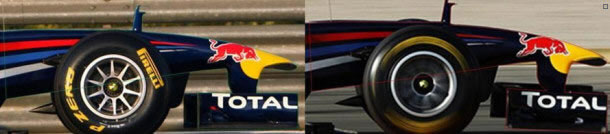
Red Bull car stationary | Red Bull car at speed |
The Rake Factor
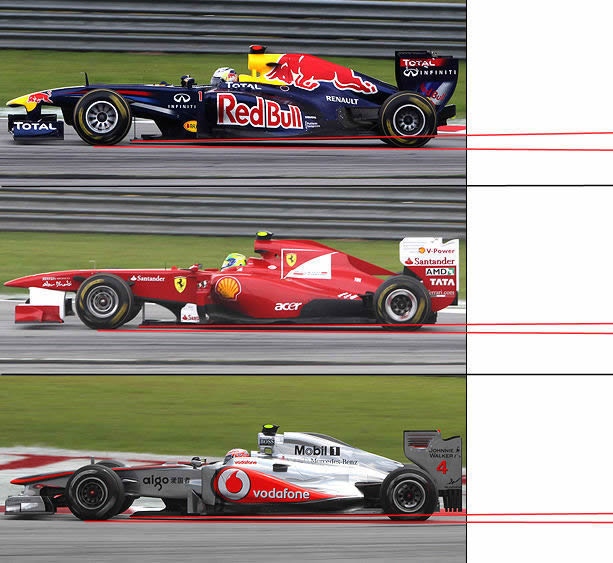
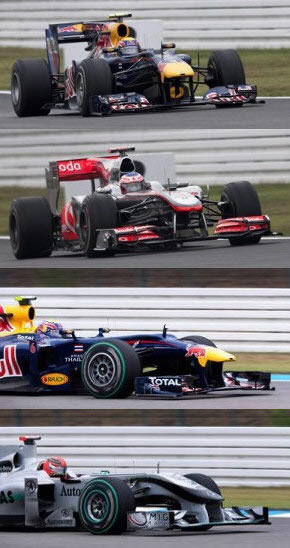
If one studied a photo of a Red Bull alongside another car in China 2011, the front wing of the Red Bull appeared to be much closer to the ground. While rivals argued this was the result of excessive flexing, Red Bull contended that it was down to the rake of the car: the RB7 had approximately the same front ride height as everyone else, but the rear of the car was run much higher in order to maximise aerodynamic efficiency, creating a rake shape. This meant that the front wing looked lower to the ground as it sat ahead of the front axle.
|
We can easily see that the RB7 is in fact running a high rake angle. The rear end of the car is much higher than the front end.In comparison, the McLaren and the Ferrari are running almost flat. |
The rake itself is fundamental to a car’s aerodynamic specification. With a car that is higher at the rear, the aerodynamic centre of pressure can be further forward at lower speeds, which helps reduce low-speed understeer. As the car speeds up, the rear lowers itself and, if the diffuser works correctly, the centre of pressure moves rearward, making the car more stable in fast corners.
The optimum rake varies from circuit to circuit, but by having a rake change ratio of less than 3:1 (in other words, if the front suspension compresses around 10 mm, the rear should compress around 30 mm), the car will not perform as well as it potentially could, and this can only be counter-acted by running a stiffer car and sacrificing some mechanical grip and suspension compliance.
If the front ride height of both the Red Bull and the McLaren were, for example, 25 mm, and Red Bull ran a 75 mm rear ride height compared to McLaren’s 50 mm, that would give a 25 mm difference in rake.
Considering that the wheelbase is around the three-metre mark and that the front wing leading edge is about one metre in front of the front wheel centre line, the front wing of the Red Bull would start life about 8 mm lower than the McLaren’s.
As the principles outlined suggest, this creates more front downforce at low speed.
If a Red Bull was running a 3:1 stiffness ratio and a McLaren – because of its lower rear ride height – was running a 2:1 stiffness ratio, then at high speed the front wing would end up at approximately the same height. Beyond that, Red Bull had superior expertise in optimising the wing lay-up, giving them an advantage throughout the speed range.
The art of copying
| |
Red Bull car on the track at speed | Red Bull car in the pits |
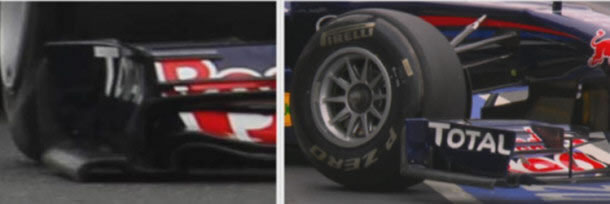
It would not be easy for rival teams to copy Red Bull’s wing and simply find a few tenths of a second straight away. If a Red Bull front wing were placed on any other F1 car in a wind tunnel, it would likely be worse than that team’s current configuration.
That is because it was not just the wing that made the Red Bull the best car aerodynamically – it was the entire aerodynamic philosophy of the car, with everything working in sync.
Designers and engineers were intelligent enough to know this, and this was the reason why nobody had tried to copy Red Bull directly.
The solution
All the FIA tests proved that the Red Bull front wing was totally legal, despite what rival teams believed. As long as this continued to be the case, the only options were for even more stringent FIA tests to tighten up that area of car design, or for rival outfits to accept that Red Bull had done a superior job.