Rake Angle
Red Bull’s High-Rake Philosophy
During 2010 and 2011, designer extraordinaire Adrian Newey’s blown exhaust design on the Red Bull F1 car became the most obvious example of rival copy-catting in Formula 1. Newey took a sanguine approach to questions about the flexibility of his car’s front wings (especially from the boys at McLaren), calling the discussion “a bit boring.”
“To be honest, it’s a bit boring,” he said. “I’ve had a season of people moaning about our front wing (flexibility) last year. The tests were made more rigorous by the FIA, it’s examined in great detail… I mean, frankly, I think it’s an effort by one team in particular to get a change in regulations because the regulations are very clear in terms of what you can and cannot do with the front wing. The rest comes down to how you run the car. We choose to run the car with quite a lot of rake; that means high at the rear, low at the front. Others, McLaren for instance, have chosen to take the opposite route. They run the car quite low-rake. Once you run the rear low, which means the front wing is automatically high.”
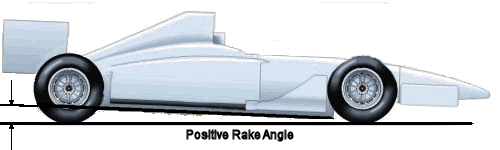
Journalist Ralf Bach wrote that the RB7’s so-called “rake” was also being emulated. The aggressive rake – the car’s attitude from front to rear – was the most likely reason the Red Bull generated additional downforce, amid the mystery previously attributed to flexing front wings.
“Der Spiegel” reported that Force India and Ferrari were among the teams emulating Red Bull’s high rear end, with the result that the front of the cars was lower to maximise the ground effect component of front-wing downforce (with the use of exhaust-blown diffusers to retain rear downforce). Front-wing ground effect had always played a role, but the current emphasis was perhaps a consequence of the 2009 technical regulations, which permitted the front wing to be much closer to the ground. An unnamed FIA official was quoted as confirming that the Red Bull sat noticeably higher at the rear.
Mercedes’ Ross Brawn, however, doubted that simply copying Red Bull was the answer, noting that a copy is never as good as the original.
What Is Rake Angle?
Since over 45% of a car’s downforce comes from the undertray and around 35% from the rear, this is a crucial area to get right. It is not simply a case of raising the ride height; work must be done on bodywork, floor, and exhausts to maximise the benefit.
The rake angle is the deviation of the floor plane from the horizontal. A positive rake angle means the rear is higher than the front, while a negative rake angle would mean the front is higher. Negative rake is not used in racing.
On any Formula 1 car – and any prototype LMP car – the nose part of the flat bottom is closer to the ground than the tail portion. The resulting angle is referred to as the rake angle, typically 2 to 3 degrees. This small rake angle creates a shallow ground-effect tunnel that produces the vast majority of the total downforce generated by the car. Although the angle that the flat bottom makes with the road is barely perceptible, it makes a huge difference in the downforce generated. When a team experiments with a large change in rake angle setup for a particular track, they might adjust the height at one end of the car by just 2 to 3 millimetres – an indication of how critical the rake angle is.
How Rake Generates Downforce
There are two significant effects of rake. First, a steeper rake angle accelerates the airflow beneath the car due to a greater release of pressure as it flows past the lowest point of the floor. The rake angle generates a venturi-like effect under the floor, where the majority of the ground effect (downforce) is produced. This angle is extremely sensitive; even a few millimetres of change at either end of the car can significantly affect downforce.
A sportscar with almost 10 m2 of bottom area (approximately 6 m2 for a Formula 1 car) has enormous potential for producing ground-effect downforce. However, this only works if the surface facing the ground is manufactured with great precision and stiffness.
According to engineers from rival teams, the higher rear end of the Red Bull artificially added volume to the diffuser, effectively making it “think” it was bigger than it actually was. The whole concept appeared to be more efficient at creating overall pressure change and downforce from the floor and the diffuser.
From 2011, diffuser regulation changes limited the angle of the diffuser walls. By raking the car (lowering the front and raising the rear), teams could effectively make the diffuser steeper without violating the rules, since the regulations restricted exit height. Newey effectively increased the diffuser angle relative to the ground within the letter of the regulations.
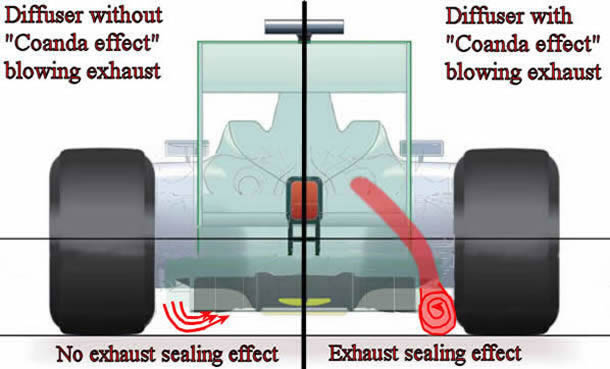
However, it is very difficult to keep the diffuser working well at high rear ride heights. With increased height from the floor, a significant amount of air can leak into the diffuser from the sides, reducing overall performance. To work efficiently, the sides of the diffuser must be sealed to prevent air ingress. Around 2011, Red Bull used exhaust gases and sidepod design more effectively than any other team to “seal” the diffuser and keep the airflow working through the underfloor area. After the blown diffuser was banned, other solutions had to be found to seal the diffuser.
Sealing the Floor Without Exhaust Blowing
After the exhaust sealing effect could no longer be exploited, a different question arose: why were not all teams simply jacking up the rear ride height? The answer is that when rake angle increases, the sides of the floor move away from the ground, which reduces ground effect as low pressure leaks from the upper side of the underfloor.
To increase the rake angle, teams must also seal the floor using complex aero structures that stem from the front wing. The Y250 vortex is often discussed for this reason: a stable vortex that can span a great distance along the car improves that seal.
Effects on Car Behaviour
Increased rake may also have an impact on the centre of pressure, potentially moving it forward. This makes it possible, at higher speeds, to pull the front of the car closer to the ground – front wing included – creating the visual effect of flexing wings. The reality was not so much that the Red Bull wing flexed excessively; rather, the whole front of the car was moving. Additionally, carbon fibre can be woven in specific ways to behave differently under different loads. The theory was that the Red Bull RB6 and RB7 wing flexed outward and down due to a sophisticated layering process of the carbon composite material. But the magnitude was less than rival teams tried to suggest. It was primarily the movement of the car body, with only a minor contribution from wing flexing itself.
|
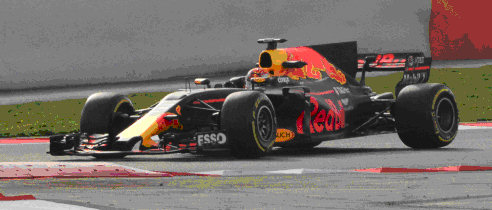
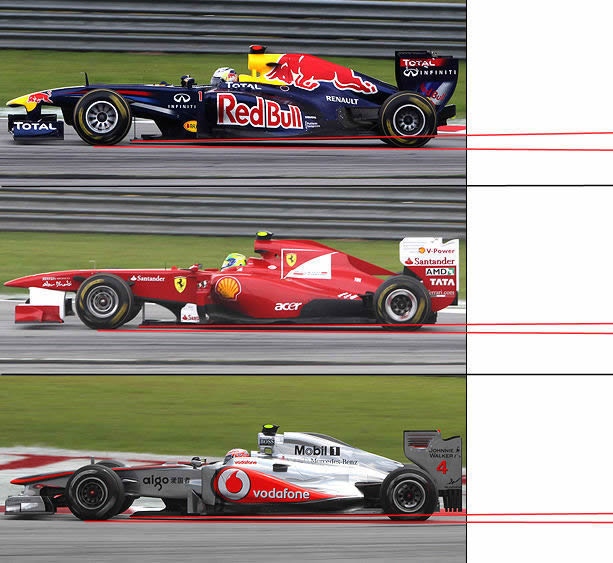
We can easily see that the RB7 is in fact running a high rake angle. The rear end of the car is much higher than the front end.In comparison, the Ferrari and the McLaren are running almost flat. Mclaren more than Ferrari. |
Furthermore, the nose-down attitude of the car puts the front wing further into ground effect, improving not only its performance but also all downstream components, as downforce is increased without additional drag.
The trick also comes from finding a speed threshold where the rear wing is effectively switched off. This happens when the car’s rake is reduced: as the aerodynamic load at the back builds with speed, the car is forced toward the ground, which in turn rotates the wing and overloads it, stalling the flow and reducing both downforce and drag. Just a few degrees of rotation is enough.
It is important to note that every part of the Red Bull must be viewed as a whole concept, not as individual pieces. The sum of all parts is what made the RB6, RB7, and subsequent models such effective cars. Rival teams such as McLaren and Ferrari could not simply jack up the rear end of their cars and expect a sudden gain in downforce.
Weight Transfer and Setup Complexity
The other major effect is on weight transfer under braking or acceleration, as the mass of the car is more or less “preloaded” toward the front end.
However, none of this is simple. Care must be taken with the car setup. Static rake (with the car stationary) is one thing, but what matters is where the rake sits under dynamic conditions – and having an understanding of where the rake should be at certain points on the track. The roll centre of the car and pitching behaviour during the braking period must all be calculated.
If the car is already at the limit of its mechanical setup and ride heights are adjusted to achieve the desired rake, it can create a mess. If something else drifts away from the target, reality will not match expectations.
Another consideration: the smaller the throat of the flat bottom (low front ride height), the more quickly the diffuser will be starved of airflow. Small ride heights do not allow steep, large diffusers, and the transition between floor and diffuser is highly critical for angle and radius.
F1 cars, with their stepped bottom and sidepods starting only at half the wheelbase, will always have an entry height of 50 mm (by the rules) to the stepped flat bottom, so starvation is not a concern. This allows teams to exploit steeper diffuser angles for the sides. To fill the centre section, additional flow from the sides or step plane may also be needed. On top of all this, Newey used the blown diffuser to energise flow inside and around the diffuser area and to seal the diffuser and keep airflow working through the underfloor area.
Wheelbase and Rake Comparisons (2017-2018)
An article published by Motorsport.com in September 2018 by Giorgio Piola compared how the three leading teams (Mercedes, Ferrari, and Red Bull) approached rake angle and wheelbase for the 2017 and 2018 seasons.
Wheelbase** ** | Rake** ** | |
Ferrari 2017 | 3551mm | 1.28 degrees |
Ferrari 2018 | 3621mm | 1.53 degrees |
Mercedes 2017 | 3726mm | 1.2 degrees |
Mercedes 2018 | 3726mm | 1.25 degrees |
Red Bull 2017 | 3407mm | 1.9 degrees |
Red Bull 2018 | 3550mm | 1.9 degrees |
Diffusers and Rake
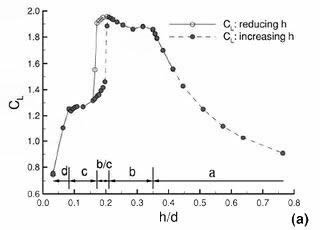
Maximising the downforce of the diffuser is a subtle issue. The downforce generated by a diffuser is a function of two variables: (1) the angle of the diffuser, and (2) the height above the ground.
Generally speaking, the peak downforce of the diffuser increases with its angle. Then, for a fixed diffuser angle, the downforce generated increases according to an exponential curve as the height reduces, until a first critical point is reached (see the diagram above, taken from Ground Effect Aerodynamics of Race Cars, Zhang, Toet and Zerihan, Applied Mechanics Reviews, January 2006, Vol 59, pp33-49). As the height is reduced further, the downforce increases again, but according to a linear slope, until a second critical point is reached, after which the downforce falls off sharply.
Without running any rake, the diffuser is limited by regulation to a shallower angle than seen in previous years. By increasing the rake, the effective angle of the diffuser is increased, thereby increasing the potential peak downforce. However, increasing the rake also has the effect of increasing the height of the diffuser.
So, how does one combat the detrimental effect of increasing the height of the diffuser? Well, the key, I think, is to understand exactly how a reduction in height increases the downforce generated by a diffuser. The crucial point is that the edges of the diffuser generate a pair of counter-rotating vortices, and the magnitude of the downforce generated is determined by the strength of these vortices. The downforce increases exponentially as the height is reduced, because the strength of these vortices is increasing. The first critical point corresponds to the height at which the vortex strength begins to decrease, and the second critical point corresponds to the height at which the vortices break down.
To mitigate the downforce-reducing effect of an increase in diffuser height, one simply uses the exhaust gases to boost the strength of the side-edge vortices to levels otherwise seen at lower heights.
In reality, this is a simplification, because the exhaust gases playing on the sides of the diffuser have two effects: (1) strengthening the side-edge vortices inside the diffuser, and (2) acting as air curtains, preventing the ingress of turbulent air created by the rotating rear wheels.
With exhaust-blown diffusers banned, the challenge became finding other ways to boost the strength of those side-edge vortices. Achieve that, and the car could still be run with a significant degree of rake.