Flags
Overview
Different coloured flags have been in use since the early days of motor racing to communicate with drivers about track conditions, penalty situations, and the start and end of a race. Marshals positioned at various points around the circuit are issued a set of standard flags to relay these messages to drivers.
The same applies to Formula 1. However, F1 would not be F1 without something highly technological involved. A special display on the steering wheel, with differently coloured lights matching the colour of the relevant flag, illuminates when a driver passes the affected sector of the track. This system is known as the GPS marshalling system. It was invented and introduced because at such high speeds, or because of adverse conditions on the track, a driver sometimes cannot see a marshal’s flag. The signal to the GPS marshalling system lights is sent to the car from race control.

Formula 1 Flag Signals
Checkered flag
Indicates the start or end of the race. In Formula 1, it signals only the end of the race. It also indicates the end of practice and qualifying sessions. At the end of the race, it is shown first to the winner and then to every car that crosses the line after. For the starting procedure in Formula 1, check here.
Yellow flag
Danger on the track ahead of the given signal. A single waved yellow flag, as described in the FIA Sporting Code, warns drivers to slow down. Drivers should reduce their speed and be prepared to change direction, as there is a hazard beside or partly on the track. It must be clear that a driver has reduced speed, and a driver would be expected to have braked earlier and/or reduced speed in the relevant marshalling sector. During a yellow flag period, overtaking is prohibited unless it is clear that a car is slowing with a completely obvious problem.
Double waved yellow flag
Danger on the track ahead of the given signal. Any driver passing through a double waved yellow marshalling sector must reduce speed significantly and be prepared to change direction or stop, because there is a hazard wholly or partly blocking the track and/or marshals working on or beside the track. For the stewards to be satisfied that a driver has complied, it must be clear that the driver has not attempted to set a meaningful lap time; in practical terms, this means the driver should abandon the fast lap. During a double yellow flag period, overtaking is prohibited unless it is clear that a car is slowing with a completely obvious problem.
Green flag
All clear. The driver may continue racing. Any incident that was causing a single or double waved yellow flag has been resolved.
Red flag
Stop. The session is suspended. Drivers must significantly reduce their speed and return to the pit lane. Overtaking is strictly prohibited and also pointless, as if the session does resume, it will do so with drivers in the order they were in when the red flags were shown.
Blue flag
Indicates that the driver is about to be lapped. The driver must allow the faster car to overtake. If the driver does not comply after three blue flags shown in succession, a penalty may be imposed.
Yellow and red striped flag
Indicates a slippery track surface ahead, usually because of oil or water.
Black with orange circle flag
Shown together with a car number, it warns a driver that the car has a mechanical problem and must return to the pits. If the team can fix the issue, the driver may rejoin the track.
Half black, half white flag divided diagonally
Shown together with a car number, it warns a driver of unsporting behaviour. It may be followed by a black flag if the driver does not comply with the warning.
Black flag
Shown together with a car number, it orders a driver to return to the pits. Most often it is used to signal that the driver has been excluded from the race.
White flag
Warns racing drivers of a slow-moving vehicle on the track, such as an ambulance, service vehicle, or fire crew.
Electronic Flags
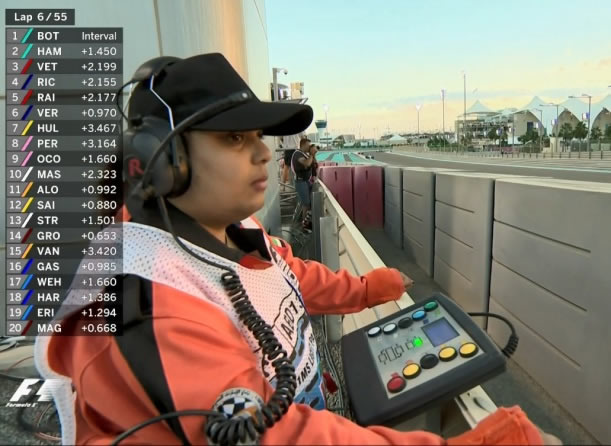
But as we all know, F1 is moving forward every day. Close observers of the 2008 winter testing at Barcelona may have noticed the conspicuous absence of marshals waving caution flags when something went wrong. That’s because F1 was trialling its latest innovation in driver safety: the electronic flag.
Placed visibly in the braking zones, these large displays can change to all the applicable F1 flag colours, and are said to be much easier to see than a marshal waving from the sidelines. The FIA had considered electronic flags for some time, recognising the benefit of the race director being able to deploy flags from a central location.
Trackside marshals, in direct communication with the race director, activate a certain colour panel from their local control position.
With these electric warning signs connected to a standard control unit, teams can easily integrate the software into their existing GPS marshalling system already installed in the cars. From the 12 November 2017 Brazilian GP, blue flag signals were also included in the marshalling lights within the car.
Yellow Flag Rules in Detail
The most frequently displayed flag is the yellow flag, indicating danger on the track. During a yellow flag period, drivers must proceed with caution and overtaking is strictly forbidden within the yellow zone, which is indicated by yellow flags waved by trackside marshals, flashing trackside yellow lights, and by an indicator on the car’s steering wheel (GPS marshalling system). The rules dictate that the yellow zone ends only when the driver passes the first green indicator. If a driver is caught overtaking in a yellow-flag zone, the punishment is either a drive-through penalty or 20 seconds added to the driver’s race time if the incident occurs close to the end of the race or is investigated afterwards.
Resolving Signal Discrepancies
Just to clear a few things. If there is any discrepancy between what is displayed on a driver’s dashboard and what is shown trackside, then the trackside flags and lights take precedence. If there is any discrepancy between a trackside light and a flag, the first signal displayed is what counts, whether it is a light or a flag. For example, if a yellow flag is displayed followed later by a yellow light, the no-overtaking zone begins at the first yellow signal, which would be the flag.
Similarly, if after a yellow flag period a green flag is waved before a green trackside light board is displayed, the first green signal is the one that counts. When there are consecutive signals from both a flag and a light, it is always the first one that takes effect.
Premature Chequered Flag
Under the regulations, a premature waving of the chequered flag (whether by mistake, miscommunication, or any other reason) results in the final standings being determined by the positions at the end of the previous lap. Article 43.2 of the sporting regulations states: “Should for any reason the end-of-race signal be given before the leading car completes the scheduled number of laps, or the prescribed time has been completed, the race will be deemed to have finished when the leading car last crossed the [finishing] line before the signal was given.”
The reason for doing that is to make sure that if there was some confusion, going back to the previous lap produces a true race classification. It’s like when a race is stopped (red-flagged) and cannot be restarted – you take it back to the lap before the red flag was shown.
NASCAR Flag Signals
NASCAR racing has some differences from Formula 1 flag signals. In addition to individual flag signals, the flagman can use combinations of rolled flags. The flagman is the person standing on the tower above the Start/Finish line who controls the race with a series of flags.
- By crossing two rolled-up flags into an “X” shape: indicates the halfway point of the race; usually shown with the white and green flags
- By crossing the black and white flag: indicates that scoring has been discontinued for that car
- By holding a hand out with all five fingers spread wide apart: indicates five laps to go
- By showing the white and green flags rolled up and held next to each other in an upward position: indicates two laps to go
- By displaying the yellow and checkered flags together: indicates there has been an accident in the back of the field; the race is over, but drivers should be careful because the track is blocked ahead

The Flags of NASCAR Racing
Green: Start or Restart - Course Is Clear
All races start with a green flag. The green flag is also displayed on restarts during an event.
Yellow: Caution - Slow Down and Hold Your Position
Signals the drivers to slow down because of a problem on the track, including accidents, debris, fluids on the track, or other hazards. Drivers are required to slow down, exercise caution, and maintain their relative position. Cars may not pass (advance a position) under the yellow flag, but the balance of the field may close up behind the leader.
Black: Pull Into Pits
No driver likes to see the black flag, which is given to send a driver to the pits for either a problem with the car (an oil leak, for example) or another infraction such as improperly lining up on a restart or rough driving. This flag will be shown twice. If a driver does not comply, disqualification from the race follows.
Red: Stop - Bad Wreck - Course Blocked
If the situation warrants a total stoppage of the race, such as rain, the flagman will display the red flag, telling drivers and crews that the race is being halted due to an unsafe condition.
Blue/Yellow Diagonal Stripe: Move Over - Use Another Lane
The most commonly used flag during a race, known as the move-over flag. This flag is given to a car being overtaken by lead-lap cars and asks the driver to give the leaders the courtesy of moving over.
White: One Lap To Go
Indicates to the driver that the last lap has begun. During road course events, the white flag may also be used by corner workers to indicate that an emergency vehicle is on the racetrack.
Checkered: Finish
Indicates the completion of the race.
FIA Technical Regulations
What the FIA 2013 Formula One Technical Regulations say about track signal displays:
8.9 Track signal information display:
All cars must be fitted with red, blue and yellow cockpit lights the purpose of which are to give drivers information concerning track signals or conditions. The lights must be LEDs each with a minimum diameter of 5mm and fitted directly in the driver’s normal line of sight. Details of the light control system, which must be fitted to every car, may be found in the Appendix to these regulations.
FIA Sporting Code
What the FIA Sporting Code says about marshal duties:
148. Duties of road observers and flag marshals
The track or road marshals shall occupy, along the course, posts assigned to them by the stewards of the meeting or the organising committee. As soon as a meeting begins, each track or road marshal is under the orders of the clerk of the course to whom they shall immediately report by any means at their disposal (telephone, signals, courier etc.) all incidents or accidents which might occur along the section for which they are responsible.
Flag marshals are specifically entrusted with flag signalling (see Appendix H). They may also be track or road marshals.
At the end of each competition, all track or road marshals must give the clerk of the course a written report on the incidents or accidents recorded by them.
During competitions, and unless otherwise instructed by the clerk of the course, track or road marshals shall, as far as possible, inform the central bureau of information concerning the order in which competitors have passed their post. This shall be effected lap by lap in the case of a closed circuit.