Racing Firesuit
The Value of Protection
Did you know that you get more than twice as much fire protection from an SFI-5 rated suit versus an SFI-1 rated suit?
Did you also know that there is about a $200 difference between a single-layer and double-layer suit?
How many square centimetres of skin graft can you buy for $200?
Overview
Formula 1 and the wider racing world owe their high safety standards not only to the use of computer technology and high-tech materials in car construction but also to the consistent enhancement of helmets and racing overalls. These items not only protect the drivers from injury in emergencies but also provide a feeling of security.
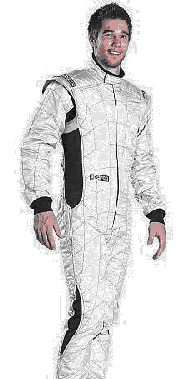
The first fire-retardant racing suit was manufactured by the Indianapolis company J.B. Hinchman over 80 years ago. Conceptually, the suit has changed little over those eight decades: the idea is still to provide protection from fire. However, today’s suits bear little resemblance to their early counterparts. High-tech materials, proprietary stitching patterns, and fashionable designs not only set drivers apart in the winner’s circle but also save lives on the track.
The Importance of Fire Protection
Driver’s clothing plays a very important role in racing, offering significant protection against the risk of fire. Fires are becoming rarer in Formula 1; however, the firesuit remains an integral part of the safety equipment used by all teams. Overalls, boots, and gloves are all made from special fireproof materials that ensure the driver will be protected if trapped in a burning car until the flames can be extinguished.
A Brief History
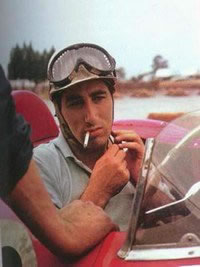
In the founding years of Formula 1, between 1950 and 1960, the dress code was primarily directed toward comfort and elegance. The legendary Juan Manuel Fangio preferred to drive in a polo shirt and cloth trousers with a balaclava on his head – at best providing relatively good sun protection. The photograph shows Alfonso de Portago preparing for a race.
Even in the 1970s, racing overalls were made of easily flammable cotton, and it was only after Niki Lauda’s fire accident at the Nurburgring in 1976 that attitudes changed.
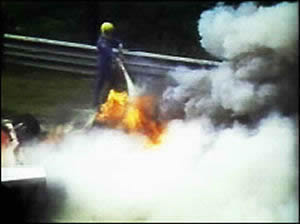
From then on, progress was rapid. In 1979, Lauda, Carlos Reutemann, and Mario Andretti competed in overalls made of five layers of fireproof material, as used by NASA for astronaut suits.
Materials: Proban and Nomex
Nowadays, there are two materials used extensively in the manufacture of driving suits: Proban and Nomex. Proban is a cotton-based material that has been chemically treated to make it fire retardant. This treatment may diminish with washing. It is used primarily in single-layer economy suits, although some manufacturers also use it in inexpensive multi-layer suits. Nomex, by contrast, is inherently fire retardant, and its protection does not diminish with time or washing.
In high-quality driver fire protection, not only the overalls but also the boots, underwear, gloves, and face masks are all made of the special synthetic fibre Nomex. It is so resistant to heat and fire that drivers in a Nomex-3 overall can survive at least 35 seconds in temperatures of 850 degrees Celsius, roughly equivalent to the heat in a house fire.
This material also protects the driver against caustic gases and acids. Nomex is a permanently fire-retardant aramid fibre manufactured by DuPont. It is woven or knitted into material by one of several mills worldwide.
The Recognisable Race Suit
The fire-retardant suit is perhaps the most recognisable piece of racing gear, emblazoned with patches of the team and driver’s sponsors. While it may appear to be a walking billboard, the suit is critically important for driver safety. As mentioned, Nomex has a 30-year track record of successfully protecting wearers in numerous different occupations, from work wear for refinery, chemical plant, and electric utility employees to multi-layer garment systems for military jet pilots, firefighters, and racing drivers and their pit crews.
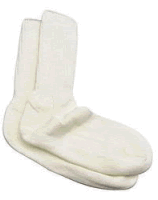
The Nomex is woven into a material used to make the suit, gloves, socks, and shoes worn by the driver.
The Chemistry of Kevlar and Nomex
There are natural polymers, like spider silk and natural rubber, as well as polymers like Kevlar and Nomex that are made in the lab. In the case of Kevlar and Nomex, the lab was that of DuPont. You may have heard of Kevlar, which is a material used to make (among other things) bulletproof clothing. If you didn’t, read my articles about Kevlar and Nomex.
Kevlar has a first cousin in Nomex. Both are polymers, meaning they are made of a repeating unit called a mer that forms a long chain.
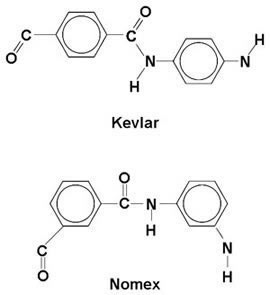
Looking at the Kevlar and Nomex molecules, they are almost identical, containing the same atoms arranged in the same order. The key difference is that the carbon (C) and nitrogen (N) atoms attached to the phenyl groups are positioned directly opposite each other (at a 180-degree angle) in Kevlar, while they are at an angle of 120 degrees in Nomex. This difference gives Nomex slightly different but very important properties.
Spider silk is an incredibly strong material – a strand of spider silk is stronger than a piece of steel of the same weight. Kevlar is similarly strong. Because Kevlar molecules are straight, they pack very neatly.
The phenyl groups are so large that there are few ways the polymer chains can stack with each other. The chains link by hydrogen bonding, which involves sharing electrons between the hydrogen and oxygen of adjacent chains. Hydrogen bonding is much stronger than Van der Waals bonding, which holds Nomex together. The combination of regular stacking and hydrogen bonding makes Kevlar five times stronger than an equal weight of steel.
|
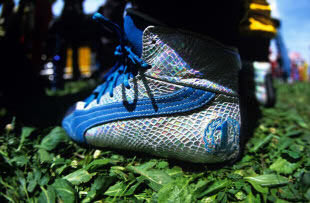
Fernando Alonso fireproof ankle boots. picture made in Spain 2006 during meeting with fans (Daren Heath photo) |
Why Nomex Outperforms Kevlar for Fire Protection
On the negative side, Kevlar starts to melt at about 500 degrees Celsius. The bonds between the atoms weaken and the solid polymer turns into a liquid. Because petrol fires can burn at around 982 to 1,149 degrees Celsius and methanol fires can reach almost 1,927 degrees Celsius, Kevlar is not ideal as a firesuit material.
The kink in the Nomex molecule makes it harder to align, which means Nomex is not as strong as Kevlar. However, Nomex does not melt. When the temperature reaches about 370 degrees Celsius, the atoms in Nomex rearrange and form a protective carbon coating around the outside of the polymer fibre. This carbon helps in four ways: first, some of the heat energy is consumed in forming the carbon layer, meaning less heat reaches the person wearing the suit; second, the melting temperature of carbon is a massive 3,777 degrees Celsius; third, carbon is an excellent thermal insulator, meaning heat takes a long time to penetrate through to the other side; and finally, the Nomex fibre actually gets thicker when it forms its carbon coating – since firesuits are woven, when the fibre thickens the weave tightens and keeps air out.
The only downside of the carbon layer is that when the charred fabric cools, it becomes brittle and weak, much like burnt paper. But once the fabric has cooled, the danger has passed.
Suit Construction
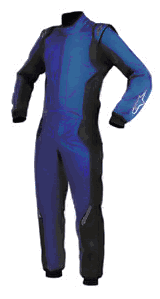
There are essentially three types of suits: single-layer, double-layer, and triple-layer. In addition, there are one-piece, two-piece, and even three-piece suits. Drivers must wear one-piece suits, while crew members can choose from any of the multi-piece options depending on their race-day duties.
In modern race suit construction (worn by both drivers and pit crews), there is even space for a few concessions in the interests of comfort.
SPARCO X-Light Driving Suits, used by many of the world’s best professional drivers and teams including a large number of Formula 1 teams, feature an ATT (Air Textile Thread) inner layer that allows up to 25% more transpiration than Nomex. An additional feature is the X-Cool chemical treatment, which draws heat from the body surface and actually cools the driver down. The ultra-high-quality shiny outer Nomex layer ensures that the required material thickness is kept to a minimum, reducing weight and further increasing driver comfort. A two-piece epaulette design removes material in the shoulder area where a HANS device is located, avoiding excessive pressure on the driver when harnesses are tightened onto the device. Soft-knit double Nomex layer collar and fully floating sleeves are applied for increased comfort, along with a breathable, moisture- and heat-wicking inner layer.
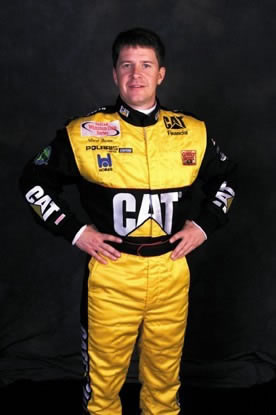
To ensure the overall does not cling or pull, a particularly flexible material is used for the shoulder and lower back areas. Elastic cuffs on wrists and ankles are made of two to four layers of Nomex. Breathable materials are used in construction, with varying thicknesses depending on the particular race. Each Formula 1 driver uses approximately 16 suits per season.
Testing Standards
A completed multi-layered overall undergoes 15 washings and 15 dry-cleaning processes before it is finally tested. It is then subjected to temperatures of 600 to 800 degrees Celsius. The critical level of 41 degrees Celsius must not be exceeded inside the overall for at least 11 seconds. The zip must also withstand the same temperatures and must not melt or transfer heat close to the driver’s skin. Even the patches on the suit and the thread used to sew it together must be fire resistant. On top of all that, the suit needs to be light and breathable, to allow the several kilos of sweat produced by the driver during a race to escape.
The suit must also have two large “handles” on the driver’s shoulders. These straps must be capable of supporting the combined weight of the driver and the seat, which in the event of an accident can be removed from the car by marshals as one unit to minimise the risk of complicating injuries.
Gloves and Boots
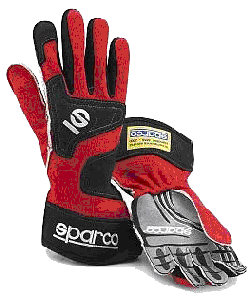
The driver’s gloves are also made of Nomex and are thin, with suede leather palms to provide the sensitivity of feel necessary for steering. Special treatment is applied to guarantee rigidity and grip on the palm, as excessive deformation of the fabric can reduce driving sensitivity. The incisions are positioned to favour the natural movement of the hands and bending of the fingers. Padded reinforcement on the knuckles protects the driver’s hands from violent contact with other parts of the cockpit.
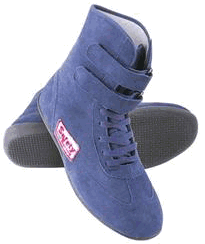
The driver’s fireproof ankle boots are made of soft, cushioned leather, and their rubber soles are far thinner than those of ordinary shoes to provide accurate and slip-free contact with the car’s pedals.
Underwear
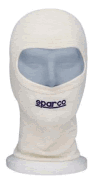
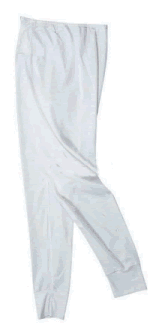
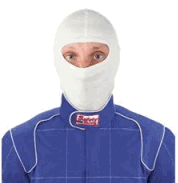
| Underneath his race suit the driver wears a further layer of flameproof underwear, and under his helmet a fireproof balaclava. | |
|
| |

Choosing the Right Suit
Deciding how many layers are needed in a racing suit is a common question.
A useful question to consider: how fast can the safety crew at a local track extract a driver from a burning car? If they can do it in 3 seconds, then a single-layer suit might suffice. For everyone else, more protection is advisable.
It all comes back to the materials used in the suit: is it Proban, Nomex, or something else?
LOI and TPP Ratings
The quality of any fire-retardant material can be determined by examining two measuring factors: Limiting Oxygen Index (LOI) and Thermal Protective Performance (TPP).
LOI is the most commonly used measure for flame retardancy and refers to the amount of oxygen needed in the atmosphere to support combustion. If a fibre or fabric has an LOI of 25, that means oxygen must be present in at least 25% of the air for the fabric to burn. A higher rating equals more fire protection. Many fibre manufacturers achieve high LOI ratings by chemically treating their fabrics with a flame-retardant finish. The downside is that these chemicals can be washed and worn off over time without proper care. LOI is not often seen in race suit literature, but it is an important factor in good fire protection.
TPP refers to the garment’s ability to provide thermal protection when exposed to both direct flame and radiant heat, taking into account the length of time before a person sustains a second-degree burn. The TPP rating is derived from a mathematical calculation performed using the results of a test procedure that utilises two different heat sources, sensors, and the fabric being tested. The TPP rating is divided in half to determine the number of seconds until second-degree burn occurs. For example, if a particular fabric has a TPP rating of 35, it takes 17.5 seconds until a second-degree burn occurs in a flashover situation.
The only way to increase a TPP rating is through adding multiple layers. However, as layers increase, suits get bulkier, and bulk does not equal comfort. The goal in selecting a firesuit should be to balance comfort with maximum protection.
A practical way to increase TPP without moving to a three-layer drag racing suit is to wear fire-retardant underwear beneath the suit. If the budget does not allow for fire-retardant underwear, even a cotton sweatshirt adds some protection.
Some suit manufacturers promote the TPP rating alongside the SFI rating.
Single-Layer vs. Multi-Layer
Proban is commonly used in economy suits due to its cotton base. The cotton fabric is impregnated with a chemical cocktail that initiates an irreversible polymer formation. This polymer is the barrier that protects against fire and intense heat. However, many racers and product specialists consider Proban to be lacking in longevity and prolonged protection.
Nomex, on the other hand, is the most widely used material in fire suits. It is known for being far more consistent, durable, long-lasting, and protective.
So which is better – single-layer or multi-layer?
A single-layer Nomex suit would actually stand a good chance of outperforming a multi-layer Proban suit, especially if both suits had already been through some wear. Ultimately, a multi-layer suit provides additional layers of protection, which is why professional racers and some leading amateur racing sanctioning bodies require a multi-layer suit that meets specific SFI and FIA ratings.
But not all of us are professional racers or even amateurs. And we all certainly cannot spend the same amount of money on racing suits that professional racers can. Most of us are just looking for what it will take to keep us safe, and the rest is simply luxury! In that case, the best thing you can do is determine your budget, and try to find the best suit for your buck. It may be a high-end single-layer suit made out of Nomex. Or maybe a multi-layer Proban suit is your best option. No matter what, keep in mind that having a suit is better than not having a suit. Even if it’s single-layer Proban, it is certainly better than absolutely nothing.
Auto Racing vs. Motorcycle and Karting Suits
Differences Between Auto Racing, Motorcycle, and Karting Suits
Just as there are different styles of dress suits, there are different styles of racing suits. The primary difference is that auto racing suits are fire retardant/resistant, while motorcycle and kart suits are abrasion resistant. In auto racing, the risk of being involved in a fire is higher. Because the driver is inside an enclosed vehicle, hopefully harnessed in, exposure to a fire can be prolonged. Therefore, the focus of auto suit design is protection from fire.
Motorcycle and kart racers face very different dangers. In motorcycle racing, the rider is at high risk of a high-speed bail-out or loss of control, resulting in sliding across pavement, gravel, grass, barrier walls, or even impacting with another bike. In karting, the driver is in an open-cockpit vehicle experiencing very high g-forces, very high speeds, and very sharp corners that can lead to ejection or being dragged along the pavement or sidewalls. While these dangers are rarely encountered, they are serious enough to warrant protection. Because fire exposure is far less of an issue in motorcycle and karting, the focus centres on abrasion resistance.
There are also subtle differences between the styles regarding fitting, cuff design, shoulder gussets, and other details. Kart racers need suits designed with spatial consciousness in mind, as cockpit space is limited. Motorcycle suits are also tailored, but for different reasons: aerodynamics plays a key role, and manufacturers design motorcycle suits to be streamlined and form-fitting while remaining protective.
Auto suits, focused on fire protection, are designed to ensure the driver is never exposed to flame. This is relatively straightforward given that the cockpit area of most automobiles is spacious enough that manufacturers face no significant space limitations.
The key guidance is straightforward: buy the suit designed for the type of racing being undertaken. Just because they are all “racing suits” does not mean they provide the same types of protection.
Safety Ratings Explained
What Do All The Ratings Mean?
SFI:
SFI ratings are determined by the results of several tests conducted on racing suits for fire-retardant capabilities and Thermal Protective Performance (TPP). The standard specification for racing suits is 3.2A, or 3.2A/1. Superior construction will yield ratings of 3.2A/3 and 3.2A/5. The increasing final digit indicates an increase in the length of time the wearer will be protected before the suit succumbs to the flames.
A driver suit certified to meet SFI spec has been laboratory tested and has passed the requirements. Manufacturers who certify their products as SFI approved demonstrate their commitment to providing the highest levels of safety.
3.2A/1 gives 3 seconds until a second-degree burn
3.2A/3 gives 7 seconds
3.2A/5 gives 10 seconds
3.2A/10 gives 19 seconds
3.2A/15 gives 30 seconds
It is important to understand that SFI ratings do NOT represent the number of fabric layers in the garment.
TUV Homologation:
TUV SUD AG is a leading technical service company active in the industry, product, and transport sectors. Its range of services encompasses consultancy, inspections, tests, expert opinions, certification, and training. The company partners with leading industry manufacturers in areas related to safety, manufacturing processes, product quality, and standards development. They perform research, testing, and certification for nearly every part of a vehicle, from tyres to electronics to glass, plastics, fabrics, and engines.
Products bearing the “TUV Homologated” stamp ensure that the consumer will receive premium performance via quality and safety.
FIA Homologation:
Since its founding in 1904, the Federation Internationale de l’Automobile (FIA) has been dedicated to representing the interests of motoring organisations and motor car users throughout the world. It is also the governing body of motorsport worldwide.
The FIA is a non-profit association that brings together 222 national motoring organisations from 130 countries on five continents. Its member clubs represent over 100 million motorists and their families. On issues such as safety, mobility, the environment, and consumer law, the FIA actively promotes the interests of motorists at the United Nations, within the European Union, and at other international bodies.
Products bearing the “FIA Homologated” stamp ensure premium performance, quality, and safety.
CE Certification:
The CE mark certifies that a product has met European Union health, safety, and environmental requirements, which ensure consumer safety. By affixing the CE marking, the manufacturer or its authorised representative asserts that the item meets all essential requirements of the relevant European Directive(s).
Recommended Brands
Which Racing Suits Are The Best?
This is a subjective topic, especially given the number of excellent independent brands in the industry. However, some well-established brands are widely recognised for quality and reliability.
|  |  | [G-Force] | |
|  |  | ||
|  |  |  | |
|  | |||
![[G-Force]](/Images/firesuit_g-force_logo.jpg)
Each of these companies has an established reputation in the industry, whether centred on performance, quality, value, or a combination of all three.
Sparco, Impact, AlpineStars, and Simpson are known as the high-end manufacturers. They offer very high-quality suits with impeccable performance and prices to match, though each also offers more affordable mid-range options.
Bell is a well-regarded all-round company, offering quality products at reasonable prices.
K-1 specialises in high-quality karting suits.
Oakley is a relatively newer entrant to the industry but has produced some outstanding products, including firesuits. Their products are not inexpensive, but they are high quality. Notably, Sparco has helped subcontract Oakley’s line.
G-Force and RaceQuip are the two value-oriented brands. They may lack the prestige of the more expensive suits, but they get the job done for considerably less money. G-Force has been around longer and has grown in popularity and recognition, while RaceQuip has been steadily gaining ground. RaceQuip’s competitive advantage is higher manufacturing quality at an even lower price than G-Force. Competition between these brands ultimately benefits consumers, making products more affordable and offering more value.
There are many other options available beyond these brands, but they represent a reliable starting point for anyone looking for a quality racing suit.