Start of the Race
The Importance of the Start
Starts are a critical part of the race. Strategy can be badly compromised by a poor start, while a good start can lead strategists to change their plans in the hope of a better result.
Preparation and Warm-Up Lap
Since launch control was banned for the 2008 season, it has been down to the driver to manage the clutch and throttle for the perfect start. There are a number of different passive electronic systems to monitor the driver’s actions, but nothing to assist him directly. With the clutch controlled via two paddles on rotary sensors behind the steering wheel and the fly-by-wire throttle pedal, there can be no active intervention on the part of the ECU, simply a linear response between the driver controls and the clutch or throttle.
Preparation for the race start begins with the warm-up lap, with the driver instructed to heat the tires with a number of burn-outs, which also brings the clutch up to operating temperature. The tires need to reach approximately 100 degrees Celsius and the clutch around 200 degrees Celsius. During the start itself, the rear tires need to be travelling 8-10% faster than the fronts, and pre-start revs need to be just right to use engine inertia to jolt the rear wheels, though not so great as to cause excessive wheelspin.
Having the clutch at the correct temperature is critical in order to have a consistent start, both for the friction qualities of the carbon clutch plates and the thermal expansion of the clutch plates moving to the bite point. Towards the end of the warm-up lap, the driver will conduct a process called Bite Point Find, initiated from a button on the steering wheel, where the clutch is released and the electronics detect the drop in revs and the clutch position is recorded in the software.
On this lap, the driver will set the car electronics to the “Race Start” engine map mode. This mapping adjusts settings of engine mixture, rpm limit, gearshift, and pedal maps to their optimum for the best start.
Monitoring and Transponders
The precision and monitoring of the start of Formula 1 races has reached a level that far exceeds that of any other race starting process. So much is at stake during the first few hundred metres that some of the most sophisticated and secret engineering on the cars is devoted to helping the driver during those first couple of seconds, during which he attempts to get his car off the line and up to speed quicker than those around him on the grid.
The prize is the order of cars out of the first corner, which in modern F1 racing so often dictates the order for the rest of the race. From the moment the cars complete their formation lap and are eased into their individual positions on the grid, they are monitored and controlled by Race Control via the TAG Heuer timing and Siemens race information systems. The identification transponder fitted to each car not only identifies the car to the timing system but also precisely positions the car relative to numerous wire aerials embedded in the track and pit lane. By monitoring the signals from each car via an aerial embedded at each grid position, checks can be carried out to ensure that no car starts the race with a wheel over its individual line.
The system can also check the exact moment that a car crosses its starting line, and any jumped start is reported to Race Control, which decides whether a penalty is to be applied.
Start Procedure: Handling Problems
After the formation lap, once all cars are stationary on their positions, the start procedure may commence. If a problem arises after returning to the starting grid at the end of the formation lap, the following procedures apply:
If a car develops a problem that could endanger the start, the driver must immediately raise his hands above his head and the marshal responsible for that row must immediately wave a yellow flag. If the race director decides the start should be delayed, the green lights will be illuminated two seconds after the abort lights are switched on, and a board saying “EXTRA FORMATION LAP” will be displayed. All cars able to do so must complete a further formation lap whilst the problem car is moved into the pit lane. The team may then attempt to rectify the problem and, if successful, the car may start from the end of the pit lane. Every time this happens, the race is shortened by one lap.
If the race has not been started, the abort lights will be switched on, a board saying “DELAYED START” will be displayed, all engines must be stopped, and the new formation lap will start five minutes later with the race distance reduced by one lap. Yellow flashing lights then green and yellow flashing lights mean an aborted start. Yellow flashing lights alone mean turn off the engine immediately – delayed start. The next signal will be the three-minute signal.
Normally, when a start has to be delayed, the front light gantry will go from green to yellow, indicating a delayed start, and then continue to flash only yellow, indicating an aborted start and a request to drivers to turn off engines immediately.
The Five Red Lights
Once all the cars are stationary and in position on the grid, Race Control starts the automatic start sequence.
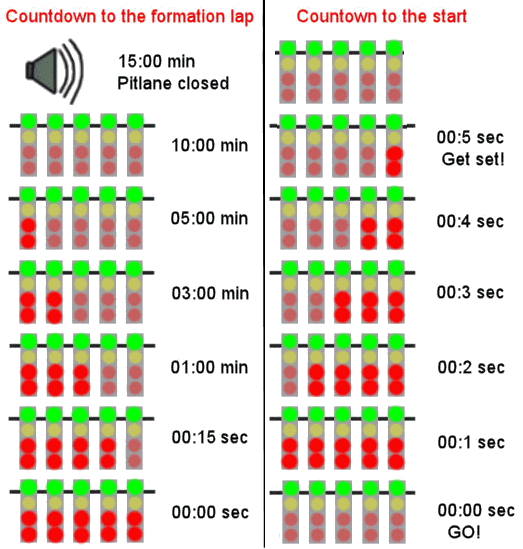
The five-second countdown begins as the five red lights on the start gantry over the track are turned on at one-second intervals.
As with running races, there is then a pause of unpredictable duration before the “go” command – in this case, randomly and automatically determined by the electronic system and kept to a few seconds so engines, clutches, and drivers’ nerves do not become strained. Then all five red lights are extinguished.
Only from this moment is the race started, and it is down to the combination of driver and car to make a better start than their competitors.
There is little opportunity to anticipate when the lights will go out, and the 10-second penalty for a jumped start is so ruinous that a driver would be foolish to take risks. Thus, starting a Formula 1 car in a race is almost entirely about controlling traction to get the maximum of the available power to the road during the first 2-3 seconds before aerodynamic downforce comes into effect and full throttle can be applied.
The starting procedure is explained in detail in the FIA F1 Sporting Regulations across more than four pages.
Notable Grid Improvements
The largest improvement from the starting grid is still credited to Christian Danner, who started the 1989 USA GP from 26th position on the grid and finished 4th. Next on this list is Sebastian Vettel, who improved 21 places at the Abu Dhabi GP 2012, starting from the pit lane (24th) and finishing in 3rd position.
FIA Technical Regulations
8.3 Start systems :
Any system, the purpose and/or effect of which is to detect when a race start signal is given, is not permitted.
FIA Sporting Regulations
38) STARTING PROCEDURE
**38.1 **30 minutes before the start of the formation lap the pit exit will be opened and cars will be permitted to leave the pit lane to cover a reconnaissance lap. At the end of this lap they will stop on the grid in starting order with their engines stopped.
Should they wish to cover more than one reconnaissance lap, this must be done by driving down the pit lane at greatly reduced speed between each of the laps.
Any car which does not complete a reconnaissance lap and reach the grid under its own power will not be permitted to start the race from the grid.
**38.2 **17 minutes before the start of the formation lap, a warning signal will be given indicating that the end of the pit lane will be closed in two minutes.
15 minutes before the start of the formation lap the end of the pit lane will be closed and a second warning signal will be given. Any car which is still in the pit lane can start from the end of the pit lane provided it got there under its own power. If more than one car is affected they must line up in the order in which they qualified. However, any car reaching the end of the pit lane after the five minute signal must start behind any car already at the pit exit.
All such cars may then join the race once the whole field has passed the end of the pit lane for the first time after the start.
38.3 The approach of the start will be announced by signals shown ten minutes, five minutes, three minutes, one minute and fifteen seconds before the start of the formation lap, each of which will be accompanied by an audible warning.
When the ten minute signal is shown, everybody except drivers, officials and team technical staff must leave the grid.
38.4 When the three minute signal is shown all cars on the grid must have their wheels fitted, after this signal wheels may only be removed in the pit lane, or on the grid during a race suspension.
A ten second time penalty (see Article 16.3.b) will be imposed on any driver whose car did not have all its wheels fully fitted at the three minute signal.
38.5 When the one minute signal is shown, engines should be started and all team personnel must leave the grid by the time the 15 second signal is given taking all equipment with them. If any driver needs assistance after the 15 second signal he must raise his arm and, when the remainder of the cars able to do so have left the grid, marshals will be instructed to push the car into the pit lane. In this case, marshals with yellow flags will stand beside any car (or cars) concerned to warn drivers behind.
38.6 When the green lights are illuminated, the cars will begin the formation lap with the pole position driver leading.
When leaving the grid all drivers must proceed at a greatly reduced speed until clear of any team personnel standing beside the track. Marshals will be instructed to push any car (or cars) which remain on the grid into the pit lane by the fastest route immediately after cars able to do so have left the grid. Any driver being pushed from the grid may not attempt to start the car and must follow the instructions of the marshals.
38.7 During the formation lap practice starts are forbidden and the formation must be kept as tight as possible.
38.8 Overtaking during the formation lap is only permitted if a car is delayed and cars behind cannot avoid passing it without unduly delaying the remainder of the field. In this case, drivers may only overtake to re-establish the original starting order. Any driver delayed in this way, and who is unable to re-establish the original starting order before he reaches the first safety car line, must enter the pit lane and start from the end of the pit lane as specified in Article 38.2.
Any driver who is delayed leaving the grid may not overtake another moving car if he was stationary after the remainder of the cars had crossed the Line, and must start the race from the back of the grid. If more than one driver is affected, they must form up at the back of the grid in the order they left to complete the formation lap. If the Line is not situated in front of pole position, and for the purposes of this Article as well as Articles 40.14 and 42.6, it will be deemed to be a white line one metre in front of pole position.
Either of the penalties under Articles 16.3a) or b) will be imposed on any driver who, in the opinion of the Stewards, unnecessarily overtook another car during the formation lap.
38.9 When the cars come back to the grid at the end of the formation lap, they will stop on their respective grid positions, keeping their engines running.
There will be a standing start, the signal being given by means of lights activated by the permanent starter.
Once all the cars have come to a halt the five second light will appear followed by the four, three, two and one second lights. At any time after the one second light appears, the race will be started by extinguishing all red lights.
38.10 Unless specifically authorised by the FIA, during the start of a race the pit wall must be kept free of all persons with the exception of two people from each team, officials and fire marshals.
38.11 If, after returning to the starting grid at the end of the formation lap a problem arises, the following procedures shall apply :
a) If a car develops a problem that could endanger the start the driver must immediately raise his hands above his head and the marshal responsible for that row must immediately wave a yellow flag. If the race director decides the start should be delayed the green lights will be illuminated two seconds after the abort lights are switched on, a board saying “EXTRA FORMATION LAP” will be displayed and all cars able to do so must complete a further formation lap whilst the car which developed the problem is moved into the pit lane.
The team may then attempt to rectify the problem and, if successful, the car may then start from the end of the pit lane. Should there be more than one car involved their starting order will be determined by the order in which they reached the end of the pit lane.
Every time this happens the race will be shortened by one lap.
b) If any other problem arises, and if the race director decides the start should be delayed, the following procedures shall apply :
- If the race has not been started, the abort lights will be switched on, a board saying “DELAYED START” will be displayed, all engines will be stopped and the new formation lap will start five minutes later with the race distance reduced by one lap. The next signal will be the three minute signal.
Tyre changing on the grid is not permitted during such a delay.
Every time this happens the race will be shortened by one lap.
If the race has been started the marshals alongside the grid will wave their yellow flags to inform the drivers that a car is stationary on the grid.
If, after the start, a car is immobilised on the starting grid, it shall be the duty of the marshals to push it into the pit lane by the fastest route. Any driver being pushed from the grid may not attempt to start the car.
Once the car is in the pit lane his mechanics may attempt to start it, if successful the driver may rejoin the race. The driver and mechanics must follow the instructions of the track marshals at all times during such a procedure.
38.12 Should Article 38.12 apply, the race will nevertheless count for the Championship no matter how often the procedure is repeated, or how much the race is shortened as a result.
38.13 Either of the penalties under Articles 16.3a) or b) will be imposed for a false start judged using an FIA supplied transponder which must be fitted to the car as specified.
**38.14 **Only in the following cases will any variation in the start procedure be allowed :
a) If it starts to rain after the five minute signal but before the race is started and, in the opinion of the race director teams should be given the opportunity to change tires, the abort lights will be shown on the Line and the starting procedure will begin again at the ten minute point.
b) If the start of the race is imminent and, in the opinion of the race director, the volume of water on the track is such that it cannot be negotiated safely even on wet-weather tires, the abort lights will be shown on the Line and information concerning the likely delay will be displayed on the timing monitors. Once the start time is known at least ten minutes warning will be given.
c) If the race is started behind the safety car, Article 40.14 will apply.
**38.15 **The stewards may use any video or electronic means to assist them in reaching a decision. The stewards may overrule judges of fact. A breach of the provisions of the Code or these Sporting Regulations relating to the starting procedure, may result in the exclusion of the car and driver concerned from the Event.