Race Control
Overview
Race control is at the heart of Formula 1 races. It is responsible for monitoring and supervising the practice sessions, qualifying sessions, and the race itself. The stewards are charged with assessing on-track incidents and penalising drivers accordingly. Facilities vary between different circuits, but all feature several key elements essential to allowing the FIA Race Director and his staff to make the right decisions to keep things safe, legal, and on schedule.
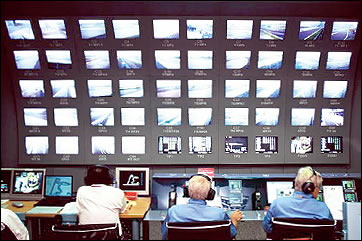
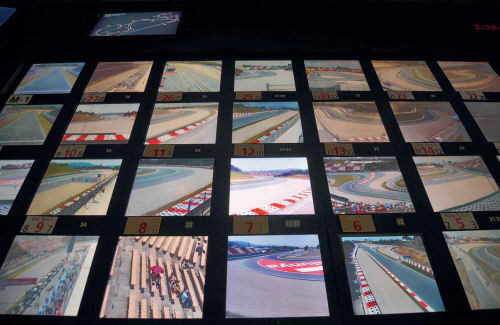
Race control has screens showing all parts of the circuit so that problems can be flagged and dealt with quickly.
Key Personnel
While the identity of the entire group of people working in race control is usually unknown – and even if it were, the names would most likely not ring a bell – they are all headed by the FIA’s race director, Charlie Whiting. Whiting’s first role with the FIA was as a technical delegate. In 1997, he was appointed Race Director of the FIA while also being named Safety Delegate.
The FIA race director and three race stewards, plus (from 2010) one former race driver acting as consultant, ensure the race is safe, legal, and on schedule. To accomplish this, the race control unit makes use of CCTV (closed-circuit television) and car onboard cameras to locate problems and take action quickly.
|
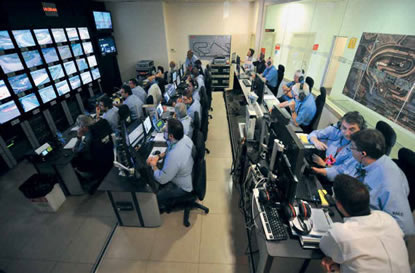
Race Director Charlie Whiting and his deputy Herbie Blash (top left) take an overview of the action in Barcelona, while a team of FIA experts and local circuit officials examine specific areas of the event. |
Data and Communication
Additional information is accessible to the FIA race director, including pit lane speed trap data, contact with personnel at marshal posts, the safety car, medical response car, and the medical centre. Deployment of the safety car and other important instructions are under the responsibility of the race control unit.
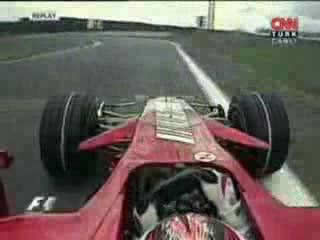
When a driver breaks the rules or the sporting code, it is the duty of the race control unit to discipline the driver accordingly.
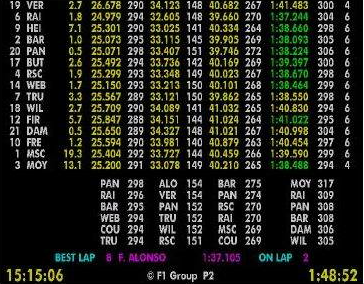
The unit has a timing data feed – the same feed given to the teams – as well as access to additional racing information so they can verify that all cars are running a fair race and adhering to all FIA rules and regulations.
Race control maintains constant contact with the teams, principal marshals, the safety car, the medical response car, and the medical centre, both via telephone and radio. This means that if any major unexpected event occurs, the Race Director can deploy safety teams to the scene quickly and safely.
Penalties and Enforcement
Charlie Whiting, race director
The Race Director has a full support team behind him, comprising both FIA personnel and local circuit personnel. Race control is responsible for ensuring all drivers abide by the rules and will penalise any drivers who break them. The most common penalty is a “drive-through,” where the driver must drive through the pit lane instead of going down the main straight, or a “stop and go,” where the driver must enter the pit lane, stop for 10 seconds, and then continue the race. For more complex disciplinary issues such as causing an accident, the penalties are decided at the end of the race to give teams a chance to review footage and defend their drivers.
|
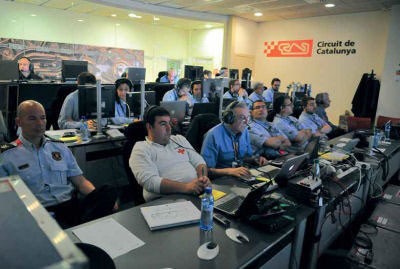
Race Control is a remarkably calm environment during a race. At the back of the room is FIA desk is manned by Whiting and people. In front sits officials from medical staff to technical and communications specialists. The control room is also in contact with the teams and drivers at all times and monitors radio traffic between the pit wall and the cars throughout each session. All the data is recorded for future reference should the need arise during a post-event investigation. |
Judging Sporting Incidents
Experience in racing comes into play when race control must react to on-track incidents from a sporting perspective. Every steward at a Formula 1 race knows every paragraph of the sporting regulations by heart.
However, there is an enduring dilemma that accompanies every decision-making process since the concept of “law” was invented: does one judge by the letter of the law, or by the spirit of the law?
For many years, the Formula 1 stewards, under FIA head of stewards Gary Connelly, made title-impacting decisions by strictly obeying the letter of the law without considering the sporting element. To address this problem, the FIA has appointed (from 2010) a former racing driver to assist when sporting decisions are made, ensuring the decision is correct from all perspectives. A different former driver serves in this role at each event.
|
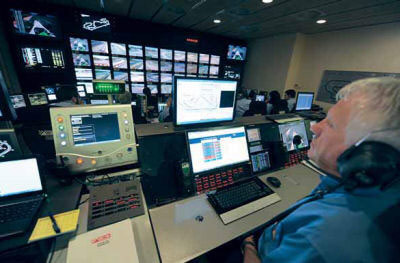
| > ###### Race Director Charlie Whiting in race control control room |
Safety Systems
If a serious event occurs or conditions become too poor to race, the Race Director can stop the race.
All traffic light systems (red-green in the pit lane, flag warning systems) are programmed and controlled from the Race Control Centre. The emergency doctor also receives orders from here when required. In addition to images of the racetrack and timing data, all information on power supply, air conditioning, heating and ventilation, fire alarm systems, and access control runs in parallel into the Building Management Control Room, where it is permanently monitored.
A racetrack requires its own internal communication system so that communication between different organisational and event units functions smoothly and reliably. This is the function of the SMATV (Satellite Master Antenna Television), a type of internal broadband information system that transmits pictures and sound. The marshal intercom system ensures that information exchange between marshals and the Race Control Management Centre runs smoothly.
Technology Infrastructure
|
There are up to 45 television screens in Race Control, each displaying a different angle of the on track action. Each is carefully monitored by the staff at each circuit. All communication is done via headsets and the room has a definite feel of ‘Mission Control’. Main points on the track are examinedin Race Control which then sends reports of any incidents that need to be evaluated to the stewards in a nearby room. |
In Formula 1, the focus of the technological arms race is always the cars. But behind the scenes, the sport continues to push technological boundaries across a range of fields. In the Race Control tower, the FIA uses an arsenal of technology to help stewards detect and review incidents on track in real time. Only a few suppliers are capable of delivering such sophisticated control systems. One of them is Siemens.
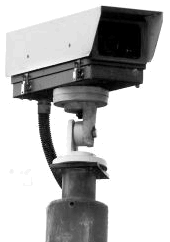
Siemens installed the complete race control management, security, data-exchange, and communications infrastructure at the Bahrain race track. The 5.4 km track in the desert boasts a race management system, a GPS-synchronised timekeeping and signalling system, and digital video recording and PA systems. Track managers have access to 45 signal lamps and nearly 1,000 loudspeakers. Thirty-six remote-controlled CCTV cameras monitor action on the course. Smooth communication is guaranteed by a 550 km fibre-optic network equipped with gigabit Ethernet technology, backed by a digital communications system.
How Stewards Reach Decisions
A STATE-OF THE-ART SOFTWARE SYSTEM IS HELPING THE FIA TO IMPROVE SAFETY AND MAKEMORE RAPID DECISIONS DURING FORMULA ONE GRANDS PRIX. ON THE PICTURE DIRECT RADIO CONECTION WITH EVERY TEAM IN THE PADOCK |
FIA deputy President of the FIA Institute and regular Chair of the Stewards Gary Connelly explains:
“First of all, we have all the video feeds – the pictures that have gone to air; the vision captured by FOM Communication TV system but which hasn’t been put to air; the closed circuit cameras around the track, and all the onboard material as well,” he says. *“We have GPS tracking, which shows where cars are at any given time.”
“We also have access to all the team radio transmissions, which are very important as they allow us to know if a team has warned a driver that he’s about to impede another car and whether a driver has ignored that information. Finally, as of this summer (2012), we can now obtain real-time telemetry from the cars. That’s really useful as we can overlay telemetry information from an incident with data from previous laps, so for example, we can tell if a driver has done something like failing to back off under yellow flags. The system is programmed to highlight any incident – for example, if a driver goes too quickly in a section under yellow flags. That’s based on GPS tracking and timing, but the software also has a number of other inputs and is programmed to respond accordingly.”
“Linking all this together you can come up with a complete picture of what’s going on. You have a mass of information that isn’t available to the public or the teams. That’s why decisions are sometimes taken that people have trouble understanding, but they simply don’t have all the information the Stewards do.”*
FIA Race Director Charlie Whiting adds that in an effort to ensure consistency, all incidents from recent seasons are kept on hard drives so that stewards can refer to them for repeat offenders or precedents when deciding on penalties. “It’s an invaluable resource because, of course, the same Stewards are not at every race. This way they can refer back to all that past footage and it helps them make a more informed and consistent decision.”