Push-Rod and Pull-Rod Suspension
|
| **Pull-rod suspension** |
|
| **Push-rod suspension** |
Basic Principles
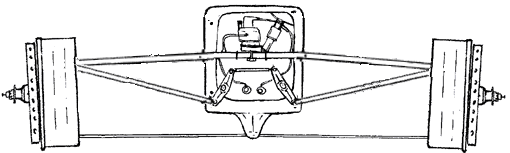
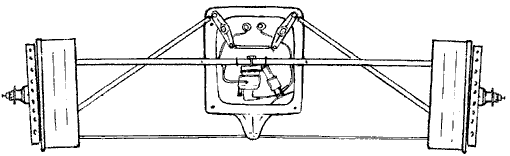
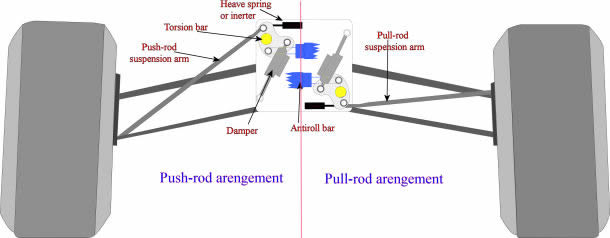
The difference between push-rod and pull-rod suspension, as the names suggest, is whether the rod pushes up to the rocker or pulls down to the rocker.
Pull rods were first brought to Formula 1 by Gordon Murray with Brabham in the 1970s, but subsequently all Formula 1 teams adopted push rods, as pull rods are difficult to implement in a high-nosed car. The advantages of a pull rod lie in the possibility to lower the nose, position most suspension parts closer to the ground, and thereby lower the centre of gravity.
A pull-rod setup has a strut running from the outer end of the upper wishbone diagonally to the lower edge of the chassis, “pulling” a rocker to operate the spring/damper.
A push rod is the opposite: the strut runs from the lower wishbone to the upper edge of the chassis.
Geometry and Loading Considerations
The choice between the two comes down to geometry and centre of gravity. A pull rod will flex in droop (wheel moving downward), while a push rod will flex with the wheel in bump (wheel moving upward). For this reason, F1 push or pull rods are large carbon mouldings designed to withstand the flexing from high wheel loads.
Most F1 cars use push rods. The high nose makes it nearly impossible to locate a rocker low enough in the chassis while maintaining the correct geometry. Minardi and Arrows used pull rods with low noses to lower the centre of gravity – these were the last two teams to use this concept.
Installation Challenges
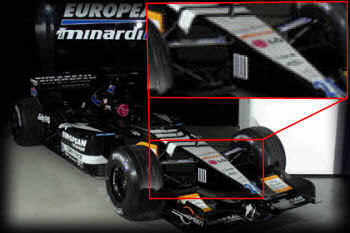
Pull-rod suspension had been ignored because of installation problems with high-nose cars. The critical geometry in spring/damper layouts is the installation angle of the push/pull rod. In the Minardi PS1 shown below, the pull rod has an angle of around 35 degrees, which is fairly steep. Notice how high on the chassis the point is where it meets the upper wishbones – on some cars, these are now almost as low as the floor of the monocoque.
The keel below the square section of the monocoque reaches down to pick up the lower wishbone, and the space created below the nose is what allows the front wing to be so efficient, as there is little to obstruct the wake forming. The keel is made as slender as possible to improve flow under the nose. Making the nose lower would compromise the aerodynamics.
When pull-rod suspension was adopted with a good installation angle, the rocker would need to be located near the keel (disrupting the aerodynamics), or the upper pick-up point of the pull rod would need to be located above the tyre. An upper-wishbone-mounted pull rod with a rocker inside the monocoque could never work efficiently due to the poor installation angle.
Access problems used to be a common issue with pull-rod suspensions: the removal of the dampers and rockers was hindered by their low location inside the monocoque.
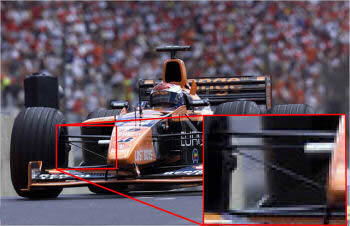
| Jos Verstappen in Arrows20, Year is 2000 and designer of this car is aerodynamicist Eghbal Hamidi |
| European Minardi PS01 Designed by Gustav Brunner and Gabriele Tredozi 2001.Drivers: Fernando Alonso and Taso Marques |
|
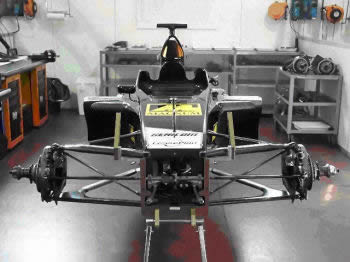
Typical Push-Rod Layout
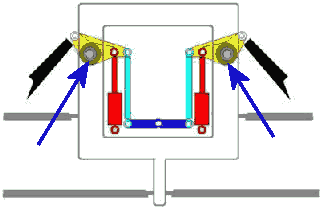
In the typical torsion bar push-rod setup described below, the torsion bars pass through the centre of the rockers and attach to the front of the chassis. The rocker pivots on the torsion bar. The push rod pushes the rocker and twists the torsion bar to provide the spring action in the suspension. The rocker then compresses the damper and operates the anti-roll bar if the car is in roll.
| Black - Push rodYellow - Rocker Dark Yellow - Rocker splined to Torsion bar Light grey - torsion bar Red - Damper Blue - antiroll bar linkages |
Red Bull’s Rear Pull-Rod Revival
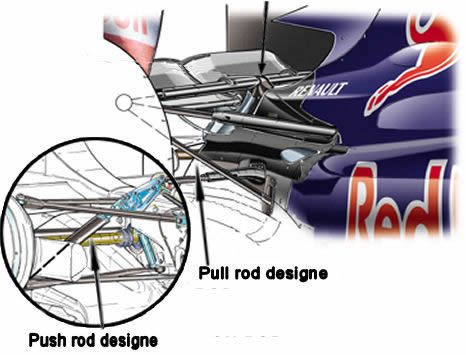
During pre-season testing for 2009, Red Bull Racing, with Adrian Newey as technical director and chief designer, brought pull-rod rear suspension back to Formula 1 for the first time in ten years. The last pull rod dated from 2000, with the low-nosed Arrows A20.
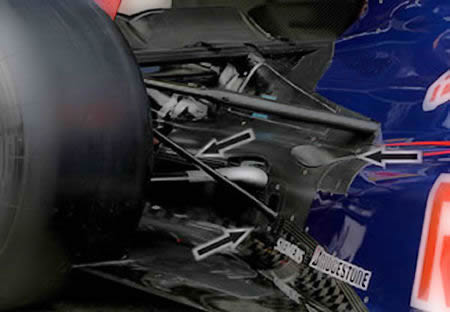
With the diffuser moving rearward under the revised 2009 regulations, the pull-rod layout allowed for cleaner aerodynamic packaging in the rear suspension area. The circled area shows the more common push-rod setup, which normally occupies more space under the engine cover, preventing designers from creating clean airflow toward the rear wing, since the suspension rockers and dampers are positioned on top of the gearbox.
Because Red Bull chose to create very low sidepods at the rear, a push rod did not make much sense, as the suspension components would have prevented a clean design. The pull-rod version allowed the designers to position more components close to the car’s floor, lowering the centre of gravity. The pull-rod suspension is lighter and, along with a gearbox that was 15 cm lower, helped to improve handling.
The top wishbone is a single piece attached very high at the rear of the car (see upper arrow), actually connecting above the car’s bodywork in the most ideal position, forming a wing-like section that works together with the lower section of the rear wing. With some imagination, if the car were turned upside down, the rear suspension would effectively be connected at an inverted single keel, supporting both upper wishbones.
This solution was clearly valid, as the RB5 was the only car with a single-deck diffuser to challenge the Brawn cars. However, the Brawn’s speed advantage came from a double-deck diffuser (DDD) that exploited a loophole in the rules, creating a secondary diffuser tunnel starting much further forward and rising much higher. In the race to exploit this loophole, Newey found that his pull-rod setup occupied the exact same space the DDD needed for the upper tunnels. He chose not to design a completely new rear end and instead compromised the DDD design within the constraints of the pull-rod suspension.
For 2010, the car was designed with a DDD in mind, and Newey was able to repackage the pull-rod setup for even larger tunnels. He acknowledged that the choice of pull rod for 2010 was still not the obvious route, but the team decided to stick with a proven pull-rod rear end rather than design an entirely new rear end. Other teams also evaluated the feasibility of a pull-rod rear end, but no others followed this design path, with the exception of Toro Rosso, who used the RB5 design in 2009 and simply revised it for 2010.
Also notable was the very low and rearward positioning of the exhausts (lower picture, right arrow), which exited just under the front arm of the rear wishbone, and the lack of a central pillar for the rear wing, which was instead mounted via the wing’s two large endplates, attaching directly to the diffuser. This concept would evolve the following year (2010) into the highly successful blown diffuser, a critical element in Red Bull Racing’s driver and constructor championship victory.
For 2011, the DDD was banned, with revised technical regulations outlawing the openings beneath the car that allowed air to flow into the upper diffuser deck. Teams once again considered the pull-rod layout for better airflow to the rear wing. During the 2011 pre-season car presentations, all teams except Ferrari and Sauber chose pull rod.
Push Rod vs. Pull Rod: Which Is Better?
In terms of effectiveness at controlling the wheels, both systems are equal. In terms of their effect on aerodynamics, each has its merits depending on the prevailing rules and trends. However, both have different benefits and demands on the chassis.
Pull-rod clearly provides a lower centre of gravity, although access can be an issue. In some cases, particularly with rear pull-rod suspension, the floor must be removed. In Red Bull’s case, they placed the third spring and inerter horizontally across the front of the gearbox, with one sitting above and the other below the shaft connecting the engine to the clutch. These can only be accessed when the gearbox is removed and are subject to considerable heat.
One difference lies in the load passed through the wishbones. According to Newton’s third law, the rod must react to the force of the springs. This reaction force passes from the rocker to the mount on the wishbone. In the push-rod case, this reaction force acts in the opposite direction to the force fed from the wheel into the chassis, and the two offset each other. With pull rod, the force from the rod and the wheel act in the same direction, doubling the load in the upper wishbone and consequently in its mounting on the gearbox. This can be accounted for in the design and weight of the final wishbone.
However, push rod also has its structural challenge. When the suspension is in bump (wheel rising), the push rod is in compression and tends to bow outward. The push rod was the first suspension component to have carbon fibre cladding for reinforcement, and additional design consideration and weight are needed to offset this load. Suspension experts note that pull rod suffers similar compression bending when the suspension is in droop (wheels falling), but droop is considered less critical in wheel control than bump.
There is no single answer to which system is best. Engineers evaluate their design requirements and select whichever solution works best for the overall package.
Ferrari’s 2012 Front Pull-Rod Surprise
During the 2011 season, all teams followed Red Bull Racing’s rear suspension pull-rod solution except Ferrari and Sauber (because Sauber used Ferrari gearboxes). Then Ferrari surprised everyone with the 2012 F2012. They switched their rear suspension to pull rod. The previous year’s car had featured a very complex push-rod setup around the rear suspension rockers, and placing all of this lower, around the clutch and engine drive shaft, was challenging to package. The new hybrid carbon and titanium gearbox casing had to accommodate a different rear suspension system, with the switch to pull-rod spring/damper operation and the raised upper wishbone. The revised gearbox allowed the rear top wishbone to be repositioned and the new pull-rod arrangement to be neatly packaged.
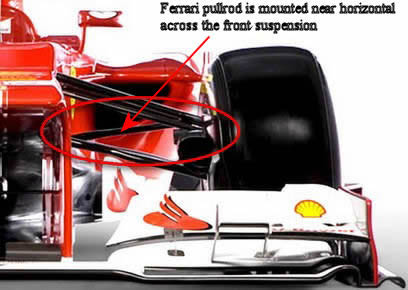
Ferrari also deserves mention for its front suspension during the 2012 pre-season, as the team revived a pull-rod front suspension layout. Every other car for over eleven years had used push-rod front suspension, but Ferrari reused this old concept, last raced on the Gabriele Tredozi and Gustav Brunner-designed European Minardi PS1, driven by Fernando Alonso and Tarso Marques. Both then and in 2012, Alonso was one of the drivers at the wheel.
Advantages and Compromises
According to Pat Fry, Ferrari’s technical director, the pull-rod setup was a little lighter and had a slightly lower centre of gravity. These gains alone would not have justified the trouble of incorporating the system, so there had to be an important aerodynamic benefit. In theory, the pull rod itself can be thinner than a push rod, but because it is mounted to the top wishbone at an extreme angle, greater loads are applied to the upper wishbone, which has to be stronger – and heavier – than it would otherwise have been.
There was also a significant disadvantage in terms of limitations on tuning the car’s handling.
If you move the push-rod mounting point backwards or forwards of the fulcrum of the top and bottom wishbone, you can transfer load across the car when the driver is steering and effectively “lighten” the front wheel. That means the car can be tuned to work in both high-speed and low-speed corners. It allows you to make the car softer and more compliant in low-speed corners without softening the suspension – thereby keeping the high mechanical stiffness you need in the car for high-speed corners.
Ferrari’s decision to design pull-rod suspension limited their ability to tune the F2012’s handling. Ferrari’s pull rod is connected to the wishbone, not the upright, so that tuning facility is not available in the same way for Ferrari. You can still do some of it with the king-pin and castor angles, but anything you do that helps you in one area of the track will hurt you in another. That compromise doesn’t exist with push rods. So getting the ideal balance in handling characteristics for both low-speed and high-speed corners is tougher with pull-rod front suspension than with push rod. Ferrari have effectively taken a tool out of their tool bag.
Aerodynamic Gains
The primary gain was that the pull rod was mounted nearly horizontally across the front suspension, placing it in line with the upwash airstream from the front wing. Just as with the wishbones, its profile could be subtly altered within the rules to help control the wake from the wing and improve airflow over the rear of the car. Despite appearances, the pull rod is as effective in moving the rocker for a given wheel travel as a push rod. The important factor is the angle between the rod and the wishbone to which it is connected, rather than the rod’s angle to the chassis.
After four years of pull-rod suspension, Ferrari’s 2016 challenger reverted to push-rod suspension.
Pull-rod suspension geometry was absent from Formula 1 for many years for good reason. History repeated itself.