Proban
Choosing Fire-Protective Fabrics
When selecting driver fire-protective clothing, there are two major types of fabric to consider: Nomex and Proban. Each brand has a different manufacturing process and a variety of different properties.
Nomex is the trademarked name for a type of fire-retardant material developed and marketed by the DuPont Company in the early 1960s. It is a meta-aramid material related to nylon, with excellent thermal, chemical, and radiation resistance. The fibre and sheet forms of the material are used in a vast number of applications, from concert hall canopies to the wings of the Space Shuttle. Nomex is an intelligent flame-resistant fibre: it thickens when exposed to intense heat, creating a protective barrier between the heat source and the wearer’s skin. Because Nomex is inherently fire-retardant, woven or knitted into the material itself, its protection does not diminish with time or washing – unlike Proban. Nomex will not melt, drip, burn, or support combustion in air. These performance benefits play a pivotal role in providing the valuable seconds racing professionals need to escape and survive critical situations. This is why the FIA mandates that in FIA-sanctioned racing classes, only Nomex may be used for fire protection in driver suits. All major brands offer double-, triple-, and multi-layer Nomex race suits rated to SFI-5 as well as SFI-15 and SFI-20.
What Is Proban?

Although “Proban” is commonly used to refer to the material itself, Proban is in fact a chemical that can be applied to other fibres and blends to make them flame-retardant. This means Proban can be used not only for industrial, sport, and military applications but also across many civilian industries, including hotels, public buildings, hospitals, and nursing homes – anywhere fires are a risk.
First developed in the 1950s, the Proban chemical is used to impart a durable flame-retardant treatment to cotton and other cellulosic fibres and blends. Proban is a trademarked, quality-controlled technological process based on specific chemicals developed by Rhodia. The process takes place at the finishing stage of cotton and cotton-blended fabrics and involves several very specific steps. The technology is only available to Proban licensees, who are carefully selected primarily on their ability to produce Proban material at the highest level of quality.
The Chemical Process
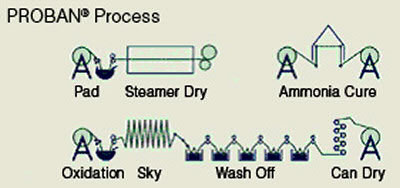
Proban is a low-molecular-weight polymeric chemical built around a phosphonium salt called tetrakis-hydroxymethyl phosphonium chloride (THPC). This salt is reacted with urea, a low-molecular-weight polymer, and the resultant chemical is applied to the fabric. THPC is first treated with sodium hydroxide solution and converted to THPOH. The Proban process involves chemical impregnation, drying, and curing with ammonia gas using Rhodia’s patented and licensed technology, followed by oxidation and finally neutralisation. Flame retardancy is achieved by the formation of a cross-linked inert polymer within the fibre. There is no chemical reaction within the fibre itself, so the fabrics remain unaffected. The process can be successfully applied to woven or knitted fabrics across the full range of fabric weights and constructions.
Durability and Limitations
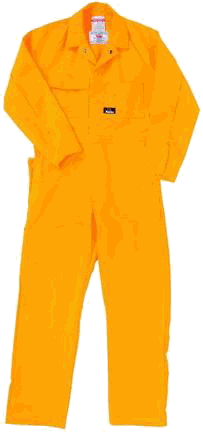
Because Proban is a mainly cotton-based material that has been chemically treated, this treatment may diminish with washing. Proban FR/7A fabrics are certified by Westex Inc. to retain their original flame resistance through fifty home washes or twenty-five industrial washes.
When heated, this flame retardant breaks down to form acid on the fabric, which masks the cellulose of the cotton fabric and catalyses char formation. Potassium coats the carbon and prevents its oxidation. The pyrolysis gases are non-flammable. This is known as a condensed-phase process. Proban-treated fabrics do not smoulder, have no afterglow, and flame does not spread outside the charred area. Unlike some other flame-retardant systems, Proban-treated fabrics do not melt away to form a hole through which flame can penetrate, nor do they form hot, sticky residues that can adhere to the wearer’s skin.
Proban vs Nomex in Racing
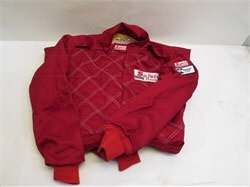
As a protective driver fire-retardant suit material (driver jacket shown left), Proban is used primarily in single-layer economy driver suits, although there has been a troubling increase in manufacturers using it for inexpensive multi-layer suits. A Proban suit may initially appear to be a bargain, but the lifespan of a Nomex suit often doubles or triples that of Proban with proper care. Worse still, it is impossible to tell when Proban may have lost some or all of its ability to protect the wearer in a fire. Additionally, garments made from Proban-treated fabrics should not be worn in environments where they could be exposed to acids, strong reducing agents, or oxidising chemicals, unless a specific finish has been applied to the treated fabric – and all of these substances can be found in motor racing.
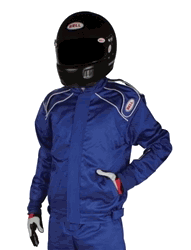
There is no meaningful comparison between Nomex and Proban suits when it comes to protection. Nomex race suits are used across most types of racing. While a novice may feel a Proban race suit provides sufficient safety, the question of “good enough” is only truly answered when facing the worst possible situation without any consequences.
There are many race suit marketing companies that offer SFI-5 rated double-layer suits that are part Proban and part Nomex. These suits do pass the SFI-5 rating, but this is a dangerous compromise. They may look good and cost less, but the buyer is getting a half-treated cotton suit and only half of a Nomex race suit.
When looking for safety, always choose a complete 100% Nomex double- or triple-layer race suit.