Plank or Skid Block
|
|
Ralf Schumacher showing his 10mm thick wooden plank (Toyota 2006) |
What is the plank?
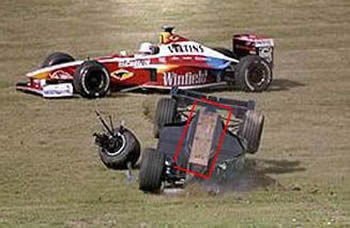
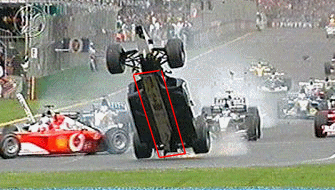
The plank is a strip of homogeneous material fitted front-to-back down the centre of the underside of every Formula 1 car. It was introduced in the mid-1990s as a way to enforce minimum ride height — if the plank wears away excessively during a race, the car has been running too close to the track surface.
The material must have a specific gravity of between 1.3 and 1.45, preventing teams from using excessively heavy or hard materials that could provide a performance benefit or lower the car’s centre of gravity.
Originally, the plank was made from a beech wood product called Jabroc, though more exotic blends of woods and resins (not unlike MDF) have also been used. Today, the material has moved on to a phenolic resin called Permaglass, made by BTR Permali. This is a glass-reinforced laminated product — so it is no longer a wooden plank at all. The material offers good fire resistance and produces little smoke or toxic fumes, making it well suited to its F1 application.
Dimensions and fitting
The plank must measure 300mm in width, with a tolerance of 2mm. It runs from the frontmost point of the reference plane (330mm behind the front wheel centreline) to the rear wheel centreline, and may comprise no more than three pieces, the forward one of which must be at least 1000mm long.
The plank must be fixed symmetrically on the car’s centreline, with no air permitted to pass between it and the surface formed by the parts lying on the reference plane. The front leading edge may be chamfered at 30° to a depth of 8mm, and the trailing rear edge may be chamfered over a distance of 200mm to a depth of 8mm.
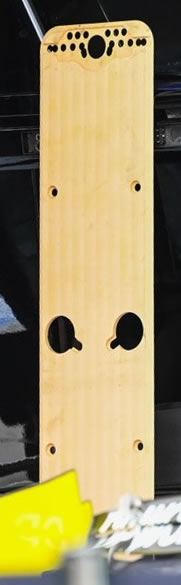
In the image above, a piece of the floor plank is propped up outside the Renault garage. Note the various holes drilled into its surface for fixing it to the underside of the car and mounting the skid blocks.
Measurement and scrutineering
When measured through six pre-cut holes of 5cm diameter, the plank must maintain a tolerance of just 1mm on its original 10mm thickness. Seven precisely placed holes allow the car’s reference plane to sit correctly on the FIA scrutineering platform for legality checks throughout a Grand Prix weekend. Any additional holes must conform to an FIA template. Four further 10mm diameter holes are permitted, provided their sole purpose is to allow access to the bolts securing the Accident Data Recorder to the survival cell.
If the plank is worn beyond the permitted tolerance, the car can be disqualified from the race. The skid block is not considered part of the floor for measurement purposes — it exists solely to enforce minimum ride height.
Skid blocks and sparks
With the high rake angles used on modern cars, the front of the plank is fitted with titanium skid blocks to resist wear as it rubs along the track surface. Teams also bond the plank to the floor with semi-permanent glue, although the regulations state it may only be fastened with the predefined fittings. Both the titanium fittings and the glue layer are permitted by the FIA.
The skid material is now specified as titanium, replacing the previously used tungsten. Tungsten was denser, heavier, more wear-resistant, and produced fewer sparks. The switch to titanium is the reason modern F1 cars produce spectacular showers of sparks when the plank contacts the track at high speed.
Why was it introduced?
The plank was introduced by the FIA to reduce aerodynamic performance and prevent excessive bottoming of the cars. This was a direct response to the tragedies of the 1994 San Marino Grand Prix, where Roland Ratzenberger was killed during qualifying in his Simtek and Ayrton Senna lost his life in his Williams during the race. The plank was part of a broader package of safety measures designed to slow the cars by limiting how aggressively teams could exploit ground effect aerodynamics.
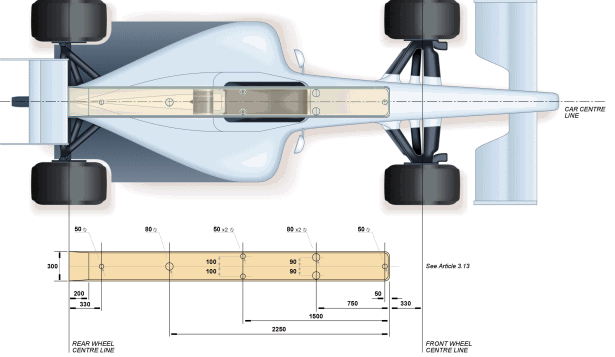
Technical regulations (2017)
3.13.2 The lower surface of the plank may be fitted with flush mounted metal skids which:
- a) May only be fitted in place of plank material.
- b) Have a total area no greater than 20,000mm² when viewed from directly beneath the car.
- c) Are no greater than 4,000mm² in area individually when viewed from directly beneath the car.
- d) Are fitted so that their entire lower surfaces are visible from directly beneath the car.
- e) Must have a minimum cross-sectional thickness of 15mm across its external boundaries in plan view. The minimum wall thickness between an internal fixing hole and the external boundaries of the skid must be no less than 7.5mm.
- f) Must have an upper surface no more than 3mm below the reference plane.
- g) Must be designed so that they are secured to the car using the fasteners described in 3.13.3. When viewed from directly beneath the car, no part of the skid may be more than 50mm from the centreline of a fastener which passes through that skid.
- h) Must be made from titanium alloy.
3.13.3 The plank and skids must be fixed to the car using fasteners which:
- a) Are no smaller than M6 and are made from grade 12.9 steel.
- b) If used to attach a skid to the car, must employ at least 1 fastener per 1,000mm² of skid area.
- c) If used to attach a skid, the team must be able to show by calculation that the shanks of the fasteners (no less than 6mm diameter) are the weakest point in the attachment of the skids to the car.
- d) May use a load-spreading washer if required. The total area of all fasteners and washers when viewed from beneath the car must be less than 5,000mm². No single fastener plus washer may exceed 500mm². No part of any fastener or washer may be more than 8mm below the reference plane. The skids referred to in 3.13.2 are not treated as load-spreading washers.