Passive Double Drag Reduction System – Passive Drag Reduction Device
The Ban on Active DDRS
The original Mercedes system, based on exposing holes in the rear wing endplates when the DRS is deployed (Double DRS - DDRS), was outlawed for 2013 after Formula 1 teams agreed to a rule change that banned the concept, via wording preventing any secondary use of the DRS opening. This technology was pioneered by Mercedes at the start of 2012, when they linked the DRS with the front wing to reduce front downforce, helping boost straight-line speed and balance the car through corners.
Mercedes led the way at the start of the 2012 season, and this helped provide a straight-line speed advantage.
Following discussions at the F1 rules think-tank, the Technical Working Group, a majority of teams agreed to a rule change ensuring they could not incorporate Double DRS into their cars for 2013.
Although Mercedes did not support the rule change (given their significant head start), they could not prevent the ban going through, as it required only a majority of teams to agree.
The changes to the rules were made official by the FIA’s World Motor Sport Council for the 2013 Technical Regulations.
The Emergence of Passive Systems
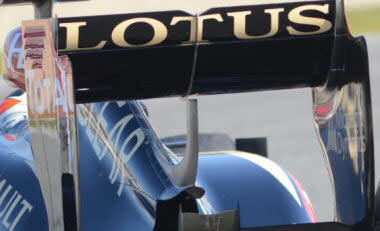
In the middle of the 2012 season, Lotus tested a prototype “passive drag reduction device” fitted to the car’s rear wing. Despite being widely referred to as DDRS, it had no connection to the DRS system. Its aim was to reduce drag on the straight for more top speed, with absolutely no connection to the DRS or any FIA-permitted movable aerodynamic device.
Mercedes subsequently tested a similar device on their car at Spa 2012, with other teams rumoured to have systems ready to test. The gain was small, but anything that improves aerodynamic efficiency is useful, whether to allow a higher top speed for a given downforce level or vice versa.
How the Passive System Works
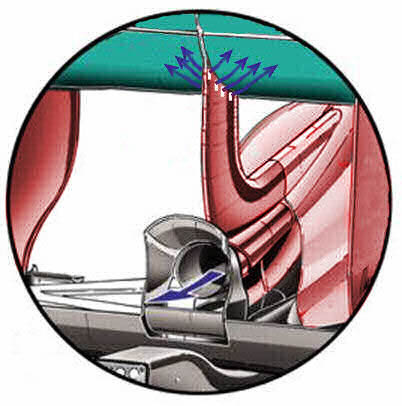
Unlike Mercedes’ DDRS, which stalled the front wing to balance the aerodynamics when the DRS rear wing was used in qualifying and the race, the Lotus system was entirely passive and not linked to any external switch. Instead, the system uses increasing airspeed to send more flow to slots under the wing, stalling the airflow in the middle part of the wing. By blowing the underside of the rear wing’s main plane, the system passively reduces drag above a certain speed threshold. This helps to stall the upper element, giving the car significant drag reduction. Sauber designer Matt Morris estimated the innovation was worth between a few hundredths and a tenth of a second per lap.
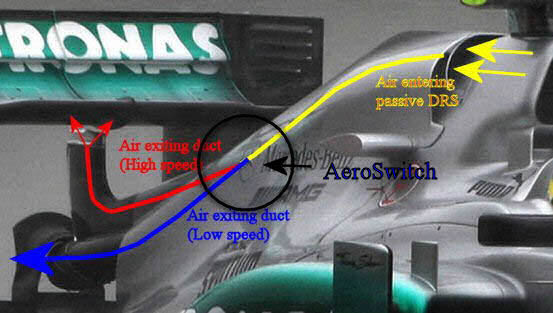
Air enters through two roll hoop inlets clearly visible either side of, and slightly behind, the engine air inlet, with ductwork exiting the engine cover between the main plane and beam wings. Being passive means the Lotus device can stall the wing above a certain speed on every lap, so the small speed advantage is available on every straight and fast corner. With the system tuned to airspeed, the wing can be designed to stall at speeds high enough to allow fast corners to be taken with the rear wing stalled. At these speeds, the diffuser provides enough downforce for cornering and the rear wing is not required for aerodynamic load. Typically, teams would want this stalling to occur at speeds above 250 km/h.
Implementation Challenges
The implementation of the passive double DRS remained far from straightforward, especially after both Mercedes and Lotus encountered difficulties gaining confidence with the prototype systems tested during 2012. The system is fraught with difficulties, as the threshold speed at which stalling should occur may vary from track to track and even throughout a race. A sudden loss of downforce at high speed while cornering could cause a serious crash.
Both Lotus and Mercedes found that, due to the air pressure characteristics surrounding an F1 car, the speed at which the passive DRS switched off to re-engage the rear wing was not always the same as the speed at which it switched on. The biggest problem lay in getting the device to switch on and off at the correct speed. It was also very tricky to make the system reliable, to ensure it withstood the turbulent air of following another car without being triggered at undesirable moments, and to make it a net positive over a race weekend.
This meant the trigger point had to be adjusted higher to ensure there was no risk of drivers losing rear downforce for corners immediately after long straights. Where the system engages and where it re-engages are often not at the same speed, as there can be some lag. The performance gain existed but was not huge – not comparable to McLaren’s F-duct. It was a nice feature to have, but not a game-changer in terms of competitiveness.
Pre-Season Testing in 2013
 Despite Lotus and Mercedes struggling to set the “aero switch” to deactivate and activate at the same speed, Lotus technical director James Allison was confident that the concept would earn its place on the 2013 car during pre-season testing. It was not present on the launch car.
One issue facing the FIA and other teams was that the Mercedes DDRS solution would be banned in 2013 via wording preventing secondary use of the DRS opening. But being passive and not part of the DRS activation, the Lotus system and any similar system did not contravene this rule. As it stood, the Lotus and similar systems would be legal for 2013, though the FIA was likely to find wording to also outlaw this method of drag reduction.
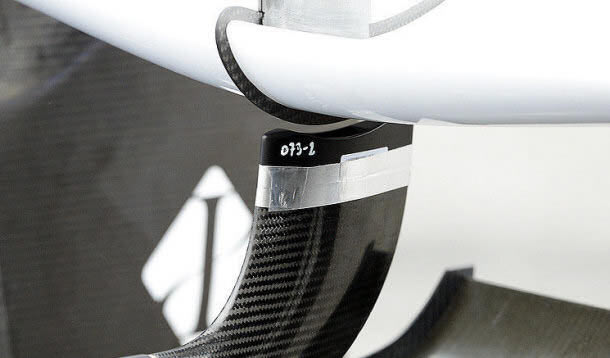
During the second pre-season test in Barcelona, Sauber joined Lotus and Mercedes in testing their version of passive DDRS. Sebastian Vettel tried the device out during the second day of the second Barcelona test on Friday, 1 March. Red Bull’s technical chief Adrian Newey said at the launch of the RB9 that the team was continuing its development of the idea.
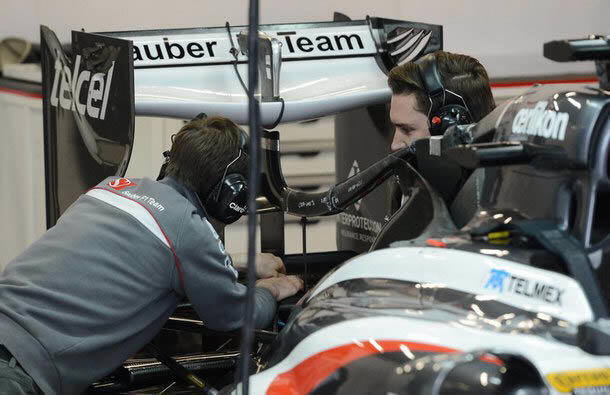
Until further evidence presented itself, the exact operation of the device and especially the “air switch” remained speculative, but its application was of considerable interest to other teams. In a year when the grid was so closely matched, even the smallest advantage could play a significant role in the results of the later races.
Further Pictures
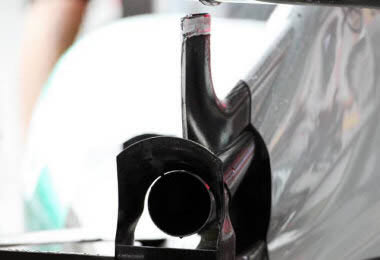
Additional pictures of the Mercedes and Lotus devices:
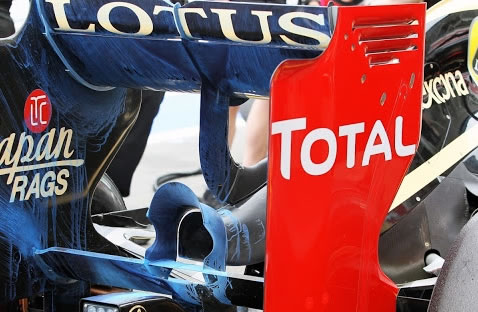 ](/Big/passive_ddrs_lotus_big.jpg)
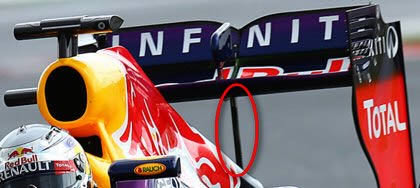
Red Bull running passive DRS during testing at Barcelona Friday, March 1st 2013
Mid-Season Developments
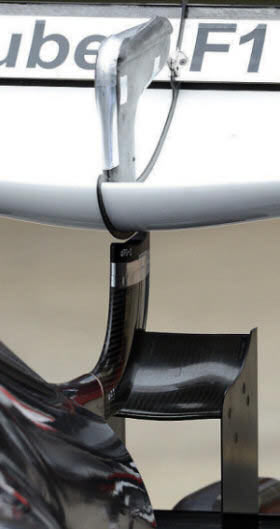
Although Lotus used the system during pre-season tests, it did not appear at a 2013 race until the Silverstone GP round. Installed on Kimi Raikkonen’s car for qualifying and the race, the device was completely passive as the rules dictated. There were some modifications to Lotus’s original design: the vertical pipe was no longer connected to the rear wing’s main profile but instead only blew air onto the profile when the car reached certain speeds, as in the Mercedes and Sauber systems.
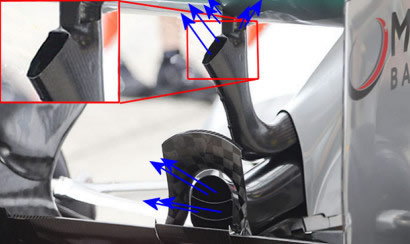
On the same day, Mercedes tested their new evolution of the system. The team trialled it on Nico Rosberg’s car early in FP1 before removing it to proceed with more conventional development work. Of interest were the different outlets compared to their earlier version. While previously the upward duct was not connected to the rear wing, Mercedes now connected the duct to the bottom of the rear wing. This duct also featured three different outlet channels (one large channel facing rearward and two small ones facing to each side of the connected duct) to help increase the stalling effect. The neutral duct under the monkey seat, just above the beam wing, also featured a few internal fins, helping to condition the flow as it was extracted by the monkey seat, which acted as a mini diffuser.