Overtaking: Applying Science and Common Sense
Partially from Grandprix.com
(Note: this article was originally created at the end of 2008.)
The Problem of Overtaking
Overtaking is not just about the tracks. It is also related to the cars. On some circuits overtaking is possible even with modern machinery, while on others it is not. Changing the circuits may help, but many F1 engineers believe that changing the cars will have a far greater effect on the ability of drivers to pass one another.
Overtaking opportunities in “downforce cars” are notoriously few. Driving close behind another car causes a loss of air over the front wing, and through the corner the following car can understeer wide. Running wide compounds the loss of grip, as the driver ends up on the dirty part of the track that is rarely driven on – typically covered with “marbles,” chunks of rubber of various sizes that have the same effect as stepping on a banana skin.
The Slipstream Era and the Rise of Downforce
In the early days, a car would arrive behind a rival and be able to tuck into the slipstream, effectively being pulled along by the car ahead. If a driver could use this “tow,” he could pull out and employ the extra engine revs to get ahead. This created some celebrated slipstreamer races at places like Reims and Monza, and some very close finishes.
In the late 1960s, however, designers began adding wings to use the airflow to push the cars down onto the tarmac. This meant the cars would no longer slide in corners and thus would lap more quickly. So began the relentless pursuit for downforce in Formula 1.
In the late 1970s, engineers at Team Lotus took the process a step further, applying a principle established in the eighteenth century by Swiss mathematician Daniel Bernoulli to use airflows around the car to create a low-pressure area underneath, effectively sucking the car to the ground. They used sidepods to achieve this and later added flexible “skirts” to the bottom edges of the sidepods to separate and seal the different airflows more efficiently. The Lotus 79 in 1978 was a hugely important and very successful F1 car, but it let the genie out of the bottle. Aerodynamics became the key element of Formula 1 design.
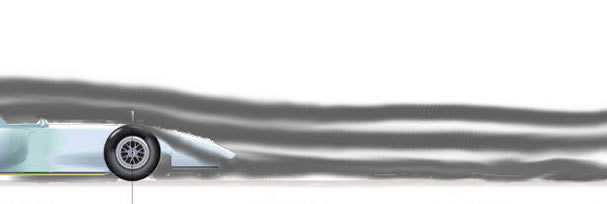
The FIA responded by banning skirts and then mandating flat-bottomed cars to stop aerodynamicists from creating downforce-generating underbodies. As designers worked to improve their cars, they did not concern themselves with what happened to the airflow behind them. Drivers soon found that running in disturbed “dirty” air meant their cars lost around 40% of their downforce, trapping them behind the car in front.
|
Formula 1 car in clean undisturbed air can take full advantage of aerodynamic grip of his car. This situation normally occur when driver is leading the race, or distance to the car in front is at least 1,5 seconds. In this cases overtaking is anyway not possible because distance to the car in front is to big. |
|
A common complaint of many F1 fans is the perceived lack of overtaking in the sport, especially compared to other forms of racing such as touring cars. The main reason for this deficiency is the advanced aerodynamics of an F1 car in that, when one car closely follows another, it has to re-use the air of the car in front. For good overall grip you need both good aerodynamic grip and mechanical grip. This so-called dirty air has already been displaced and manipulated by the leading car and, when receiving it ‘second-hand’, the car following cannot take full advantage of it. As a result, the car behind experiences decreased aerodynamic grip, and struggles to keep close enough to its rival to mount a successful challenge for the position. He needs to relay almost entirely on car mechanical grip, and that’s not enough. |
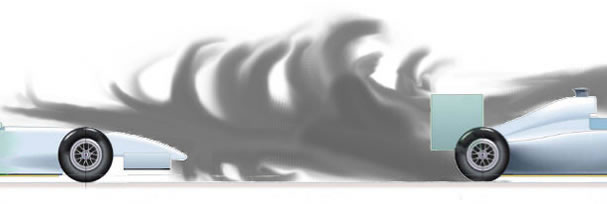
Overtaking became increasingly difficult, and races grew less spectacular than they had once been.
The CDG Wing Experiment
|
|
| |
| |
F1 Centre Downwash Generating Wing, one of the FIA “great ideas” and Ferrari prototype | |
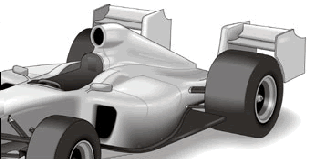
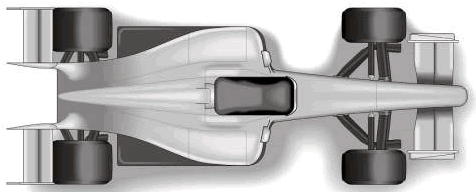
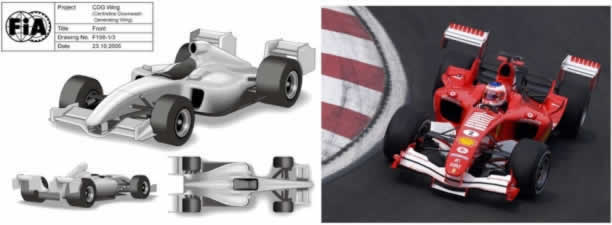
Eventually, the FIA began to look for car shapes that might create a wake in which a following car would gain an advantage, as in the old slipstream days.
In 2005, FIA President Max Mosley commissioned his former partner Nick Wirth, a designer who had worked with the Simtek and Renault F1 teams, to develop a concept to lower aerodynamic turbulence behind the cars and thereby create more overtaking. Wirth worked with computational fluid dynamics (CFD) programmes to create what he called the Centreline Downwash Generating (CDG) wing. The FIA announced it would introduce the CDG wing in 2008.
At the time, the Technical Working Group, working with the Grand Prix Manufacturers’ Association (GPMA), used the Italian Fondtech wind tunnel, run by former Ferrari and Tyrrell aerodynamicist Jean-Claude Migeot, to evaluate the CDG wing. Migeot and his team concluded that the idea was flawed. By the autumn of 2006, no one had much confidence in the CDG wing, and Mosley agreed that its introduction could be delayed and that the Technical Working Group should develop a better idea for 2009.
The Overtaking Working Group (OWG)
The Technical Working Group met to discuss the question that autumn. All the teams sent technical directors, senior engineers, and aerodynamicists – 25 opinions in total (as Prodrive was still planning to enter F1 at that point, and Super Aguri was still in business). The meeting was chaired by Charlie Whiting, and after hours of different opinions he decided that it was a pointless exercise. He concluded that the only way forward was to create a sub-group and allow only the top three teams to be represented. Ferrari, Renault, and McLaren were each invited to nominate a representative. Thus was born the Overtaking Working Group (OWG).
Pat Symonds of Renault, Rory Byrne of Ferrari, and Paddy Lowe of McLaren were all well-established engineers of repute, and all were keen to get the job done using common sense and a scientific approach. The OWG met for the first time in January 2007. They defined the downforce targets they were looking to achieve and the character of the aerodynamics required to improve overtaking. Whiting provided data that had been averaged from information given by all the teams. The aim was to make the cars five seconds a lap slower, but they had to factor in other progress and the reintroduction of slick tyres planned for 2009. This meant the OWG was looking for very significant changes. The conclusion was that they needed to reduce downforce by 50% while retaining similar drag coefficients to the 2006 car.
Simulator Testing and Targets
The first move was to use McLaren’s highly advanced simulator to establish baseline aerodynamic performance parameters. McLaren test driver Pedro de la Rosa was called in to “drive” the simulator, and after recording a series of different laps with different settings, it was determined that to overtake going into Turn 1 he would need a car that was two seconds a lap quicker than the one in front.
The engineers paid great attention to de la Rosa’s comments. He would try each configuration and report on whether the resulting setup would allow him to attempt a pass. Halving the downforce meant the necessary “overtaking advantage” figure could be reduced to 1.5 seconds a lap, and the work then moved on to finding ways to balance the following car to reduce the required advantage to one second. The three engineers all agreed that this was a realistic figure rather than trying to make overtaking even easier.
At the same time, Symonds was sent to secure funding from Renault team principal Flavio Briatore and the other eleven team bosses. The result was a budget of half a million euros. The trio agreed to use Fondtech for wind tunnel work and chose not to place too much faith in CFD. It was an interesting technology, but it was not ready for this kind of work, as it was not possible to use CFD to study the unstable behaviour of air behind a car. The McLaren simulator, representing 30 person-years of development, proved a far more flexible tool than other simulations and used a real driver to obtain a subjective view.
Wind Tunnel Research and Findings
Once the basic data and targets were established, the OWG asked Fondtech to devise means by which the desired changes might be achieved. Ferrari provided baseline data for the two models that Fondtech ran in tandem in its 25% moving-ground wind tunnel. They in turn drew on an experiment by Ferrari at Monza in 2004, when it ran two cars in tandem around the circuit. This full-scale Ferrari data was used to validate the twin-model behaviour in the tunnel, which in turn validated the entire experimental technique – a very important step that justified the use of the tunnel rather than CFD.
Between March and September 2007 there were several wind tunnel sessions, with Byrne doing much of the hands-on work. All sorts of ideas were investigated, and the final configuration largely hit its targets, though baseline drag fell by 10%.
The next step was to feed the actual data back into the McLaren simulator to compare it with the established baseline model. De la Rosa confirmed the benefits in terms of improved chances to overtake. The OWG made its presentations to the TWG in October 2007, and the teams agreed to accept them.
Key Findings
What was particularly interesting was that a scientific approach made it clear that previous attempts to solve the problem had in reality made things worse.
One member of the OWG observed that almost all of the attempts to reduce downforce in the recent past had been retrograde in terms of overtaking possibilities and wake behaviour.
One of the most significant findings was that the rear wing is a very important device in characterising the wake a car generates. While the upwash from the rear wing is strong, a very strong inwash at ground level is also driven by the rear wing. That inwash brings new high-energy air in at ground level. Removing the rear wing altogether would lose that effect and make the wake considerably worse.
The OWG found that a 75% narrower and 150 mm higher rear wing would optimise the new air.
Nick Wirth’s CFD-generated rear wing had eliminated the central section altogether, effectively comprising two separate rear wings to eliminate the upwash. The OWG concluded that this was the very reason it did not work.
The 2009 Regulation Package
Having determined the best possible rear wing configuration to generate the least damaging wake, the OWG moved on to determine the optimum front wing and floor for the following car. Many different floor shapes were tried, including underbody tunnels and other radical ideas, but the OWG found that the best solution was similar to that on the current cars, with the diffuser section mounted further back to use more of the benefit of the inwash air.
The front wing would be lowered and, at 1,800 mm, would be 400 mm wider than on the 2008 car. The most important point was that the aerodynamic profile of the central section would be fixed so that it remained neutral and did not generate downforce. This was because the central section is the most badly affected by the central upwash of the wake and the last part of the wing to receive the fresh high-energy air from the ground-level inwash. By disabling this section, the effect was eliminated. Conversely, the wider outboard and lower extremities of the new front wings benefited more from the high-energy inwash air, helping to maintain a good level of downforce and manage the following car’s balance while running in another car’s wake.
Another crucial development was to allow the front flap to be adjustable while the car was in motion, although only by plus or minus three degrees. This was deemed necessary because of the problem of oversteer in the wake of another car. The driver would only be allowed to change the angle twice per lap, either to reduce frontal downforce and prevent oversteer in the wake, or to trim out any remaining understeer.
That system was controlled by the standard FIA electronic control unit (ECU), so nobody could adjust their front wing more than twice per lap. This also obliged the driver to choose his overtaking opportunity carefully, in keeping with the OWG’s desire that overtaking should not become too easy.
The new rules excluded all bargeboards, radiator air extraction chimneys, flip-ups, nose horns, and similar devices. The plan was for the cars to be smooth between the axles. While there was a small overtaking benefit attached to that, it was done mainly in response to demands from the team principals for cleaner advertising areas.
However, the most significant element of the research was probably not the technology or the commercial advantages. Getting the three top teams to work so closely together was a genuine first.
Implementation of the 2009 Rules
The regulation changes for 2009 were some of the most extensive ever introduced to Formula 1 and fell into three main areas: aerodynamics, KERS, and tyres. Formulated with help from the OWG engineers, the new rules aimed to: (1) reduce the aerodynamic sensitivity of the cars to turbulence; (2) increase overtaking opportunities; and (3) slow the cars in the very quick corners. To compensate for the loss of downforce from the aerodynamic changes, slick tyres were brought back for the first time since 1997 to boost mechanical grip.
As a result, the 2009 cars appeared quite different from their predecessors, with the removal of the vast majority of bargeboards (now only allowed in a very small area), winglets, chimneys, and cooling gills, leading to much cleaner designs.
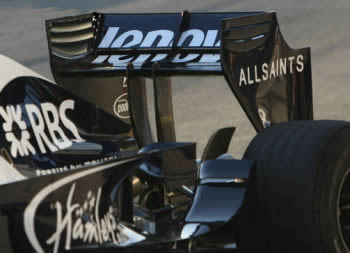
Williams was first to give an idea of how the 2009 regulation changes would affect the look of the cars. During testing at Jerez on 19 September 2008, a 2009-spec rear wing was fitted to the FW30, along with elements of the new front wing configuration. The new rear wing was clearly considerably taller and narrower than the current item.
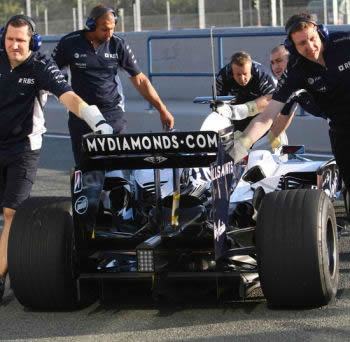
As part of the aerodynamic changes designed to allow cars to follow each other more closely and hence promote overtaking, the 2009 front wing was both lower (75 mm instead of 150 mm) and wider (1,800 mm instead of 1,400 mm). The wing also featured a universal central section (500 mm) that all teams’ designs had to comply with, along with a flap section adjustable by the driver twice per lap over a range of six degrees (+/- 3 degrees).
The rear wing became taller (up 150 mm to bring it level with the top of the engine cover) and narrower (750 mm from 1,000 mm).
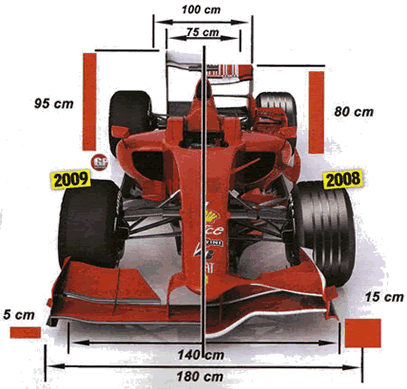
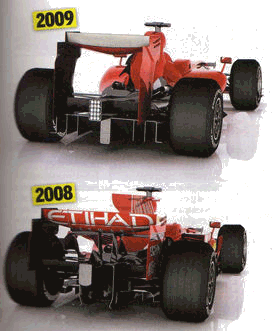
The following images show an estimate of the 2009 Ferrari, designed to meet the new aerodynamic regulations. The main characteristics were a reduction in the height and increase in the width of the front wing, combined with an increase in the height and reduction of the width of the rear wing. All upper body elements and aero devices such as turning vanes, winglets, chimneys, and flip-ups were banned, and the underbody diffuser dimensions were longer and higher, with the device moved rearward. These aerodynamic changes ran in tandem with slick tyres and the opportunity to use KERS.
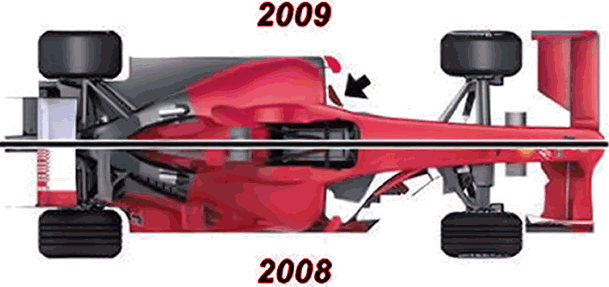
From overhead, the clearest difference between the 2008 and 2009 designs is the increased width of the front wing, now as wide as the car itself at 1,800 mm. Gone are the fairings on the front suspension pick-up points and the broad use of turning vanes, now restricted to a small triangular section (see arrow) in front of the sidepods.
Cooling vents, chimneys, and winglets are noticeably absent from the top of the sidepods, and there is no winglet on top of the rear axle. The rear wing is narrower (750 mm instead of 1,000 mm) and taller (950 mm as opposed to 800 mm), and the diffuser has been moved further back.
The Introduction of DRS (2011)
Added at the beginning of 2011
At the end of 2010, the FIA’s World Motor Sport Council agreed a number of significant changes to the Formula 1 regulations, including a new single tyre supplier, aerodynamic revisions designed to boost overtaking, a ban on F-ducts, and the return of a 107% qualifying rule.
A great overtaking move is one of the most thrilling sights during a Grand Prix, but critics had argued for some time – and rightfully so – that passing had become too difficult for even the world’s best drivers. Recent attempts by the FIA and engineers to develop technology to help drivers pass rivals had enjoyed variable success, but teams were hopeful that the moveable rear wings introduced for 2011 could achieve much more.
In 2011, drivers were able to adjust their car’s rear wing from the cockpit, thereby boosting their top speed and increasing their chances of overtaking the car ahead. McLaren’s director of engineering, Paddy Lowe, was among those who believed this new concept would enjoy more success than 2010’s moveable front wing, which had been dropped.
The adjustable front wing was introduced alongside the OWG regulations in 2009 and was intended as a mild adjustment for a driver to trim the balance of the car when in the wake of another car. As it turned out, nobody used the front wing for that purpose at all; teams only used it to make mild adjustments during the race. They agreed to get rid of it in the interests of simplicity and cost saving.
Although some voiced concerns that the new rear wings might make passing too easy and racing somewhat artificial, there were restrictions on use that presented a real challenge to teams and drivers. Under the new moveable bodywork regulations, drivers could adjust the rear wing from the cockpit as soon as they had completed two laps. The system’s availability was electronically governed and during the race could only be activated when a driver was less than one second behind another car at pre-determined points on the track. The system was then deactivated once the driver braked. It was available at all times throughout practice and qualifying.
These “deployment points” were specified by the FIA on a race-by-race basis. While the season may have been a couple of races old before the stewards were happy with the implementation, the objectives of the changes were expected to be realised.
The FIA retained the ability to manage the situation by adjusting, for each circuit, the points on the deployment straights at which the driver was allowed to press the button. This allowed the authority of the system to be fine-tuned on a race-by-race basis.
In 2011, a driver’s overtaking arsenal also included Kinetic Energy Recovery Systems (KERS), which returned after a mutually agreed suspension in 2010. KERS converted waste energy generated under braking into additional power, made available to the driver via a steering wheel-mounted “boost button.”
When used in combination with an adjustable rear wing, KERS could enable a driver to pass a rival who had track position but not necessarily a speed advantage.
Fernando Alonso expressed enthusiasm about the prospect, even while acknowledging concerns about the complexity of managing so many car adjustments simultaneously.
World Motor Sport Council Decisions
Driver adjustable bodywork
From 2011, adjustable bodywork (rear wing) could be activated by the driver at any time prior to the start of the race. For the sole purpose of improving overtaking opportunities during the race, it could be activated after the driver had completed two laps. The driver could only activate the adjustable bodywork when notified via the control electronics that it was enabled. It was only enabled when the driver was less than one second behind another car at any of the pre-determined positions around each circuit. The system was disabled the first time the driver used the brakes after activation. The FIA could, after consulting all competitors, adjust the time proximity to ensure the purpose of the adjustable bodywork was met.
Front wing adjustment was no longer permitted.
2011 Season Overtaking Data
Data issued by Mercedes GP at the end of the 2011 season
With DRS, Formula 1 made a significant effort to increase overtaking opportunities.
The question of overtaking – how much, not enough, or too much of the artificial sort – was a frequent topic throughout the 2011 season, following the advent of DRS (the Drag Reduction System) and Pirelli tyres.
Overall levels of overtaking rose to record levels, with nearly 1,500 passes during the 2011 season. The figures below were calculated for strategic purposes by the Mercedes team, compiled from a combination of video, timing data, and GPS technology. The data excludes overtaking through pit stops, first-lap moves, lapping of slower cars, or passes on damaged cars. Only clean racing (battles between two or more cars) is counted.
The combined total of “Normal” and “DRS-assisted” moves – the indicator of what most observers consider “clean” overtaking – was 804 overtakes, an average of 45 normal and DRS overtakes per race.
Of the 804 total clean overtakes, there were 441 normal overtakes and 363 DRS overtakes; 55% were normal and 45% were DRS.
The highest numbers of clean overtakes were recorded in Turkey (85), Canada (79), and China (67). The races with the fewest were Monaco (16), Australia (17), and India (18). Nine races featured fewer than 50 clean overtakes; eight races featured more than 50. The average was 45 clean overtakes per race, broken down to 25 normal overtakes and 20 with DRS.
The highest ratio of DRS overtakes to normal (where the influence of DRS was greatest) occurred at Abu Dhabi (89%), Europe (81%), India (78%), Turkey (59%), and Spain (57%). The lowest ratios were at Monaco (13%), Hungary (20%), Canada (22%), Japan (26%), and Great Britain (27%). Note that three of those five races featured wet or mixed conditions, and DRS use was restricted for portions of the races in Canada and Great Britain. DRS overtakes outnumbered normal moves in eight of 18 races.
In the first nine races, there were an average of 21 DRS overtakes per race (45% of clean overtakes). The influence of DRS remained stable in the second nine races: an average of 20 DRS overtakes per race, representing 46% of clean overtakes.
The drivers with the most overtaking moves after lap one were Perez and Buemi (both with 82), followed by Button (77), Webber (76), Alguersuari (74), and Michael Schumacher (71). Note that DRS use was allowed after the second lap.
Most overtaking manoeuvres in a dry race (a record): 126 at the 2011 Turkish Grand Prix.
Most overtaking manoeuvres in a wet race (a record): 125 at the 2011 Canadian Grand Prix.
Of this year’s overtaking manoeuvres, a lot have been assisted by DRS, but it has also set up opportunities to pass later in the lap. I think DRS on its own is good but personally I feel that having KERS has really helped this year. I think they can really use it to their advantage, to overtake and obviously to try and block and defend a position. That’s meant that KERS was as important as DRS. There are some instances when perhaps it made overtaking too easy, but there are always negatives and positives with something new like this. Positives outweigh the negatives. DRS and KERS has brought a lot to racing, and you can get closer to the cars ahead and prepare your next move.
The Fundamental Dilemma
During a 2014 Belgian GP interview at Spa, Adrian Newey responded to a question from Edd Straw (Autosport) about whether Formula 1 cars should always be about ever-faster speeds or about the fastest car within set regulatory parameters.
As MotoGP was mentioned and I think the racing and overtaking in MotoGP is probably one of the big attractions and entertainment, I think that Adrian is mixing apples and oranges. He knows well that the reason for lack of overtaking and close racing is the aerodynamics of the Formula 1 car. Aerodynamics so sophisticated he helped to create. MotoGP aerodynamics are not developed with the primary reason to create downforce, but to reduce drag. Downforce is just a very small part of the MotoGP aero story, and close racing is not disrupted by lost traction of the following bike, at least not to the extent that a Formula 1 car is. Power-to-weight ratio is different, true, but there are 2 small tyres, without monocoque to protect driver, without a big engine, big aero appendages, 4 sophisticated suspensions and a lot more. There the driver rides a bike open to air with an engine which can be fitted between his legs. Apples and oranges.
To achieve similar levels of close racing and overtaking, an entirely different approach to car design would be required – cars without aero appendages and very low downforce, resembling F1 cars of the late 1960s or early 1970s, or karts.
With high-downforce cars, there will always be a problem following other cars. Looked at another way, there is no real answer to the overtaking problem if the cars are to remain very fast through corners. The only options are to artificially increase the downforce on the following car in corners (as the moveable front flap attempted) or reduce it significantly on the straights (which is what DRS does). The problem with these systems is that many fans dislike them and feel they diminish the role of driver skill.
Improving any single aspect requires a holistic approach. Changing A may have unforeseen consequences on B, which in turn affects C. While it is entirely reasonable for fans to want more overtaking, a tyre war, and refuelling while disliking DRS-based overtakes, putting all of those desires into practice simultaneously while achieving more passing is simply not possible.