Oversteer
Definition
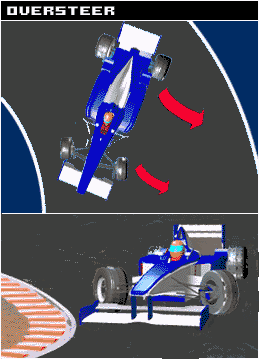
Oversteer is the tendency of a car’s rear end to lose traction and slide outward in the middle of a corner, causing the front of the car to rotate excessively into the turn. In other words, the car turns more than the driver intends. Oversteer is a distinct phenomenon and should not be confused with “drifting” or “power sliding.”
Oversteer vs Drifting
Drifting is generally induced intentionally by the driver, with the wheels losing grip in a controlled manner through deliberate use of the throttle and steering wheel. By contrast, understeer and oversteer are typically unintentional conditions that are largely uncontrollable and unwanted.
Engineering Considerations
Engineers aim to eliminate both understeer and oversteer as much as possible, since both conditions ruin lap times and accelerate tyre wear. In practice, a slightly understeering car (only very slightly) is generally faster than an oversteering car, although some drivers have their own preferences – sometimes the wrong ones.
Understeer and oversteer problems can often be addressed through fine tuning of suspension elements or adjusting the ballast position.
Role in Cornering
Oversteer and understeer are vital to understanding the way a car corners.
Understeer is inherently stable: once the car reduces speed sufficiently, grip is restored. This is why almost all road cars are set up to understeer at the limit of adhesion. However, understeer also slows the car down, which is why Formula 1 chassis engineers try to avoid it.
Oversteer is, by contrast, highly unstable. Unless a driver acts quickly to correct it with skilful use of steering and throttle, it can result in a spin. However, an “oversteery” chassis helps the driver to turn into a corner and, at the limit of adhesion, enables a skilled driver to carry far more speed through a corner than understeer would allow. This is why, to a greater or lesser extent, all Formula 1 cars are set up with an oversteer characteristic.