Engine Off-Throttle Overrun
Origins of the Blown Diffuser
Red Bull’s Adrian Newey initially pioneered the new generation of blown diffusers, positioning the exhaust outlet low above the floor of the Red Bull RB6. This was extremely beneficial for energising airflow going through and over the diffuser. This type of diffuser became known as the blown diffuser. Essentially, teams were blowing exhaust gases over the rear floor of their cars even when the driver was off the accelerator going into a corner.
There are two ways to blow a diffuser: hot and cold.
In a press conference at Monaco 2011, Adrian Newey defended the legality of exhaust-blown diffusers on the overrun by claiming that the primary function of an open throttle on the overrun was to cool the exhaust valves:
“In the case of Renault, (Red Bull Racing’s engine supplier) when they open the throttle to full open on the over-run for exhaust valve cooling, and that’s part of the reliability of the engine… Obviously if other people are going further and perhaps firing the engine on the over-run then clearly exhaust valve cooling is not part of that and that would be something that presumably they would need to explain to keep Charlie (Whiting, FIA technical delegate) happy.”
Much more about the blown diffuser you can read here, but just a short recap:
What Is a Blown Diffuser?
On road cars, the engine exhaust exits are normally located at the rear of the car. On a Formula 1 car, they are deliberately located in front of the rear wheels so that the hot, fast-flowing exhaust gases can be channelled toward the car’s diffuser. This increases airflow through the diffuser and in turn increases the amount of downforce the diffuser produces. This was perfectly legal under the F1 regulations of the time.
What Is Cold Blowing?
Normally the engine only produces exhaust gases suitable for effective diffuser blowing when the driver is on the throttle. This means that when the driver lifts off, the blown diffuser is suddenly deprived of the additional airflow.
To get around this, some teams modified their engine mapping so that when the driver lifted off, although fuel supply and ignition were cut, airflow through the exhaust to the diffuser continued. This technique became known as “cold blowing” – the exhaust was still blowing into the diffuser, but the airflow was now “cold” since no fuel or ignition was involved. Renault used this technique.
What Is Hot Blowing?
Some teams (notably McLaren and Ferrari) took things a step further. To make the off-throttle blowing as similar as possible to on-throttle blowing (hot and fast-flowing gases), they cut the ignition (supply to the spark plugs) when the driver lifted off the throttle but continued to inject some fuel through the engine’s valves into the exhaust. This fuel ignited on the hot exhaust, increasing the amount, speed, and temperature of the airflow exiting toward the diffuser.
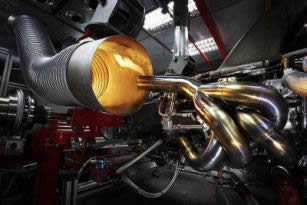
Leading engineers estimated that hot blowing could give an advantage of as much as one second per lap over no blowing at all, while cold blowing was worth about 0.3 to 0.4 seconds over no blowing. The controversy began when the FIA decided to introduce a limit of 10% throttle when the driver was not pressing the accelerator.
The FIA Dispute
The brief history is that Charlie Whiting, head of the FIA technical department, felt that the use of exhaust gas to create downforce was illegal. This stemmed from the regulation change that banned the F-Duct, which stated that “no driver movement shall deliberately affect the aerodynamics of the car.” Clearly, this involved driver movement (a foot lifting off the accelerator pedal).
Therefore, any engine mapping with the primary purpose of using the engine as a thrust producer was deemed illegal. Charlie issued a series of technical directives to that intent, culminating in a directive sent to teams roughly two weeks before the Valencia GP in 2011. It stated that hot blowing – fuelling and igniting on overrun – was banned, and for cold blowing the maximum throttle opening would be 20% at 18,000 rpm, tapering to 10% at 12,000 rpm.
Engine Manufacturer Exemptions
 Mercedes in particular lobbied that they should be allowed to retain overrun fired by four cylinders (half the cylinders in an F1 engine). They persuaded Charlie that they had been doing this since 2009 primarily for brake balance modification and therefore should be allowed to continue for reliability reasons. Charlie’s philosophy was that practices teams employed prior to using the exhaust to create downforce should still be legal. He agreed to what Mercedes requested.
 Renault engines had been operating since 2009 with a strategy of running throttles 50% open on overrun (cold blowing) for reasons of throttle response and engine braking balance. Since this was also for non-downforce-generating reasons, Renault believed they should be allowed to continue, for the same reason Mercedes were allowed to continue hot blowing. Charlie agreed to allow 50% throttle opening for Renault.
Renault’s rivals objected, however, because the French engine company had now been allowed a 50% throttle opening when the driver was lifting off.
This was what Martin Whitmarsh called “a very substantial performance benefit,” to which Christian Horner responded: “Why is it any more of a performance benefit than fired overrun?”
The Complexity of Overrun Strategies
Leading Formula 1 engineers spoke out about the influence of cold and hot blown diffusers, and how their teams had to adapt their cars for the upcoming rule change. As I can see, a lot of fans on forums think that this is quite a simple thing – change a few parameters and the thing is done. But it’s not that simple, and it affects how you operate the engine.
Understanding what happens within the engine when a driver lifts off the throttle, and the subsequent effect on other aspects of the car, is essential. Unlike in road cars, where the driver leisurely lifts off the throttle and delays the braking phase, an F1 driver may be at near-maximum revs when simultaneously lifting completely off the throttle pedal and hitting the brake pedal hard for the initial downforce-aided braking. During braking, lower gears are sequentially selected, further peaking revs as the car slows.
This sudden closing of the throttles blocks the inlet to the combustion chamber, but the pistons continue to pump up and down at great speed. This creates huge stresses inside the combustion chamber, and the vacuum created sucks air past the piston rings (so-called blow-by). This rapidly slows the engine, creating excessive engine braking effect, which in turn stresses the drivetrain and over-brakes the rear wheels. The excessive engine braking effect makes the car nervous on throttle lift-off, regardless of any subsequent aerodynamic effect. Engine manufacturers therefore developed different solutions to ease the stresses and braking effect of the driver lifting off the throttle.
In the past, several different engine strategies were available, and the driver could change overrun settings to tune the car’s handling. Drivers switching between teams often found that the change in overrun settings required adjustment to both their driving style and sometimes the engine settings.
Manufacturer-Specific Solutions
Renault engines, for example, ran open throttles on the overrun (but with no fuel injected or spark). This both eased the blow-by – reducing the vacuum effect inside the pistons and stress issues – and was useful for cooling the exhaust valves, as an alternative to using excess fuel to cool the back of the valve. Renault Sport is believed to have run as much as 90% open throttle on the overrun. This is what became best known as cold-blown mapping. During the season and throughout free practice, the three Renault-powered teams had a distinctive loud overrun note, which continued briefly as the drivers picked up the throttle out of slow turns. Because the throttles were open more than on other teams’ cars, the induction noise was far greater.
 Mercedes High Performance Engines had their own solution: the so-called fired or hot overrun. When the driver lifted off, fuel continued to be injected into the engine and the spark fired within the combustion chamber, but ignition timing was delayed by as much as 45%. This offset the engine braking effect, giving a smoother transition from on-throttle to overrun and again reducing vacuum effect and stress issues. The result was less engine braking effect, giving Mercedes the freedom to define braking bias and KERS charging without having to account for engine braking – effectively decoupling the engine braking effect from the braking system itself. At pre-Silverstone practice sessions and races, Mercedes-powered teams had a particularly clean overrun sound, whereas Ferrari had far more cracks and pops as the engine slowed.
 Cosworth engines used the same system as Renault to ease stresses on their engines and transmissions.
The FIA Compromise
With all engine manufacturers having long-established overrun strategies that critically impacted their basic engine design or braking systems, it was difficult to rapidly switch to a very strict overrun mapping as demanded by the blown diffuser rule after the Valencia GP race in 2011.
Renault and Mercedes lobbied the FIA to retain elements of their established overrun strategies while still curtailing their current, more aggressive approaches. The FIA had been able to review the mappings used from 2009 through to the present day, as the ECU code is held by the FIA since the advent of the single ECU. They could see that the engines had long-established mappings but also how those mappings had become more aggressive since the blown diffuser was developed.
So the FIA relented. While this appeared to be a climb-down by the FIA and unfair to different engine manufacturers, the unreported events at Silverstone were fairer than the picture painted by the teams and the media. Renault were given their greater throttle opening, and Mercedes their fired overrun, but these dispensations were given to every engine manufacturer – so Ferrari could have adopted more throttle opening and Cosworth could have developed a fired overrun.
Airbox Spillage and Off-Throttle Blowing
A couple of weeks ago I found an excellent article on Gordon McCabe’s blog explaining one phenomenon regarding Formula 1 airbox air spillage. Link to this article you can find here. The picture is my small addition.
Airbox spillage and fluidics
|
Under full throttle (lower half of the image), all air approaching the airbox is drawn inside, through the engine, and out through the exhaust. The same occurs with hot or cold blowing – the engine pumps all air in, so there is no air spillage around the airbox.In an off-throttle situation (upper half of the image), or without engine hot or cold blowing (no engine pumping effect), some of the air approaching the airbox is not drawn in and continues as turbulent spillage toward the rear wing. |
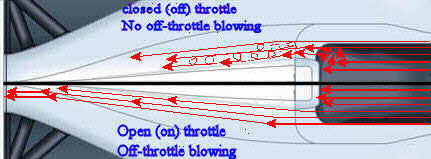
A couple of weeks ago, the FIA issued a Technical Directive to the Formula One teams, announcing that off-throttle blowing of the exhausts will be severely curtailed in 2012 by engine mapping restrictions.
In combination with stringent requirements on the position and angle of the exhaust exits, this is intended to minimise the exploitation of exhaust flow for aerodynamic purposes. It will, however, have a secondary consequence. As Gary Anderson recently explained, off-throttle exhaust flow also serves to reduce spillage from the airbox:
“In the past when the driver closed the throttle to slow for a corner, the airbox spillage became a lot worse. If the airflow attachment on the sides of the engine cover was not good, the performance of the rear wing would be compromised – not something the driver wants under braking or on corner entry.
“Step forward the blown diffuser. Hot or cold blowing allows the engine to work like an air pump, moving this airflow through (Airbox) and out of the exhausts. This reduces the potential turbulent airflow creating negative performance on the rear wing.
If off-throttle blowing of the exhausts is genuinely to be prohibited next year by means of engine mapping restrictions, this will presumably re-create the problem of airflow spilling out of the airbox when the driver lifts off the throttle on turn-in to a corner.
So here’s an idea: Why not introduce a fluidic switch which, under certain circumstances, re-routes the airbox airflow through the chassis to the lower leading edge of the sidepods? This could have the joint benefit of boosting the velocity of the underbody flow, and improving airflow to the rear wing, just at the time when the driver most needs it, when the car is in pitch under braking and turn-in.