Nomex
Overview
Nomex (styled NOMEX) is a registered trademark for a flame-resistant meta-aramid material developed in the early 1960s by DuPont and first marketed in 1967.
Many synthetic materials emerged from DuPont research, forming the basis for numerous global businesses and products including household names such as Teflon fluoropolymer resins and SilverStone certified non-stick finishes, Stainmaster flooring systems, Kevlar brand fibre, Nomex brand fibre and paper, Lycra spandex fibre, Sontara spun-laced fabric, Mylar polyester film, Tyvek spunbonded olefin, Cordura nylon fibre, and Corian solid surface material.
Properties
The year 2007 marked the 40th anniversary of the commercialisation of DuPont Nomex, a revolutionary heat- and flame-resistant fibre that, when used in protective fabrics, garments, insulation, and other high-performance applications, helps provide protection to millions of people and processes worldwide.
Nomex is an inherently flame-resistant, high-temperature fibre that will not melt, drip, or support combustion in air. It also delivers outstanding resistance to a broad range of chemicals and is available in paper, felt, fabric, and fibre forms.
Applications
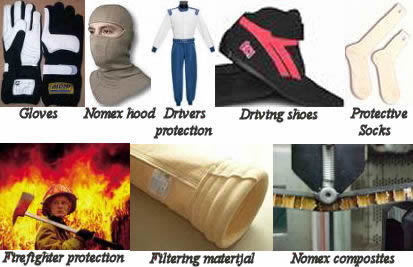
Nomex brand fibre is used in a wide range of applications, but it is perhaps best known as a critical component in protective apparel. Today, almost all firefighters around the world are protected by Nomex for its unique combination of flame protection, durability, and mobility. Nomex is also used by military pilots, combat vehicle crew, racing car drivers, pit crew members, and track officials.
Beyond protective apparel, motor, generator, transformer, and other electrical equipment manufacturers have relied on DuPont Nomex as the standard for electrical insulation for over 40 years. Honeycomb structures made from Nomex paper are used for lightweight structural support and substantially improve the performance of most commercial aircraft.
Use in Motorsport
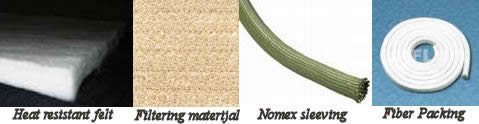
Race car drivers must wear a multi-layer Nomex driving suit and flame-resistant gloves, long underwear, balaclava, socks, and shoes to protect them in case of fire. The FIA provides specifications for the FIA Standard 8856-2000 flame-resistant clothing to be used in racing.
Racing apparel made with Nomex brand fibre plays a pivotal role in providing long-lasting protection and the valuable seconds racing professionals need to escape and survive flash fires resulting from both on-track collisions and pit accidents. Whether found in protective suits, underwear, socks, or gloves, the exceptional flame resistance provided by Nomex cannot be washed out or worn away. This is why all drivers competing in NASCAR, IRL, NHRA, CART, IRHA, and Formula 1 events wear flame-resistant racing suits made with Nomex. Nearly all pit crews, rescue teams, and track officials who work in the presence of potential flash fires also depend on Nomex, because it protects them from intense heat and flame, provides the valuable seconds they need to escape fires, and minimises the potential for burn injury.
Regulatory Requirements
The FIA 2008 Formula One Sporting Regulations state:
30.11 Drivers taking part in practice and the race must always wear the clothes, helmets and head and neck supports specified in the Code.
The FIA Sporting Code states:
**CHAPTER III - DRIVERS’ EQUIPMENT
In circuit events, hill-climbs, special stages of rallies and selective sections of cross-country events entered on the International Sporting Calendar, all drivers and co-drivers must wear overalls as well as gloves (optional for co-drivers), long underwear, a balaclava, socks and shoes homologated to the FIA 8856-2000
standard. Users must ensure that garments are not too tight, as this reduces the level of protection.
Embroidery sewn directly onto the overall shall be stitched onto the outermost layer only, for better heat insulation. Backing material of badges and thread used for affixing them to the overalls must be flameproof (see Appendix 1 of the FIA 8856- 2000 Standard for detailed requirements and instructions for use).
Drivers of single-seater cars in races with standing starts must wear gloves in a high-visibility colour which contrasts with the predominant colour of the car, so that the driver can clearly draw the attention of the race starter in case of diffi culties.
Substances which may circulate in any cooling system worn by a driver are restricted to water, or air at atmospheric pressure. Water systems must not require the saturation of a garment in order to function.
For events taking place in extreme heat, it is recommended that a cooling system be used (connected, for example, to the underwear designed for that purpose and homologated according to the FIA 8856-2000 standard).
Exceptionally, driver cooling vests which are not FIA homologated may be worn but shall be in addition to the mandatory homologated underwear. They must include a base garment certified and labelled to ISO 15025, any tubing must be certifi ed and labelled to ISO 17493 and must not be in contact with the driver’s skin and any connection to an on-board system must comply with Article 5.8.6 of the FIA 8856-2000 standard.