Movable Floor
Background
Since the 2007 season-opener in Australia, there was much discussion about “movable” floors on Formula 1 cars. Teams were developing ways to mount the floor so that it would pass the standard deflection test during scrutineering but then lift under greater aerodynamic loads at speed on circuit, providing significant aerodynamic gains. All teams were working on this, but only a few had the courage to actually race it.
The Deflection Test
Ride heights are crucial to improving the aerodynamic performance of a Formula 1 car. For this reason, teams developed flexible floors that would bend under load, allowing the car to run much closer to the ground. The FIA decided to police the situation by introducing a floor deflection test. This test uses the normal scrutineering platform: a hydraulic ram pushes the floor upwards from beneath the car and the amount of movement under a specified load is measured.
As with the wings flexibility test, if the part passes the deflection test it is deemed legal, even if the part may flex further under a greater load. This apparent anomaly exists because the FIA decided to provide a certain degree of freedom in the regulation to avoid damage to this section of the floor when the car rides over kerbs – especially since in recent years most of the ballast placed on the car has been located in this area.
Article 3.17.4 of Formula 1 racing’s technical regulations states that no bodywork part, floor included, can deflect more than 5mm vertically when exposed to a 500 Newton upward load.
The McLaren-Ferrari Controversy
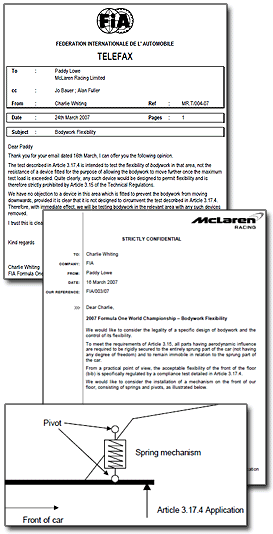
McLaren became aware of Ferrari’s device, also used by BMW Sauber, early in the Melbourne weekend. During this period, Ferrari’s chief mechanic Nigel Stepney (later accused of spying on the Ferrari team and transferring technical and set-up information to McLaren) informed McLaren about this innovation. Subsequently, autosport.com learned that McLaren’s engineering director Paddy Lowe wrote a letter to the FIA in Australia, asking if his team could fit a similar system to their car.
In his letter, which also contained a diagram of McLaren’s plans, Lowe wrote: “We would like to consider the installation of a mechanism on the front of our floor, consisting of springs and pivots.
“By a suitable arrangement and configuration of the springs (rates and preloads) within this mechanism, we will be able to control the flexibility of the bib so as to meet the requirements of the test specified in Article 3.17.4, but to otherwise allow greater flexibility at higher loads by a non-linear characteristic.”
Lowe’s letter was clearly aimed at drawing FIA attention to the device used by Ferrari and BMW as their main opponents, and clarifying whether the use of such a device was deemed legal if its sole intention was to circumvent the FIA’s flexibility tests.
The FIA Response
A week later, FIA technical delegate Charlie Whiting responded to McLaren, and in a letter also distributed to every other team, he clarified the allowed usage of such a device – and revealed that bodywork testing would be altered accordingly.
Whiting wrote: “The test described in Article 3.17.4 is intended to test the flexibility of bodywork in that area, not the resistance of a device fitted for the purpose of allowing the bodywork to move further once the maximum test load is exceeded.
“Quite clearly, any such device would be designed to permit flexibility and is therefore strictly prohibited by Article 3.15 of the Technical Regulations.
“We have no objection to a device in this area which is fitted to prevent the bodywork from moving downwards, provided it is clear that it is not designed to circumvent the test described in Article 3.17.4.
“Therefore, with immediate effect, we will be testing bodywork in the relevant area with any such devices removed.
Potential Benefits
What are the potential benefits?
If the car’s floor is allowed to lift at high speed, it leads to stall of the underbody aerodynamics. In technical terms, the airflow passing through the diffuser no longer closely follows the diffuser’s profile. Instead, at a certain point – determined by air pressure levels close to the diffuser wall – the airflow detaches and proceeds on its own horizontal trajectory. In practical terms, this airflow is no longer generating additional downforce via the diffuser. This could be seen as a malfunction of the diffuser – which indeed it is – but it is also an effect that can be generated intentionally. Among the potential benefits is an increase in straight-line speed thanks to the loss of drag, or an improvement in the car’s overall balance thanks to reduced rear downforce.
Some teams mount their floor with thin metal struts or cables. However, these solutions are just as prone to flex at speed, as the support structures can bend under the pressure of air passing under the car. Some teams – with media attention focused on Ferrari and BMW Sauber – utilised sprung supporting devices that allowed limited but legal movement of the front of the floor to prevent damage over kerbs. The question being asked in Melbourne was: could a similar device be designed to allow much greater – and thus not in the spirit of the rules – movement under the greater loads generated at high speeds?
The simple answer is, in theory, yes. By correctly engineering the “set-up” of the spring – specifically its fixed rate and preload – it would be possible to control the flexibility of the bib (the section of the floor under the splitter) to pass the FIA deflection test while still allowing greater movement under higher loads. In reality, however, there was no evidence of any team employing this theory, and all cars passed scrutineering in Melbourne.
FIA Clarification
The FIA clarification:
“The various teams’ methods of mounting the floor have been known to the FIA scrutineers for some time. The Ferrari and BMW floor has passed scrutineering in every race it was used so far, at least since the Japanese Grand Prix last year (2006).”
The speculation over movable floors was unlikely to continue much longer thanks to a clarification to the rules introduced by the FIA ahead of the Malaysian Grand Prix. From then on, the floor deflection test would be carried out with any such supporting devices removed.
From that point on, all similar devices designed to allow greater – and now illegal – movement under greater aerodynamic loads at high speeds were prohibited.
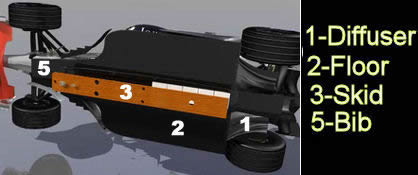
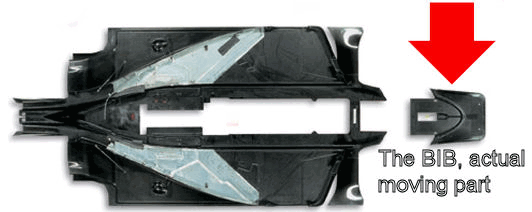
Ferrari’s and BMW’s sprung devices
Stepney’s Revelations
On a side note, it was Coughlan’s assertion that the Ferrari splitter of 2007 was also being sprung to create a mass damper effect, with mass dampers having been banned the previous year.
Quote from Racecar-engineering.com *“One of the defences used by McLaren (after Stepney-gate) was that Stepney, the former Ferrari employee, was ‘whistle blowing’ – something the court struggled to accept covered the whole affair, but it did certainly have an effect at the Australian Grand Prix. Ferrari won the race, but the FIA later outlawed the car’s floor. McLaren contended that the Ferrari that won was illegal, and a letter from Stepney to the FIA sent after the hearing revealed that it may well have been, as it was in effect a mass damper. Such devices were banned last season as they were controversially deemed to be a moveable aerodynamic device.
Stepney reveals in detail the exact workings of the floor that was used at the race: ‘The front floor is attached to the chassis via a mechanical hinge system at its most rearward point. The most forward support is a body with one compression spring and one tension spring inside which can be adjusted according to the amount of mass that is fitted to the front floor. There is also a skirt that seals the floor to the chassis, which is made out of rubber and Kevlar to help flexibility and reduce friction in the system.
‘If the system had been allowed it could have meant a huge cost of development for other teams in such areas as chassis and under trays etc to make way for the provision for storing the system and the variable quantity of mass. The possible long-term consequences of such a system would be quite substantial because the system is in a crude state of development.’
The system detailed by Stepney allowed the F2007 to ride kerbs harder due to the 14-15mm deflection at the leading edge of the floor, which meant the Ferraris could straight-line chicanes more than other chassis. Front plank wear would also be reduced, allowing the car to run lower at the front for an aerodynamic gain.
Stepney also explains the dynamic behaviour of the car: ‘From around 160-180km/h (100-112mph) the car is about 7-8mm lower at the leading edge of the floor, which multiplies up to nearly 19-20mm lower front wing height. The benefits in terms of ground effects and efficiency would be gained all around, with components like turning vanes and front wings at a reduced height relative to the ground.’ “*
2012 Tolerance Exploitation
Ever since 1983, when flat floors were mandated, there has been a tolerance to allow for manufacturing problems. This tolerance was tightened from 5mm to 3mm for 2012, but earlier in 2012 it was rumoured that teams were using this tolerance to tilt the splitter upwards. Exploiting this tolerance meant the car could run 3mm lower at the front, gaining crucial front wing efficiency. A technical directive was issued about the practice and subsequently made it into the rule book:
3.12.6 To help overcome any possible manufacturing problems, and not to permit any design which may contravene any part of these regulations, dimensional tolerances are permitted on bodywork situated between a point lying 330mm behind the front wheel centre line and the rear wheel centre line. A vertical tolerance of +/- 3mm is permissible across the surfaces lying on the reference and step planes and a horizontal tolerance of 3mm is permitted when assessing whether a surface is visible from beneath the car.
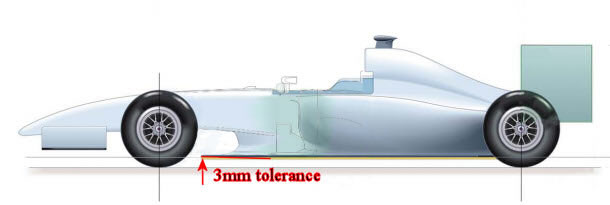
Teams could no longer purposely curve the flat floor for aerodynamic advantage.