
Monocoque - Survival Cell
Overview
The monocoque guarantees the safety of the driver in extreme situations. This carbon fibre safety cell is almost indestructible and plays a key role in the safety of Formula 1.
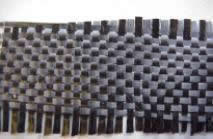
And safety standards in top-class motor racing have improved at a breathtaking rate in recent years. On the infinite safety scale, it has reached a level that will be hard to surpass. Nonetheless, research and development in this field still continue because safety has the highest priority for the drivers.
Early History
The path to the current “safety capsule” Formula 1 monocoque began in the early 1980s with the adoption of carbon fibre composite materials for chassis manufacture, although in the strict definition of the word, composites had already been in use in motorsport since the 1950s in the form of glass fibre moulded body panels.
The first Formula 1 car to be raced that incorporated composite material in its chassis was the 1965 McLaren M2A, which featured panels of Mallite – a composite formed of aluminium sheets over a core of end-grain balsa wood. Although the McLaren benefited from a chassis rigidity advantage over its rivals, the technology was not pursued in later models. This was an early exercise in producing a Mallite monocoque and was the team’s first single-seater designed by Robin Herd. The car served as the base for development of the Formula 1 car and as a Firestone test vehicle. It used Traco Oldsmobile and Ford V8 engines. The McLaren M2A competed only in non-championship races, but many lessons from its testing were incorporated into the M2B.
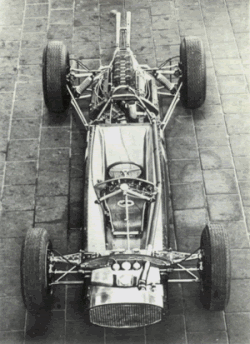
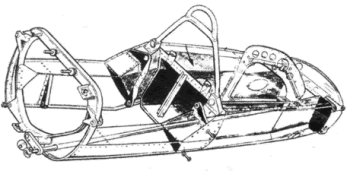
The monocoque was invented by the legendary designer and Lotus team boss Colin Chapman, who inserted a riveted lightweight metal case instead of the classic tubular spaceframe in his Lotus 25 in 1962.
|
|
| Colin Chapman’s Lotus 25 powered by Climax engine. First F1 car with Monocoque design, Colin used riveted metal plates to create “closed” survival cell. Fuel was stored in plastic bags inside monocoque. On upper pictures you can see Lotus 25 car, and on left and down you can see monocoque design in open view. |
|


The Carbon Fibre Revolution
McLaren was the first Formula 1 team to race cars with a carbon fibre safety cell, in 1981. However, there is debate as to which team first produced a fibre-reinforced composite chassis, since the Lotus team was carrying out similar research in parallel. Lotus followed a “cut and fold” methodology, simply replacing pre-bonded aluminium skins with a hybrid composite of carbon and Kevlar-reinforced epoxy.
|
McLaren MP4/1C, first F1 car with Carbon fiber moulded monocoque in plain view |
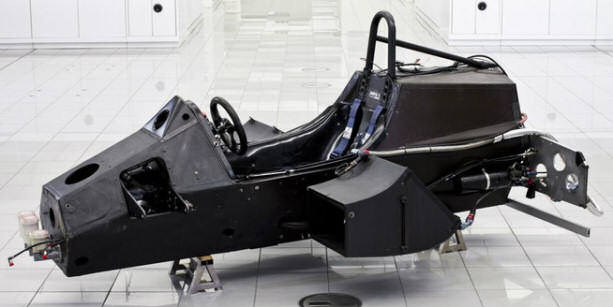

The McLaren MP4/1C competed in 1983 and was the first Formula 1 car with a carbon fibre moulded monocoque. The main engineer for the MP4 was John Barnard. The car was originally powered by a Ford engine but later switched to a Porsche engine.
Manufacturing Process
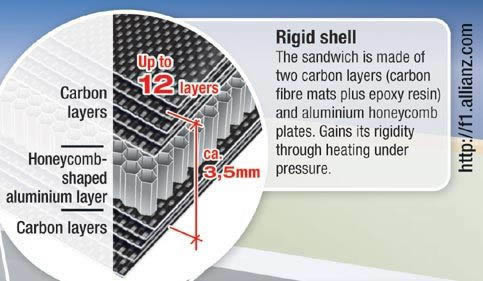
McLaren subcontracted the manufacture of this first model to Hercules Aerospace in the US, while Lotus opted to build theirs in-house. The McLaren was built by laying up plies of carbon fibre around a male mould or “mandrel,” before alloy honeycomb and a second carbon skin were applied to the outside of the sandwich using unidirectional (UD) carbon fibre prepreg tape. Lotus opted for folded sheets of composite material in a similar manner to the way chassis had previously been fabricated using sheet aluminium and aluminium honeycomb.
Two moulds formed the top and bottom halves and were bonded together around the bulkheads to form the final composite chassis. As the hard points for the suspension mountings needed to be accurate and were attached to the inner skin/bulkhead, the chassis was moulded inside out: the male mould was used to lay up the inner skin directly against the mould, removing any variance in sandwich thickness from the final suspension geometry. This resulted in the outer skin being laid up against the honeycomb rather than a mould face, hence the outer finish of these early chassis was relatively poor.
/Big/monocoque_williams_fw08c__1983_big.jpg |
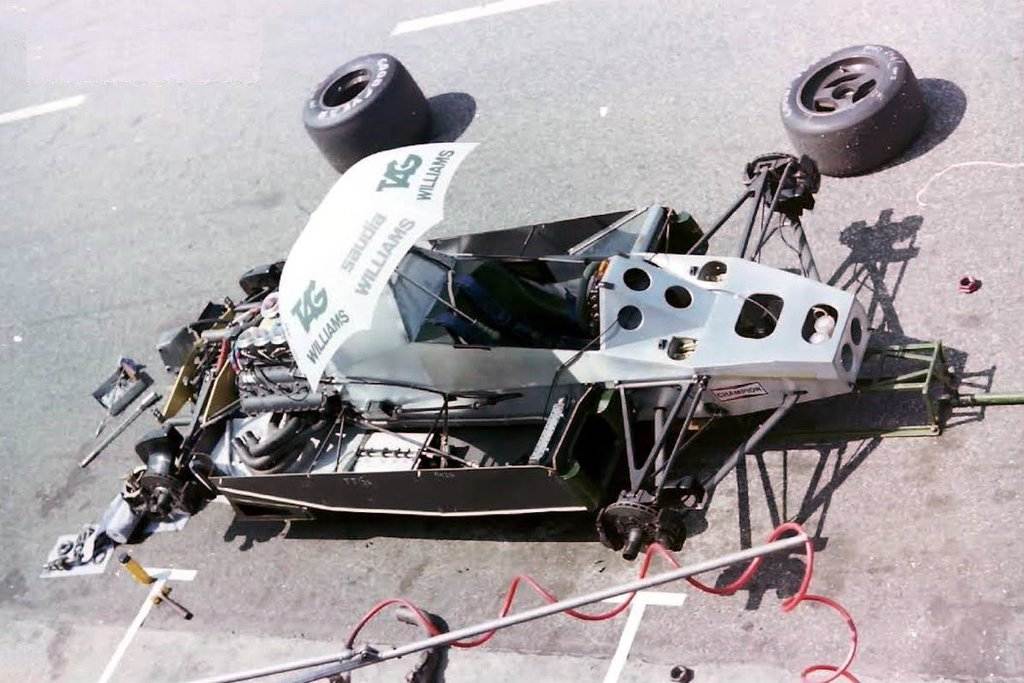
Williams FW08 was designed by Patrick Head with Aluminium honeycomb monocoque. Car debuted at the 1982 Belgian Grand Prix. This year Williams will finish in 4th place, the best of the Cosworth-powered cars. |
Safety Proof
What concerned designers most was the ability of carbon composites to withstand a major collision. At the 1981 Italian GP, John Watson lost control of his McLaren and smashed violently into the barriers. He walked away from the debris unscathed. This incident went a long way toward removing any doubts about the safety of carbon fibre composites under strain-rate loading. In subsequent years, the energy-absorbing properties of composites have made a great contribution to the sport’s safety record.
Other teams soon followed the carbon fibre chassis route, almost entirely adopting the McLaren moulding method.
| Gustav Bruner ATS team D4 racer left, and below, female moulded monocoque of ATS DS6 from 1983 |
| |

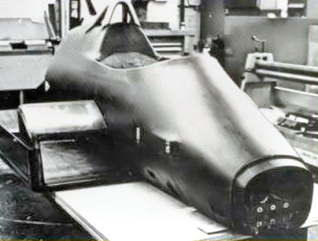
Female Moulding
For the 1983 championship, the ATS team D4 racer, under the technical direction of Gustav Brunner, introduced a female-moulded chassis. This took advantage of the neater external surface of the moulded chassis by making the monocoque’s outer skin the primary bodywork for the car, discarding separate bodywork for the large part of the front. Ferrari adopted this design soon after for their first full carbon chassis, the 126C3.
|
|
Ferrari 126C3, first full carbon chassis | |


Meanwhile, other teams adopted female-moulded chassis while still using separate bodywork.
|
Caterham CT05 2014 monocoque female mould |
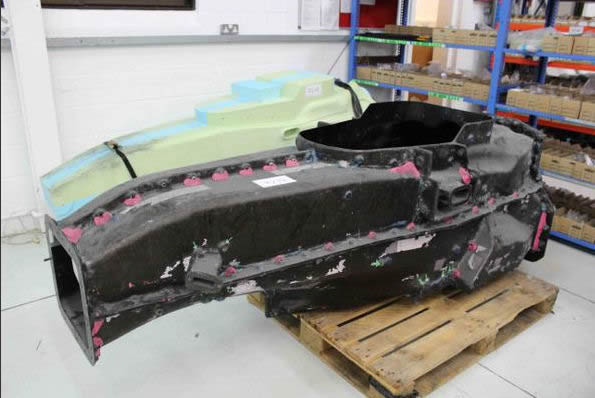
Modern Construction
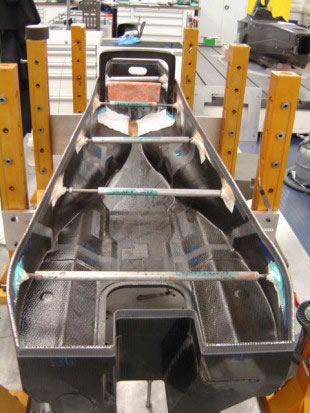
Moving into the 2000s, teams needing to produce much more complex chassis shapes began breaking the tub up into several sections.
|  | |
|
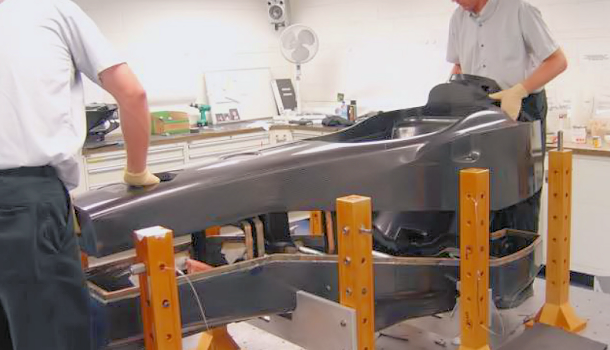
| Final stages of production of Formula 1 car monocoque. Pictures showing final measuring process of the monocoque |
|
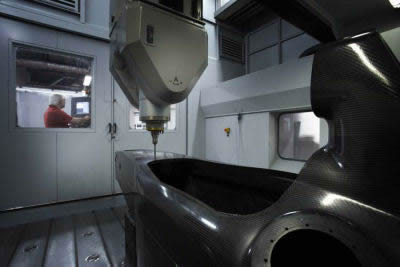
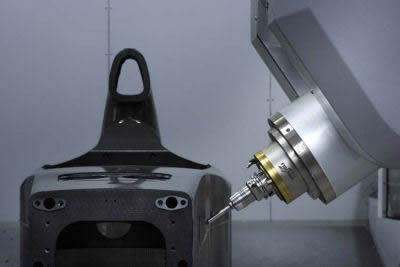
Modern monocoques are manufactured by hand from carbon fibre, a composite material that is twice as strong as steel but five times lighter. They consist of up to 12 layers of carbon fibre mats, in which each individual thread is five times thinner than a human hair. According to the anticipated loads on varying areas of the structure, fabrics with differing weave patterns and orientations are applied. A honeycomb-shaped aluminium layer is inserted between these mats, which increases rigidity further. The whole shell is then heated in an autoclave (a giant oven) under negative pressure. After two and a half hours, the shell is hardened, but the baking procedure is repeated twice more. As a result, the monocoques are strong enough to protect drivers even in the most serious of accidents.
Notable Accidents
An example is the accident involving Giancarlo Fisichella at Silverstone in 1997. The evaluation of the ADR showed that his Jordan slowed from 227 km/h to zero in just 0.72 seconds, mathematically equivalent to a fall from a height of 200 metres. The Italian suffered only a minor knee injury, thanks in part to the monocoque.
Kubica accident during Canada GP 2007
Or the terrible accident of Kubica in Canada 2007 at 230 km/h while driving for BMW-Sauber. The speed measured when his car clipped the barrier was 300.13 km/h (186.49 mph), at a 75-degree angle, subjecting Kubica to an average deceleration of 28 g. After data from the onboard accident data recorder was analysed, it was found that he had been subjected to a peak g-force of 75 g!!! After a two-race break he was back in the car. And the next year, 2008, he won for the first time on the same racing track while driving for the same team. Check here for a pictorial of the Kubica accident.
In spite of the high standard achieved, the FIA never ceases in its efforts to improve safety in the sport even more. Still, the monocoque is not perfect, as we can see in the pictures of Kubica’s accident.
Weight and Strength
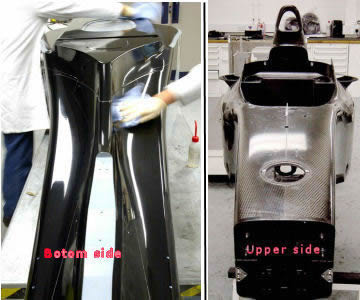
A monocoque can weigh as little as 35 kg and still absorb very large impacts, forces due to cornering speeds, and aerodynamic loads. That’s why designers, under FIA supervision and always new rules, are still working on how to make the cell more safe.
The crash tests stipulated by the FIA since 1985 guarantee the load capacity of the monocoque and crash structure, and they have become progressively more stringent over the years.
Thickness of monocoque in colours
Since 1997, it has been obligatory for the rear structure as well as the side crash structures and the roll-over bar to pass a crash test before every season. Here, again, the FIA was not satisfied with the standards already achieved and keeps raising the level of requirements a little higher before every season by increasing the impact speed for the dynamic crash test.
Material Properties
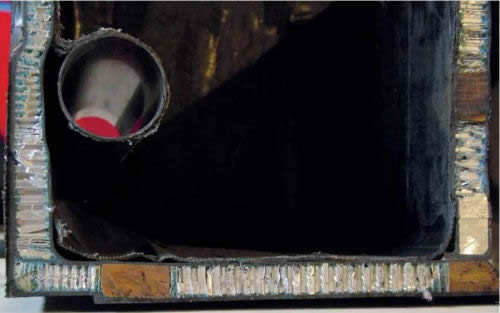
To prevent penetration of the survival cell by front suspension components, the FIA imposed a rule that the first inner layer must be made from Kevlar, a material highly resistant to penetration forces. This rule was imposed after Michael Schumacher’s crash at Silverstone, when a left front suspension wishbone penetrated the monocoque and broke his leg.
Overall, composites are largely unrivalled as a material for impact absorption, with a specific energy absorption (SEA, measured in kJ per kg of material used) far higher than their metallic counterparts – provided sufficient optimisation. Comparing SEA values, steels achieve about 12 kJ/kg while aluminium reaches around 20 kJ/kg. However, a well-optimised carbon fibre structure (one with an optimised lay-up/fibre orientation and component geometry) can absorb anything from 40 kJ/kg up to 70 kJ/kg in a highly refined and tested design.
From a safety perspective, CFRP does not look likely to be superseded as Formula 1’s material of choice any time soon.
Dimensional Regulations
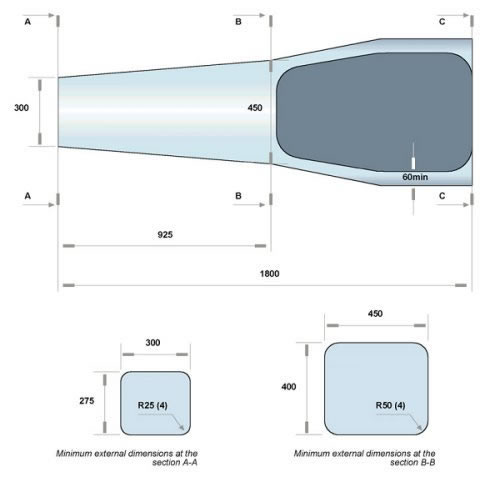
As with everything, the FIA imposes strict dimensional limitations on monocoque design. The interior of the tub has imposed minimum dimensions to create maximum space for the driver’s legs and prevent impact injuries. Outside dimensions are limited in maximum measurements to prevent engineers’ wild ideas. At certain specific positions, the exterior cross-section is also limited by minimum dimensions.
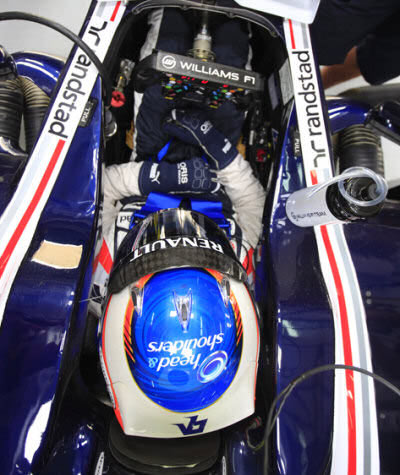
A Formula One monocoque cocoons the driver in a carbon fibre safety cell.
| 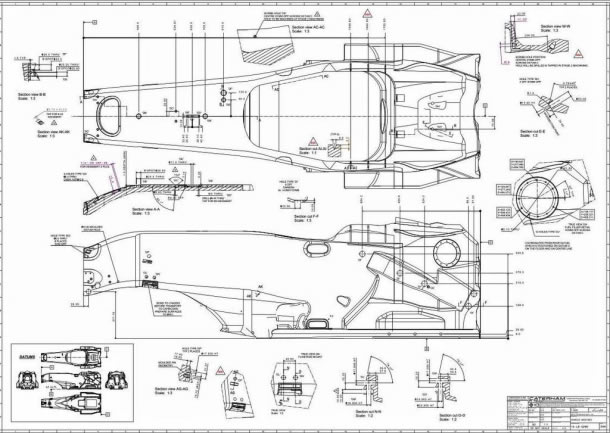 |
Caterham CT05 F1 2014 car Monocoque drawing |
To know more about chassis in the automotive industry and a bit of history, check this article.