Mercedes Double DRS (DDRS)
Front “F-duct” / “W-duct”
The Controversy
The start of a Formula One season would not be complete without some controversy over a clever new piece of technology designed to make cars go faster. The beginning of the 2012 season was no exception. Mercedes AMG produced a novel system – variously called a front “F-duct,” a “W-duct,” or, more officially, DDRS – utilising the DRS activation mechanism on the Mercedes W03 and designed to give the car a straight-line speed and braking advantage. It caused controversy at the season-opening Australian GP.
Development History
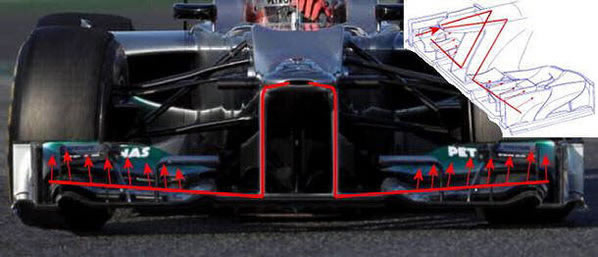
In Japan the previous year, the team tested a secret weapon aimed at the following season: a passive system that fed air through the nose cone vent and down the two wing pillars to the front-wing flap. It proved difficult to set up, and with the nose cone vent now only permitted for driver cooling, a different method was needed to get the airflow to the front wing. The Finnish broadcaster MTV3, describing the system as the “W-duct,” provided some detail as to how it worked. The “W-duct” name described the airflow from the nose tip hole, normally used for driver cooling, through both wing pylons, dispersed in a W-like pattern across the underside length of the front wing. Unlike the driver-operated rear wing F-duct, which was banned for 2011, Mercedes’ system was entirely passive and required no moving parts or driver interaction, making it legal.
The 2012 Active Version
For the first race of the 2012 season, Mercedes improved their system. It was no longer completely passive; instead, it was activated by and linked to DRS. The system was essentially a DRS-operated speed boost that used the opening of the DRS flap on the rear wing to open a duct sending high-pressure air to other parts of the car, specifically to the front wing underside.
Legal Challenges
Several teams, notably Lotus and Red Bull, protested the system as illegal, arguing it violated the spirit of the rules regulating movable aerodynamic surfaces and the rule prohibiting drivers from altering aerodynamics. The system operated in conjunction with the DRS overtaking aid, which most teams understood to be limited to the rear wing. The argument became particularly contentious because Mercedes had raised their competitiveness after two difficult seasons and were now front-runners.
After the Melbourne race protest, the FIA allowed the system because race director Charlie Whiting felt it was simply an extension of the DRS and that it was impossible to draw a line saying it was not allowed. His view was that the driver can affect the aerodynamics as long as it is only for the operation of the DRS, and the Mercedes system was part of the DRS.
The contrary argument was that this was an illegal secondary system activated by the driver when using the DRS. In simple terms, the system could not work unless the driver pressed the DRS button, therefore making it driver-controlled. Whiting felt that as the team was reducing drag – albeit elsewhere on the car than originally intended by the DRS system – it should be allowed.
Mercedes argued that the “W-Duct” system was automatic and not driver-controlled, and therefore legal.
The Primary and Secondary Purpose Debate
This case raised the designers’ favourite interpretation in the rule book: “primary and secondary purpose.” Any part on the car is made for some primary purpose, and designers always try to find a secondary, useful purpose. Sometimes any secondary purpose is banned or restricted, but in most cases the rules are vague and designers are free to exploit secondary uses. A good example is the blown diffuser, where exhaust gases served both primary and secondary purposes. Another example is engine on the over-run.
Formal Protest and Ruling
Before the third race of 2012 at the Chinese Grand Prix, Lotus became the first team to formally lodge a protest against the controversial DDRS wing.
Lotus argued that Mercedes’ new wing, which stalled the front and rear wings for added straight-line speed, was illegal under article 3.15 of the technical regulations, which states that any car system, device, or procedure using driver movement as a means of altering the aerodynamic characteristics of the car is prohibited (with the exception of parts necessary for the DRS system as described in Article 3.18).
However, the stewards did not agree with Lotus’s argument and unanimously dismissed the protest. The FIA stated that the Mercedes design was not activated by driver movement but was a consequence of a change of position of the driver-adjustable bodywork, which is permitted under the regulations. While the Mercedes design did appear to alter the aerodynamic characteristics of the car by reducing drag, this was deemed consistent with the intent of the regulations.
How the System Works
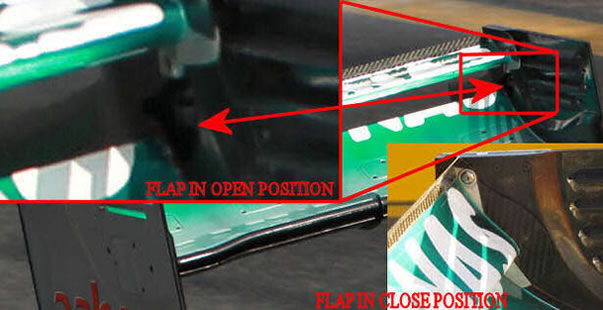
All cars have the DRS, which moves a flap on the rear wing to reduce drag and therefore increase straight-line speed. On the Mercedes, the flap moves in the same way as on all other cars. But when the DRS flap opens on the
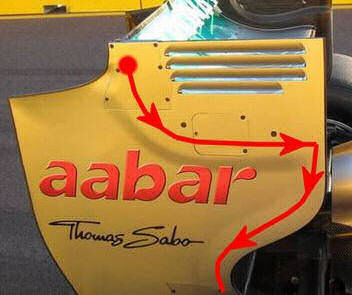
Mercedes, it reveals holes on the inboard side of both end plates, into which air flows. This air is then directed down through the hollow wing end plates, along the lower beam wing, through pipes and ducting in the engine bay and the cockpit, through the nose cone, down the front wing pillars, and into the front wing. It emerges under the front wing through slots, stalling the front wing when the DRS is open. The holes on the rear wing end plates are located in a high-pressure area, on the upper side of the rear wing main plane, which forces flow through the duct. The low-pressure air under the front wing also helps suck air through the car’s ducting from the rear wing, reducing the effectiveness of the front wing. This produces two effects.
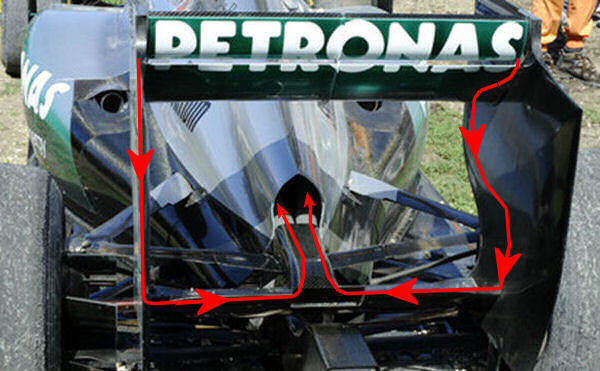
First, it cuts drag (in the same way as the “F-duct” system used two years earlier, but with air flowing in the opposite direction), thereby boosting straight-line speed even more than the DRS flap alone.
Second, it makes the car more balanced front to rear in high-speed corners during practice and qualifying, where DRS use is unrestricted. The main problem with F1 cars in fast corners with DRS activated is too much front downforce, which increases oversteer (instability at the rear). This can limit how fast a driver can go through a bend.
Because the Mercedes system also reduces front downforce, the car can maintain a consistent balance while also benefiting from the top-speed boost of the DRS and stalled front wing. When the DRS is deactivated, the airflow stops. However, because there is still some air in the system that continues flowing and stalling the front wing, the rear downforce returns slightly before the front downforce. This may only be a tenth of a second or less, but it means the rear of the car is stable earlier.
There must also be some kind of restrictor that can be changed from track to track depending on circuit characteristics. Some rivals estimated the system could be worth as much as 0.5 seconds a lap during practice and qualifying.
Internal Ducting
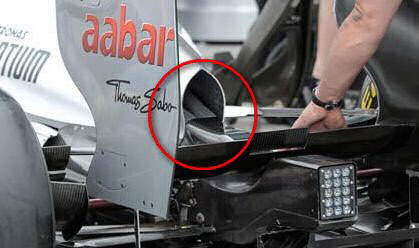
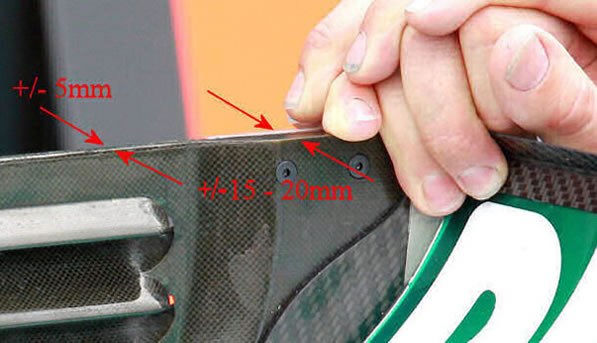
Mercedes fitted their DRS actuation system in the rear-wing end plates, which is what allowed them to have the hole in the end plate in the first place (such a hole would otherwise be illegal). The hole’s primary purpose is to allow DRS actuation system levers to connect to the wing flap. This hole was made unusually large, and with the DRS closed, it was covered.
When the driver opens DRS, the flap uncovers a pair of openings on the rear wing end plates. These openings are fed with high-pressure air. There is a duct inside the unusually thick end plates that feeds the DRS-duct system.
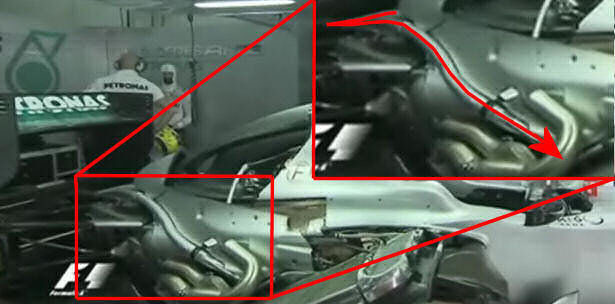
The airflow passes around the wing end plates toward the beam wing, then inside the beam wing to a bulged fairing with two ducts that disappear inside the engine cover. There is a possibility that these ducts are linked together to balance the system pressure, as in yaw or side wind, one duct might not have the same pressure feed as the other.
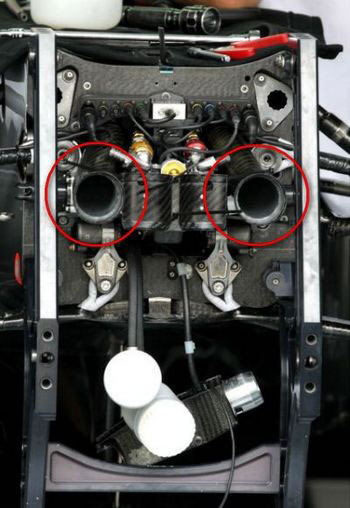
The ducting passes the engine bay on either side of the engine. It continues past the rear monocoque bulkhead, apparently passing below or near the fuel tank. After the bulkhead, the ducts likely pass outside the fuel tank area and into the cockpit, where they run along the roof or sides of the footwell to emerge at the front bulkhead. This pipe routing within the tight confines of the car probably explains why two ducts are used rather than one larger duct.
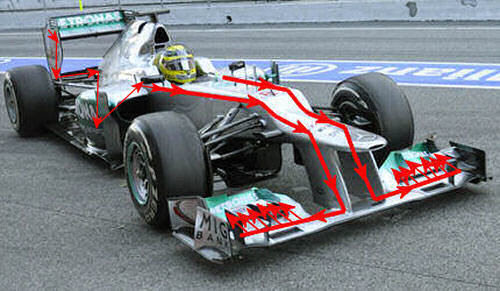
With the nose cone removed, two tubes are visible exiting the footwell area and entering the nose cone. They feed the flow into the front wing through the nose cone. When the nose cone is fitted, these ducts connect with corresponding holes and ducting inside the nose cone to pressurise it. This in turn feeds the airflow down the front wing pylons to the front wing.
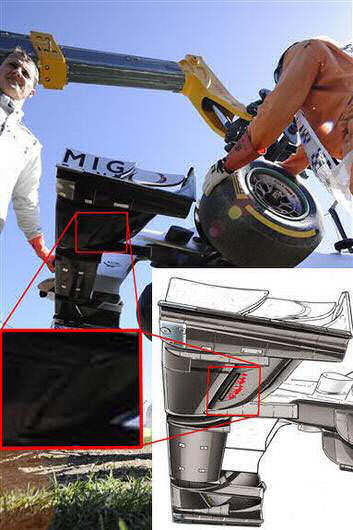
Underneath the front wing there is a pair of slots, one on each side. When DRS is open, the flow through the ducts blows through these slots and stalls the front wing in the same way the “F-Duct” stalls the rear wing. Stalling a front wing through a blown slot is legal. Although F-ducts are banned, it is only because the slot in the rear wing is banned. Direct driver intervention is banned, but the driver is allowed to operate the DRS, so any secondary aerodynamic effect of that is not prohibited in the rules.
Opposition and Difficulty of Replication
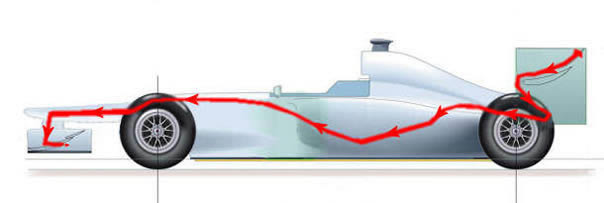
Unless banned, rival teams would all likely develop something similar, but it was a very expensive undertaking for a small gain. For rival teams to replicate the system, they would need to find space to package the ducts inside the footwell area. As demonstrated in 2010 with the “F-duct,” teams can be very creative in packaging this sort of solution. But this would take time and may explain some teams’ opposition to the system’s legality.
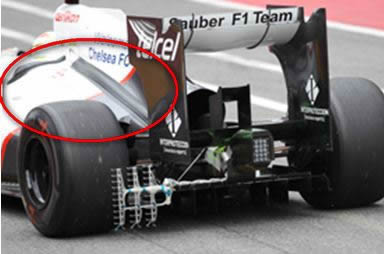
During the May 2012 in-season test at Mugello, Italy, Sauber ran with external piping on its C31, prompting speculation about double DRS evaluation. Sauber chief designer Matt Morris said early analysis had left the team feeling that it would be better off devoting resources to more conventional development. He noted that while the system was worth a few tenths in qualifying, the number of parts that would need to be changed made the cost-versus-performance equation unappealing.
Mercedes team principal Ross Brawn said the opposition to the system existed because it was difficult to integrate into a car that was not designed from scratch with the system in mind. Because the airflow was channelled from the rear wing back to the front wing, the entire structure needed to pass along the length of the car. Brawn described it as a very simple, inexpensive system that was not, however, easy to implement retroactively.
All rival teams would also have needed to move their DRS actuation system. On the Mercedes, it was in the rear-wing end plates, which is what allowed the hole; the others all had their actuation systems in the centre of the wing.
Whether deemed legal or not, this kind of creative rule interpretation is part of what makes Formula 1 engineering compelling. And it came from Ross Brawn, the same engineering mind behind the double diffuser.